
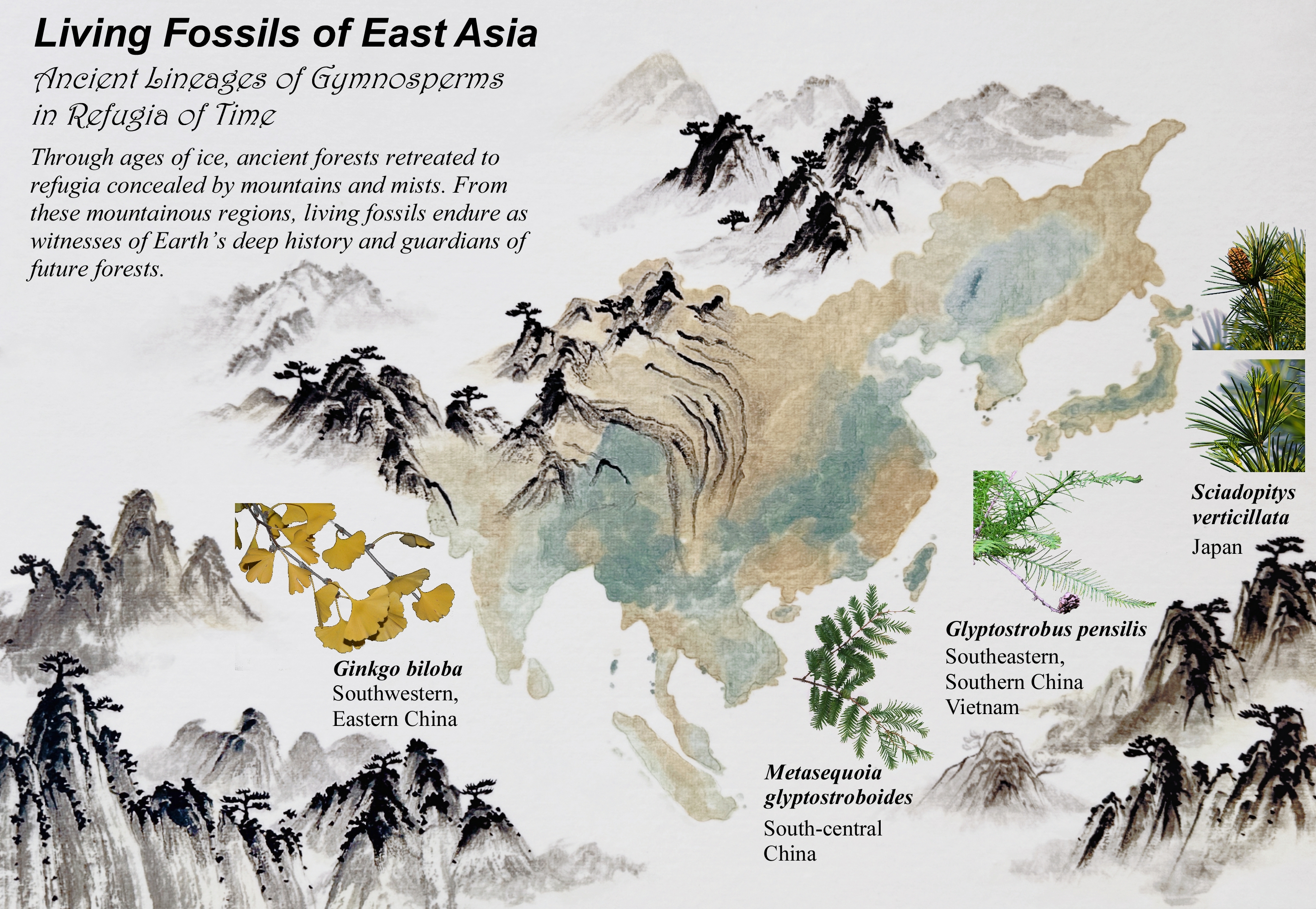
 Image credits: Sciadopitys verticillata photograph courtesy of Dr. Takuto Shitara; Chinese ink drawing courtesy of Ms. Hao-Ying Zhang
For hundreds of millions of years, gymnosperms have witnessed the rise and fall of continents, the extinction of dinosaurs, and repeated cycles of global climate change. Some of their lineages are so ancient that they are often called “living fossils.” Despite having dominated the Earth’s flora for over 200 million years, they were progressively replaced by the more competitive flowering plants; today, they have become relatively scarce across vast regions of the globe, including much of the Indian subcontinent. In other places, however, they managed to thrive while conserving a relatively high diversity, such as in the mountains of southwestern China and, to a lesser extent, in North America. It is difficult to imagine the world's landscapes without the immense coniferous forests of the taiga—the largest terrestrial biome on Earth—the iconic redwood and giant sequoia forests of North America, or the majestic Araucaria forests of South America. Beyond their ecological and cultural significance, gymnosperms remain of immense economic importance, supplying nearly 80% of the world's timber.
Yet the greatest challenge these ancient plants have ever faced may be unfolding today. Widespread deforestation and habitat fragmentation have already reduced many gymnosperm forests to isolated remnants, while rapid climate change threatens to eliminate the climatic conditions on which they depend. Asia is one of the world’s regions where human threats are the most worrisome but, paradoxically, it is also where gymnosperms hold their deepest spiritual and cultural significance (as seen in Ginkgo biloba, a holy tree for Buddhists). Yet when our future projections for more than 200 gymnosperm species were assembled and the scale of climatically suitable habitat loss in eastern and southern Asia became visible for the first time. We discovered many of these survivors of deep time may have nowhere left to go by the end of this century.
We often think of extinction as something that happens to rare species on isolated islands. Our analyses suggest that even some of Asia’s most ancient and emblematic tree lineages may be entering a period of rapid decline. About 15% of the gymnosperm species currently occurring in eastern and southern Asia would face complete extinction by 2100, whereas another 15% are projected to lose almost all climatically suitable habitat. Predicted complete (or nearly complete) extinctions include Cunninghamia lanceolata, the most prized timber tree in China and endemic to the study region, and Cathaya argyrophylla, a living fossil representing 150 million years of unique evolutionary history, the disappearance of which would result in an irreparable loss of phylogenetic history. Tragically, the Hengduan Mountains—the world’s ultimate sanctuary for gymnosperms—are projected to lose most of their protective capacity. Our models show that the only safe havens left by 2100 will be in southern Indochina and southern India, which are regions with currently low gymnosperm diversity or lack of gymnosperms altogether. Because natural dispersal is impossible within this timeframe, saving these species demands assisted migration. However, intense agriculture and a severe lack of protected areas in these new regions present monumental barriers to survival.
The species in our analyses represent lineages that originated tens or even hundreds of millions of years ago. Yet the study itself was made possible by a network of scientists connected through modern databases, digital mapping tools, and international collaboration. The study ultimately brought together 25 researchers from seven countries across Asia, Europe, and North America. While the gymnosperms we studied have persisted for millions of years, understanding their future required expertise that no single researcher or institution could provide alone. Species distributions cross national borders, and so did our scientific effort.

Follow the Topic
-
Communications Earth & Environment
An open access journal from Nature Portfolio that publishes high-quality research, reviews and commentary in the Earth, environmental and planetary sciences.

Related Collections
With Collections, you can get published faster and increase your visibility.
Ecological resistance and resilience under global change
Publishing Model: Open Access
Deadline: Apr 07, 2027
Hazards in Mountain Regions
Publishing Model: Open Access
Deadline: Nov 02, 2026