When humans hesitate, do we trust AI?
Published in Social Sciences, Computational Sciences, and Behavioural Sciences & Psychology

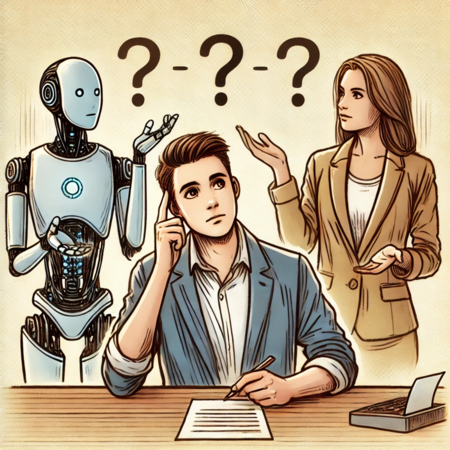

Why do people sometimes refuse to call an action either good or bad?
This question was the starting point for our study.
In earlier work on indirect reciprocity, we examined justified defection: refusing to help someone who already has a bad reputation because they have behaved uncooperatively toward others. Theoretically, such defection is often treated as justified because punishing non-cooperators can help sustain cooperation. Yet when we asked people to evaluate this behaviour, many did something strikingly different. They avoided judging it as either clearly good or clearly bad.
The response remained stubbornly neutral.
That result raised a question that we wanted to explore further. Why were people so reluctant to judge?
At the same time, another development was becoming increasingly difficult to ignore. Artificial intelligence was beginning to enter domains in which it would not merely classify objects or optimise routes, but evaluate people and make decisions with moral or social consequences. AI was already being discussed in contexts such as recruitment, medicine, law, and automated driving. It seemed inevitable that questions about AI making moral judgements would become increasingly important.
We therefore saw an opportunity to bring together two research interests: reciprocal cooperation and the social acceptance of AI.
A situation in which people themselves are uncertain
Studying acceptance of AI judgement is not straightforward.
If people already have a strong opinion about what the correct decision should be, then their response to an AI may simply reflect whether the AI agrees with them. To understand whether people accept AI differently from humans, we wanted a situation in which people themselves were uncertain.
Justified defection offered exactly that.
Imagine an employee who refuses to help a colleague with a bad reputation because that colleague has repeatedly behaved selfishly toward others. Is the refusal justified? Perhaps the employee is appropriately withholding help from a free rider. But perhaps refusing assistance still feels harsh or vindictive.
Our previous research suggested that these competing considerations often lead people to withhold judgement altogether.
This made justified defection a useful case for asking a different question: what happens when someone else makes the judgement that people themselves hesitate to make?
And does it matter whether that evaluator is a human or an AI?
Our first experiment produced a null result
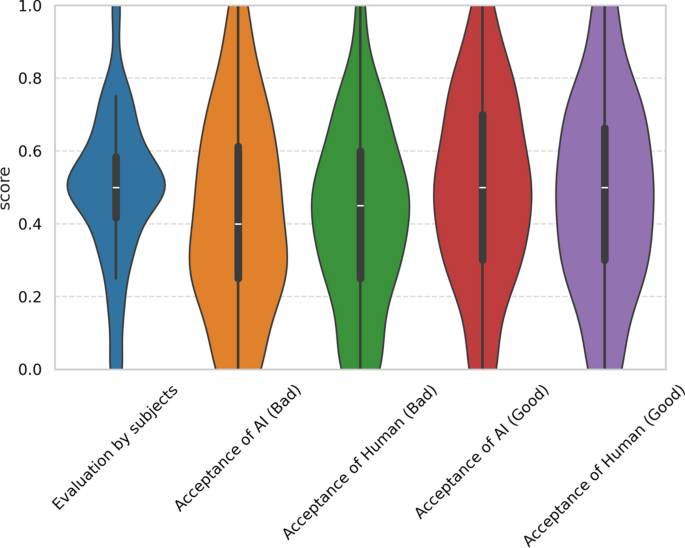
In Study 1, participants first evaluated an employee who refused to help a coworker with a bad reputation. Once again, most participants rated the behaviour close to neutral, replicating our previous finding.
Participants then saw the judgement of a manager. Depending on the experimental condition, the manager was either human or AI and evaluated the employee's behaviour as either good or bad.
We expected that the identity of the evaluator might influence whether the judgement was accepted.
It did not.
Participants were somewhat less accepting of negative judgements, but there was no significant difference between AI and human managers.
This was an important result, but it also suggested a limitation in our design. Participants had seen only one evaluator. They were not being asked to compare a human judgement with an AI judgement directly.
We therefore changed the question for Study 2.
What happens when AI and humans disagree?
In the second experiment, we placed two evaluators side by side.
Participants saw opposing judgements about the same act of justified defection. In some conditions, the two evaluators were one human and one AI; in others, they were two humans or two AIs. One evaluator judged the action as good, while the other judged it as bad.
This direct comparison produced a much more interesting result.
Participants preferred the AI judgement over the human judgement only in one specific condition: when the AI judged the justified defection as good and the human judged it as bad.
In the reverse condition, where the AI judged the action as bad and the human judged it as good, there was no corresponding preference for the human. Nor did the other comparison conditions show a clear departure from neutrality.
This asymmetry was important.
If people simply preferred algorithms, we should have observed a general tendency to accept AI judgements over human judgements. If people generally distrusted algorithms, we should have found the opposite. We observed neither.
Instead, acceptance depended on what the AI judged and what the human judged in contrast.
Why might the AI's positive judgement have been more acceptable?
Our experiment does not establish the mechanism behind this result, so any explanation must remain tentative.
One possibility concerns how people interpret intentions.
Previous research has suggested that when humans make socially questionable judgements, observers may infer motives such as prejudice or hostility. The same inference may be weaker when the decision is made by an AI.
Something similar may have occurred in our experiment.
Participants may have regarded a human manager who judged justified defection positively as implicitly endorsing retaliation: "It is acceptable not to help someone because they behaved badly." When an AI made the same positive judgement, it may instead have appeared more like an impersonal or rule-based evaluation.
This interpretation is plausible, but our study did not directly measure such inferred intentions. We therefore treat it as one possible explanation rather than a conclusion.
AI acceptance may be more context-dependent than we think
The broader lesson from our experiments is that attitudes toward AI cannot necessarily be reduced to a simple preference for or aversion to algorithms.
People may accept AI differently depending on the kind of decision being made, especially when moral norms are ambiguous.
This point may become increasingly important as AI systems are used to evaluate human behaviour. Decisions in organisations, education, online platforms, and other institutions often involve situations where there is no universally accepted answer. In such cases, people may react not only to the outcome of a decision but also to who—or what—made it.
For us, this study also opened another route for investigating human social norms.
If people react differently to identical judgements depending on whether they come from a human or an AI, those differences may reveal something about the hidden assumptions people bring to human judgement. We may infer intentions, emotions, loyalty, hostility, or responsibility from human evaluators in ways that we do not yet apply to machines.
In that sense, studying AI judgement can also become a tool for studying human judgement.
We began with a puzzle about why people refuse to classify justified defection as good or bad. By introducing AI into that puzzle, we discovered that the question was not simply whether people trust machines.
The more interesting question may be when people are willing to let machines make judgements that they themselves hesitate to make.
Follow the Topic
-
Scientific Reports
An open access journal publishing original research from across all areas of the natural sciences, psychology, medicine and engineering.

Related Collections
With Collections, you can get published faster and increase your visibility.
Cancer Prevention and Control
Publishing Model: Hybrid
Deadline: Feb 19, 2027
Healthy Aging
Publishing Model: Open Access
Deadline: Dec 31, 2026