Reputation or personal experience? Why not use both?
Published in Social Sciences, Ecology & Evolution, and Behavioural Sciences & Psychology
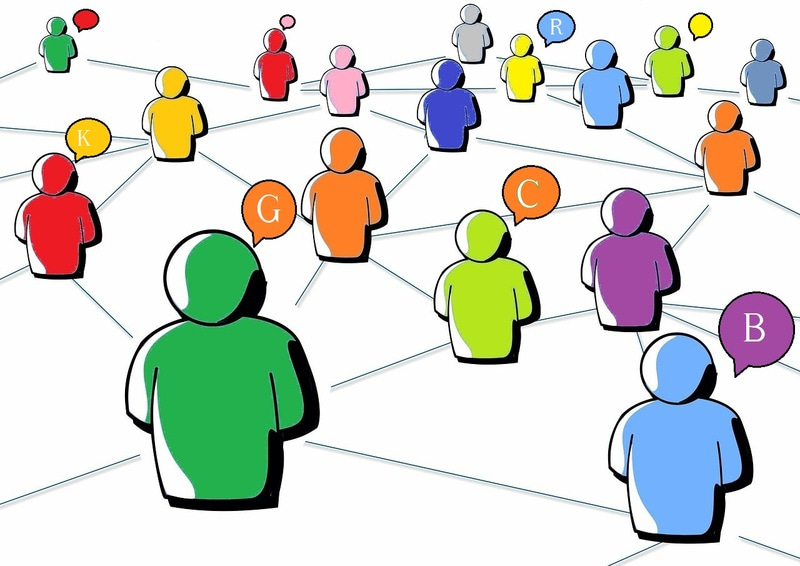

Imagine someone who has a bad reputation. Other people tell you that this person is selfish or untrustworthy. Yet your own experience is different: whenever you have interacted with them, they have treated you well.
Would you cooperate with them?
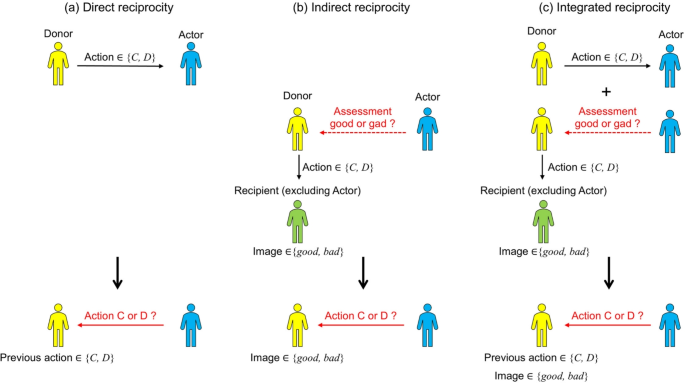
This simple situation captures a problem that motivated our study. Human cooperation is often explained through two fundamental mechanisms: direct reciprocity and indirect reciprocity. Direct reciprocity follows the familiar principle, "I help you because you helped me." Indirect reciprocity instead relies on reputation: "I help you because you helped someone else."
Both mechanisms have been studied extensively, but for a long time they were largely treated as separate processes. This is theoretically convenient, but it does not fully resemble everyday social decision-making. In real life, we often know both what someone has done to us and what other people think of them.
Bringing two forms of reciprocity together
Around 2020, several studies began developing frameworks that brought direct and indirect reciprocity together. This was an important development in the literature and raised a question for us.
Could we construct a model in which individuals explicitly consider both sources of information at the same time when deciding whether to cooperate?
Rather than treating personal experience and reputation as alternative routes to a decision, we wanted to examine what happens when they are combined within the decision rule itself.
Our model therefore gives an individual two pieces of information about a potential partner: the partner's past behaviour toward the individual and the partner's reputation based on interactions with others. The decision to cooperate or defect can then depend on the combination of these two signals.
This produces several possible strategies. Some resemble traditional direct reciprocity, some resemble indirect reciprocity, and others genuinely integrate the two.
One integrated strategy turned out to be particularly interesting.
Being cautious without being unforgiving
We called this strategy tolerant integrated reciprocity.
Its basic logic is simple. An individual refuses to cooperate only when two negative signals agree: the partner has previously defected against them and has a bad reputation. In all other cases, the individual cooperates.
This means that a single piece of negative information is not enough to reject someone.
If a person has a bad reputation but has treated you well, you still cooperate. If someone has defected against you in the past but otherwise has a good reputation, you also give them another chance. Only when both your personal experience and reputational information are negative do you withhold cooperation.
This is a relatively tolerant rule. But would such tolerance actually help cooperation survive?
To investigate this, we used agent-based simulations and systematically examined a wide range of social norms. We also introduced two kinds of noise: errors in behaviour and errors in reputation assessment. These are important because real social environments are never perfectly reliable. People make mistakes, observers misinterpret actions, and reputations can be inaccurate.
Tolerance became especially valuable when information was noisy
The simulations showed that tolerant integrated reciprocity could maintain cooperation under a broader range of social norms than strategies relying on indirect reciprocity alone.
The difference became particularly clear when errors increased.
A strategy based heavily on reputation can work well when reputational information is accurate. But if reputations become noisy, an individual may refuse to cooperate with someone who has been incorrectly labelled as bad. That defection may then itself be interpreted negatively, potentially triggering further deterioration of cooperation.
Personal experience provides an additional source of information that can help prevent this process.
One combination was especially robust: tolerant integrated reciprocity paired with a social norm known as Standing. Under this combination, high levels of cooperation persisted even when both behaviour and reputation assessment were affected by substantial errors.
The result suggested something broader than the superiority of a particular technical strategy. It pointed toward the importance of tolerance.
Why not trust reputation alone?
Reputation is enormously useful. Humans can cooperate with people they have never met because information about past behaviour travels through communities. This ability is one of the foundations of large-scale human cooperation.
But reputation is also imperfect.
This problem may be particularly relevant in modern digital societies. Online ratings, reviews, social media posts, and other forms of reputational information give us unprecedented access to information about other people. At the same time, they expose us to misinformation, incomplete information, conflicting evaluations, and simple mistakes.
Our results suggest that reputation need not be abandoned when it becomes noisy. Instead, it can be supplemented with another source of information: one's own experience.
In our simulations, cooperation was more resilient when agents could draw on both.
This does not mean that people should always ignore bad reputations or endlessly forgive harmful behaviour. Tolerant integrated reciprocity is not unconditional cooperation. When both reputation and direct experience indicate that someone is uncooperative, the strategy responds by defecting.
What matters is that it avoids condemning someone on the basis of a single negative signal.
Cooperation requires more than strict reciprocity
This finding also connects with a broader idea in the study of cooperation: forgiveness can be essential in imperfect environments.
In direct reciprocity, strategies that retaliate endlessly after a single defection can become trapped in cycles of mutual punishment when mistakes occur. More forgiving strategies can restore cooperation. A similar principle appears in indirect reciprocity, where tolerant social norms can prevent erroneous reputational judgments from spreading through a population.
Our integrated model suggests that tolerance can also emerge from combining different kinds of social information.
In this sense, cooperation may depend not only on rewarding good behaviour and punishing bad behaviour, but also on knowing when not to punish.
That was perhaps the most interesting lesson for us. We began with a technical question about how to integrate direct and indirect reciprocity. The simulations led us to a more general conclusion: robust cooperation requires a balance between discrimination and tolerance.
Human cooperation is often described in terms of fairness and reciprocity. But in a world where actions can be misunderstood and reputations can be wrong, cooperation may also depend on giving others the benefit of the doubt.
Sometimes, maintaining cooperation requires not only remembering what people have done and listening to what others say about them, but also resisting the temptation to judge too quickly.

I study the evolution of human cooperation through direct and indirect reciprocity, reputation, and social norms. Using evolutionary game theory, agent-based simulation, and behavioral experiments, I explore how cooperation emerges and is sustained in human societies, as well as how AI and other emerging technologies may reshape social judgment and cooperation.
Keywords: Evolution of Cooperation, Social Dilemma, Social Simulation, Agent-Based Modeling, Social Infomatics, and Internet Sociology
Follow the Topic
-
Scientific Reports
An open access journal publishing original research from across all areas of the natural sciences, psychology, medicine and engineering.

Related Collections
With Collections, you can get published faster and increase your visibility.
Cancer Prevention and Control
Publishing Model: Hybrid
Deadline: Feb 19, 2027
Healthy Aging
Publishing Model: Open Access
Deadline: Dec 31, 2026