When males and females sound almost the same: searching for hidden differences in antbird songs
Published in Zoology & Veterinary Science and Mathematics


The question that started it all
Birds are famous for the striking differences between males and females. In many species, males are brightly colored while females are more cryptic. This is a textbook example of sexual dimorphism. But what about sound? If males and females look different, do they also sound different? As it turned out, the answer was far less obvious than we expected.
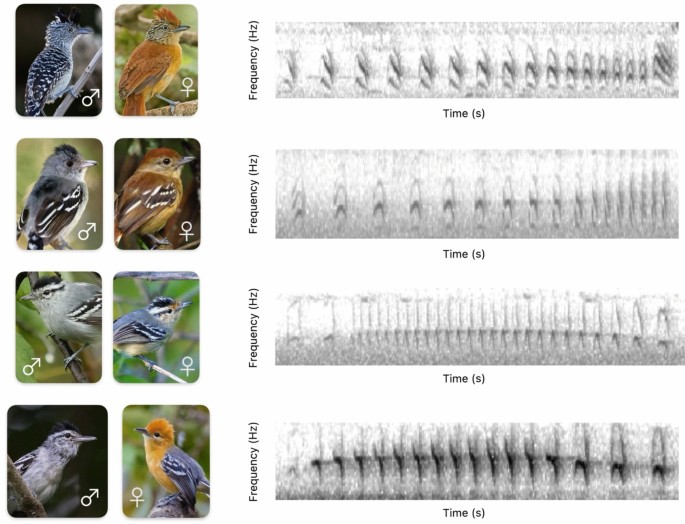
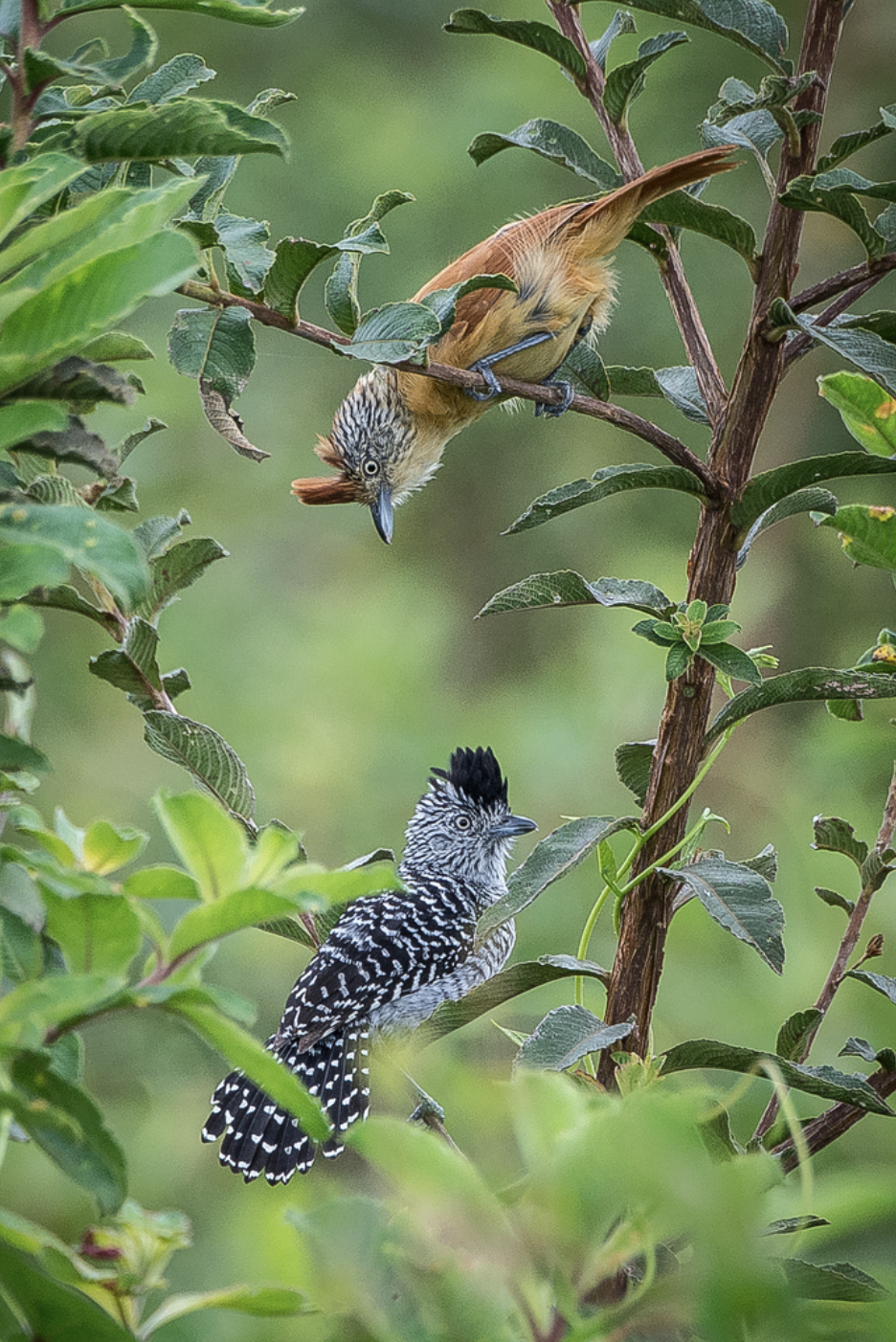
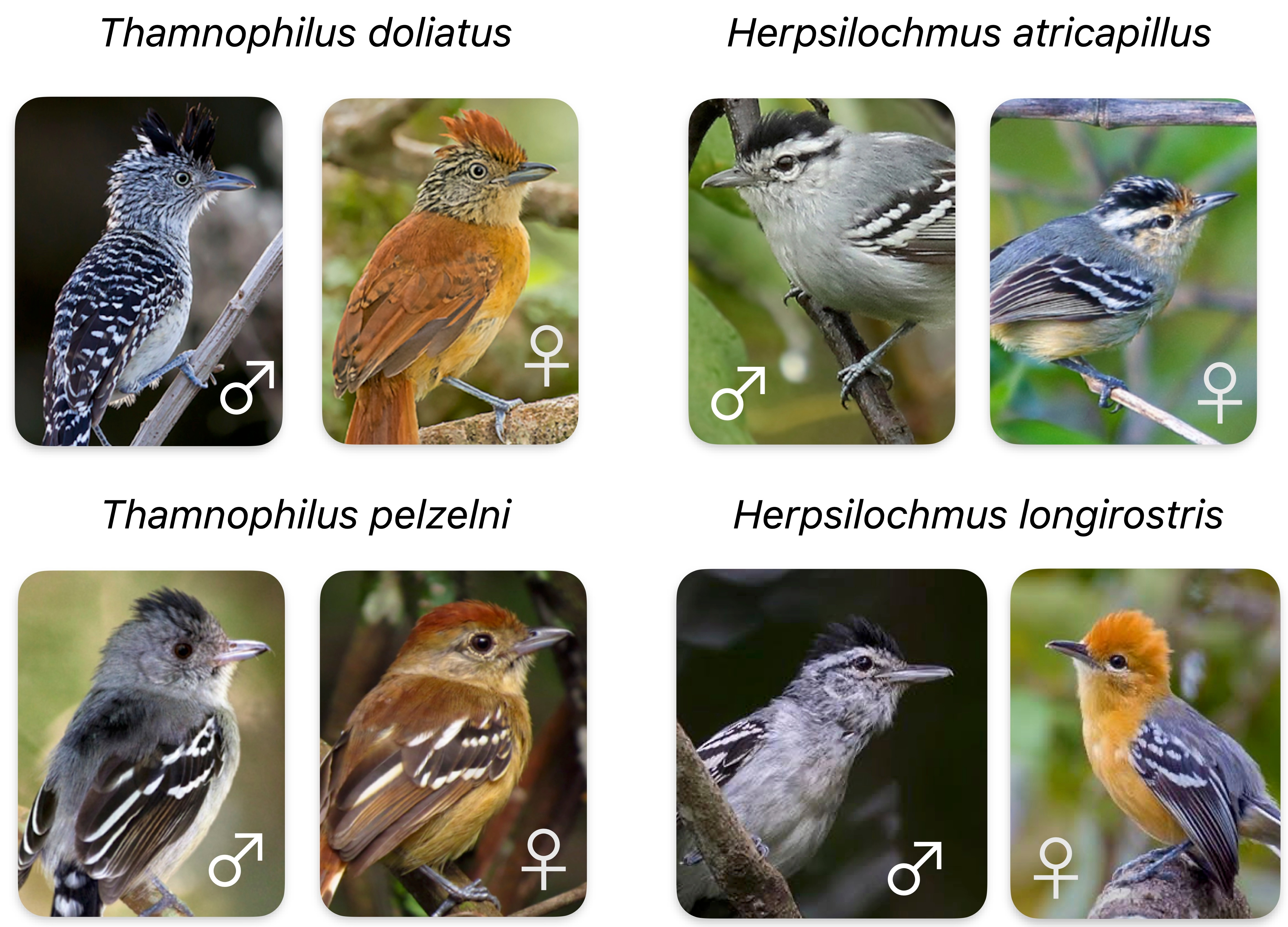
That simple question became the starting point for our study of four antbird species from Brazil's Cerrado, one of the world's biodiversity hotspots. Antbirds (family Thamnophilidae) are particularly intriguing because they challenge our expectations. In several species, females—not males—are the more colorful sex, with warm rufous and orange plumage contrasting against the males' gray and black feathers (Fig. 1). Yet despite these striking visual differences, remarkably little is known about whether males and females also sound different.
At first glance, this might seem like a niche question about bird sounds. In reality, it addresses a much broader question in evolutionary biology: do visual and acoustic signals evolve together, or can they follow different evolutionary paths? Answering this helps us understand how animals recognize mates, defend territories, and adapt their communication to the environments in which they live.
From the Cerrado to Cornell
A question worth chasing
My fascination with bird sounds began during my undergraduate studies in Brazil. One of the first books that truly captured my attention was Bird Song by Catchpole and Slater. I was especially intrigued by suboscine birds, whose songs are innate rather than learned. If their songs are genetically encoded, could subtle differences between males and females reveal something about how communication evolves?
Around that time, my supervisor, Dr. Guilherme Sementili-Cardoso, suggested that we focus on antbirds, one of the most diverse and abundant bird families in the Cerrado. What began as my first undergraduate research project would eventually grow into something much larger.
Every recording counts
Answering our question turned out to be much harder than we expected.
To study vocal sexual dimorphism, we first needed to know whether every recorded individual was male or female. That information is rarely available in online sound archives, meaning we couldn't simply download hundreds of recordings and start analyzing them. We needed our own dataset.

Over several field seasons, we recorded 681 vocalizations from 76 individuals belonging to four species (Fig. 3).
One challenge of working with antbirds is that they often vocalize as pairs. Males and females frequently sing together in coordinated duets, making it surprisingly difficult to isolate individuals and confidently assign recordings to one sex. In all cases, we had to visually confirm the birds while recording, often in dense vegetation and under low light conditions.
A new way of listening
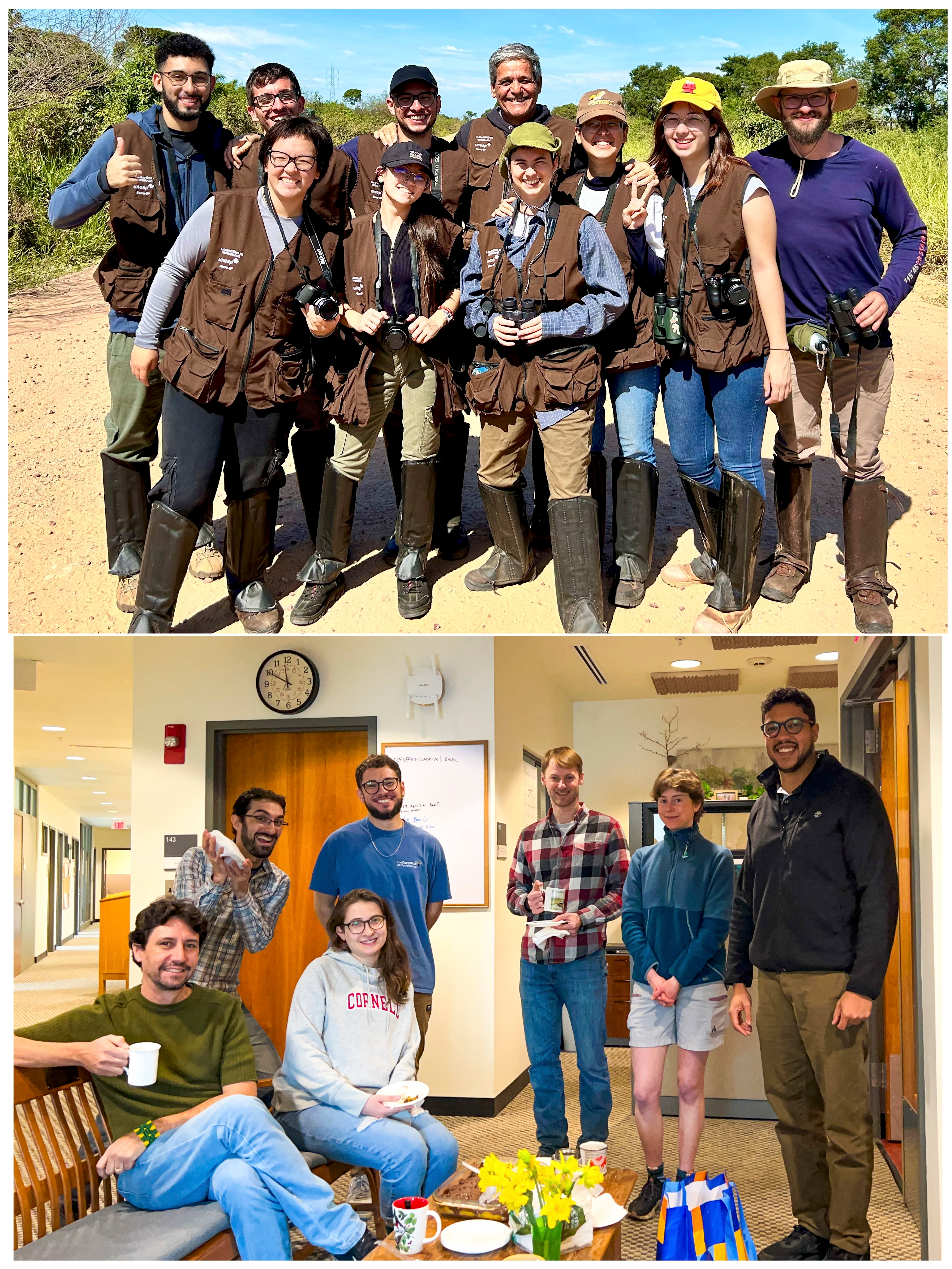
While the fieldwork was progressing, I had the opportunity to spend four months as a visiting scholar at the K. Lisa Yang Center for Conservation Bioacoustics at the Cornell Lab of Ornithology, supported by a fellowship from the São Paulo Research Foundation (FAPESP). There, under the supervision of Dr. Larissa Sugai, the project took an unexpected direction.
One of the first questions we discussed was surprisingly simple: could a computer detect acoustic differences that humans struggle to hear?
We decided to combine traditional bioacoustics with modern machine learning. First, we measured familiar acoustic traits such as frequency, duration, and entropy. We then extracted MFCCs, features widely used in speech recognition, and BirdNET embeddings, which are compact numerical representations of sounds generated by a deep-learning model trained on millions of bird vocalizations. Rather than identifying species, we used these embeddings as a way of describing each song in hundreds of dimensions, asking whether they contained subtle information about the bird's sex.
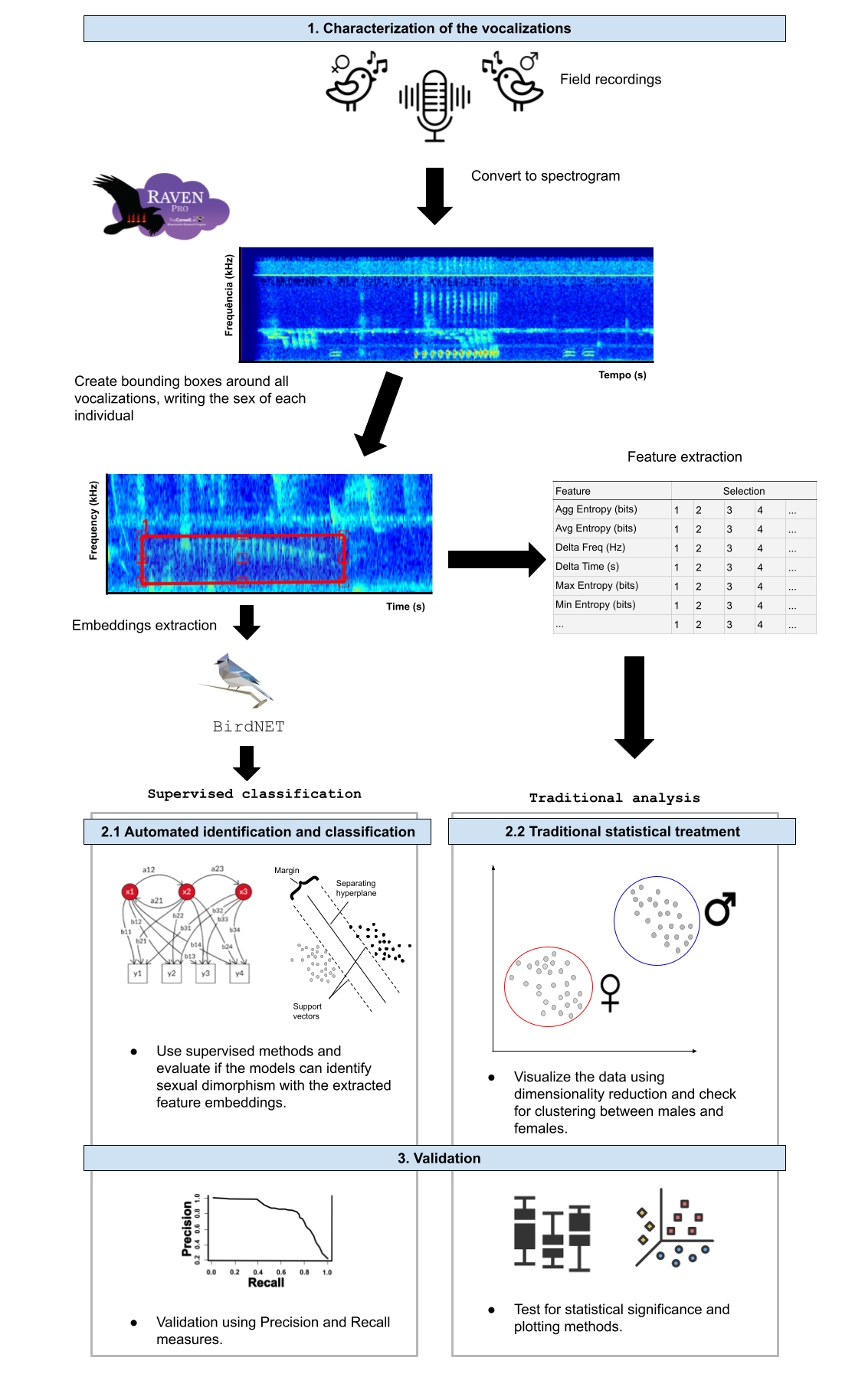
At times, the project felt like translating between two scientific languages. Traditional bioacoustics focuses on interpretable biological traits: frequency, timing, note structure. Machine learning, on the other hand, can detect patterns hidden across hundreds or thousands of dimensions, often without obvious biological interpretation.
We wondered whether these approaches would converge on the same answer.
Listening for differences that weren't there
After months of fieldwork, hours of acoustic measurements, and countless machine-learning models, we finally had our answer.
The surprise was not that males and females sounded different, but how remarkably similar they were.
Across most species and analytical approaches, male and female vocalizations overlapped extensively. Classification algorithms generally performed only slightly better than chance when trying to predict the sex of an individual from its song.
This wasn't what we expected.
Given the striking plumage differences in these antbirds, we anticipated at least some consistent acoustic separation. Instead, vocal differences proved to be subtle, inconsistent, and strongly species-dependent. Only one species, T. pelzelni, showed modest but detectable differences between males and females, and even there the separation was far weaker than the dramatic differences visible in their plumage
Perhaps the most surprising finding was methodological. We expected modern AI approaches to uncover patterns that traditional bioacoustic measurements might miss. Instead, the machine-learning methods performed similarly to more classical analyses. Although some of this likely reflects our relatively small dataset, which is a consequence of collecting every recording ourselves with known-sex individuals, it also highlights an important principle: sophisticated algorithms cannot compensate for biological patterns that are inherently weak
Rather than revealing hidden differences, the machine-learning models reinforced the same conclusion reached by traditional bioacoustics: male and female songs are genuinely very similar.
This finding carries an important message in the current era of artificial intelligence in ecology. Even though our data collection method showed to be limited, machine learning, despite incredibly powerful, cannot magically recover patterns that are biologically weak or nearly absent. Sometimes, the most interesting result is discovering that the expected difference simply isn't there.
More than meets the ear
Our findings suggest that visual and acoustic sexual dimorphism do not necessarily evolve together.
In these antbirds, males and females look strikingly different, yet their songs are remarkably similar. This pattern may reflect the ecology and social behavior of the group. Unlike many temperate songbirds, both sexes in antbirds actively defend territories and often perform coordinated duets. When males and females share similar ecological and behavioral roles, there may simply be less evolutionary pressure for their vocalizations to diverge, even as plumage evolves along different trajectories.
At the same time, the subtle differences we detected should not be dismissed. Birds themselves may perceive distinctions that remain difficult for current analytical methods, and perhaps even artificial intelligence, to detect. Understanding how these birds perceive and use vocal information remains an exciting challenge for future research.
More broadly, our study highlights an important principle in evolutionary biology: communication is multidimensional. Different signaling systems need not evolve in parallel. Selection can drive dramatic divergence in one trait, such as plumage coloration, while another, such as vocalizations, remains relatively conserved. Exploring why these signals become decoupled may help us better understand the evolution of animal communication across many groups, not just birds.
Science, however, is rarely a solitary endeavor. This project took me from early mornings recording antbirds in the Brazilian Cerrado to collaborating with researchers at the Cornell Lab of Ornithology, where new perspectives and computational approaches reshaped the questions we were asking. Although our original hypothesis was not supported, the collaboration itself became one of the most rewarding outcomes of the project. It reinforced something that science teaches us again and again: unexpected results are not failures, but often the beginning of better questions.
Perhaps that is the most fascinating lesson I take from this work. We set out expecting to uncover hidden differences between male and female antbird songs. Instead, we discovered something equally valuable: that the absence of a strong difference can reveal just as much about evolution as its presence. Even when male and female songs sound almost identical to us, they may still carry information that only the birds themselves can perceive. For me, that is both the beauty of bioacoustics and the promise of future research: every answer uncovers a new question waiting to be heard.
Follow the Topic
-
Journal of Ornithology
The Journal of Ornithology publishes innovative research in ornithological science, with special emphasis on the behaviour, ecology, evolution and conservation of birds.