When Pancreatic Cancer Loses Its Ability to Spread: Uncovering the Role of UNC5B in Metastasis
Published in Cancer and Cell & Molecular Biology

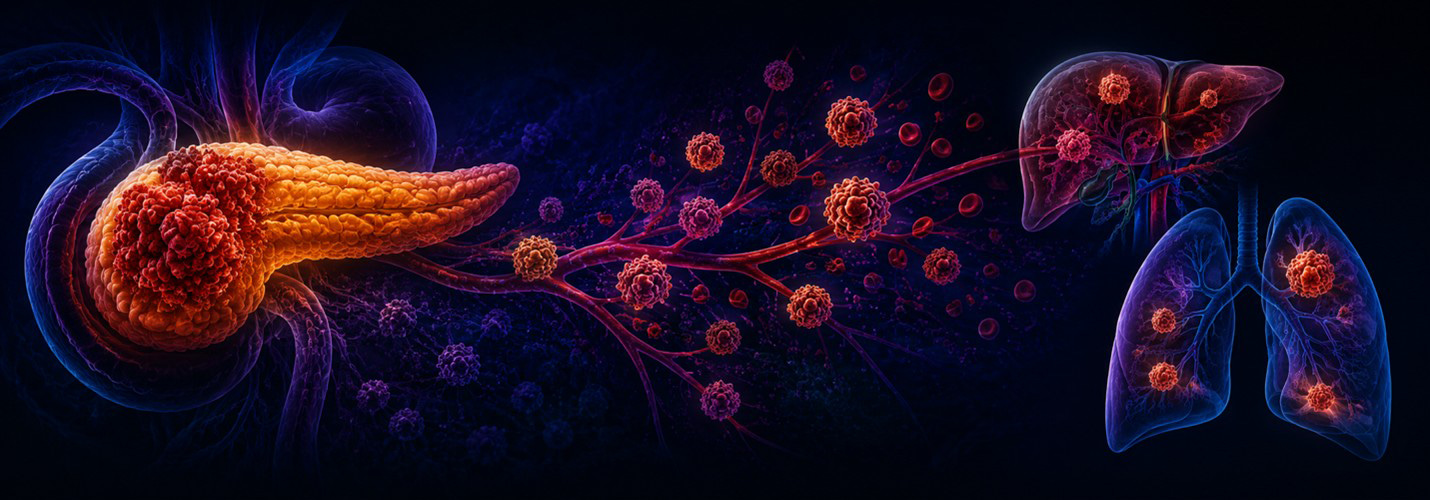





Pancreatic ductal adenocarcinoma (PDAC) is one of the most difficult cancers to treat, largely because of its ability to invade surrounding tissues and spread to distant organs. For many patients, metastasis—not the primary tumor itself—is what makes the disease so difficult to control.
Our research began with a simple question: What gives pancreatic cancer cells the ability to become invasive and metastatic?
The answer led us to an unexpected molecule: UNC5B, a cell-surface receptor best known for its role in axon guidance, the process that helps developing nerve cells navigate to their correct destinations. What was a receptor associated with cellular navigation doing in pancreatic cancer, and could it also help cancer cells move beyond the pancreas?
Following an unexpected clue
Our interest in UNC5B grew from earlier work on Netrin-1 ligand, a signaling molecule involved in axon guidance. We had found that Netrin-1 signaling contributes to pancreatic cancer metastasis and that UNC5B is a prominent Netrin-1 receptor expressed in PDAC. This raised an important question: Was UNC5B simply present in pancreatic tumors, or was it actively helping them spread?
To investigate this, we generated a genetically engineered mouse model in which Unc5b could be deleted in pancreatic tumors. The results were striking. Mice whose tumors retained Unc5b frequently developed metastatic disease involving lymph nodes and distant organs, including the liver and lungs. In contrast, when Unc5b was successfully deleted, metastatic spread was not detected.
Two animals initially classified as having Unc5b-deficient tumors did develop metastases. However, closer examination showed that their tumors had retained Unc5b expression because the genetic deletion was incomplete-we confirmed that cre-loxp system is not 100% efficient and may have leakage. Rather than weakening the finding, this observation reinforced the connection between UNC5B expression and metastatic behavior.
A tumor that cannot escape
Primary tumors still formed, and their overall weights were not significantly different among the genetic groups. Yet their behavior was dramatically different. Tumors with intact Unc5b invaded nearby tissues and appeared in regional lymph nodes. Unc5b-deficient tumors remained confined within the pancreas, without comparable local or lymphatic invasion.
This distinction fascinated us because it suggested that the machinery allowing a tumor to grow is not necessarily identical to the machinery allowing it to invade and metastasize. Unc5b-deficient tumors also contained more necrosis and showed reduced proliferation, indicating broader effects on tumor biology. However, the loss of metastatic capacity remained the most striking result.
We confirmed the finding using a second approach. When pancreatic cancer cells with reduced Unc5b expression were implanted directly into the pancreas, metastatic lesions were again absent, whereas control cells produced widespread disease.
Watching cancer cells change their identity
For cancer cells to metastasize, they must acquire properties that allow them to move, invade, and survive outside their original environment. One biological program involved in this process is epithelial-to-mesenchymal transition, or EMT.
Tumors lacking Unc5b shifted toward a more epithelial state: they retained stronger epithelial features and showed fewer mesenchymal characteristics. The opposite occurred when we increased UNC5B expression in human pancreatic cancer cells. The cells became elongated and scattered, and their gene-expression patterns shifted toward a mesenchymal state.
Most importantly, these changes were reversible. We engineered pancreatic cancer cells so that an introduced UNC5B protein could be rapidly removed using a targeted protein-degradation system. Increasing UNC5B pushed cells toward a mesenchymal state; rapidly removing it shifted them back toward a more epithelial program. It was like watching a biological switch being turned on and off.
These experiments showed that UNC5B was not merely associated with EMT. Manipulating UNC5B levels could actively alter the identity and behavior of pancreatic cancer cells.
Connecting UNC5B to ZEB1
We next asked how UNC5B controlled this transition. Several transcription factors regulate EMT, including SNAIL, TWIST, SLUG, and ZEB1. Among them, one repeatedly stood out: ZEB1.
Reducing UNC5B caused ZEB1 levels to fall, while other major EMT regulators were largely unchanged. Increasing UNC5B produced the opposite effect. When we reduced ZEB1 in cells with high UNC5B expression, the mesenchymal characteristics driven by UNC5B were reversed.
This identified ZEB1 as a critical downstream mediator connecting UNC5B to cellular plasticity and aggressive tumor behavior. We then asked what linked a receptor at the cell surface to ZEB1.
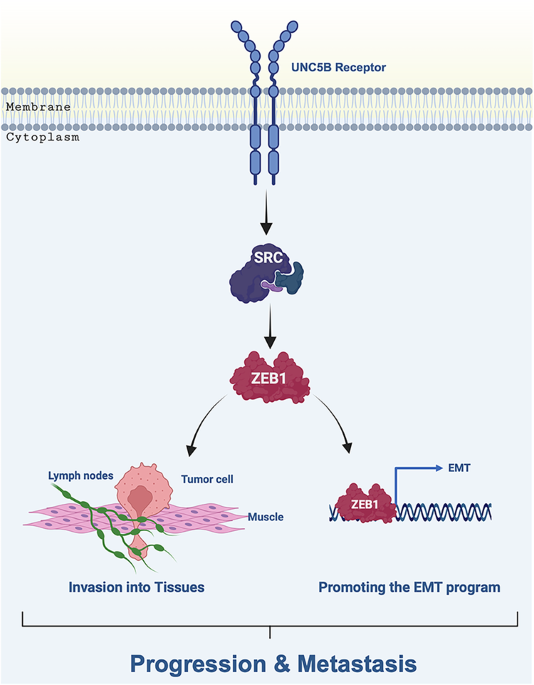
Our experiments pointed to SRC, a signaling kinase known to regulate cancer-cell migration and invasion. Increasing UNC5B altered SRC expression and activation, while reducing SRC lowered ZEB1. Reducing ZEB1 did not have the same effect on SRC, suggesting a directional pathway:
UNC5B → SRC → ZEB1 → EMT and invasion.
Disrupting either SRC or ZEB1 significantly reduced the invasive ability of UNC5B-expressing pancreatic cancer cells, providing a mechanistic explanation for how UNC5B promotes metastatic competence.
A story built across different models
One of the most compelling aspects of the study was that the same biological story emerged from several experimental systems. We observed it in genetically engineered mouse tumors, reproduced it in orthotopic pancreatic cancer models, and studied it in both human and mouse pancreatic cancer cells. We tested the pathway through gene knockdown, gene activation, and targeted protein degradation.
Each experiment addressed a different part of the question, but together they converged on the same conclusion: UNC5B helps pancreatic cancer cells acquire and maintain the characteristics required for invasion and metastatic spread.
Where do we go from here?
Metastasis remains one of the greatest challenges in pancreatic cancer. Our findings suggest that understanding the programs controlling metastatic competence may reveal opportunities that are different from simply trying to shrink the primary tumor.
Important questions remain. We still need to determine precisely how UNC5B regulates SRC, when UNC5B becomes important during pancreatic cancer development, and how this pathway interacts with the complex tumor microenvironment.
This study changed how we think about UNC5B. Sometimes, the most revealing experiment is not the one that makes a tumor disappear. It is the one that leaves the tumor in place but takes away its ability to escape.
What began as a question about an axon-guidance receptor became a story about cellular plasticity, invasion, and the molecular machinery that gives pancreatic cancer its metastatic potential. By understanding that machinery, we hope to move closer to a future in which metastasis is not only detected after it occurs, but better understood—and ultimately prevented.
Follow the Topic
-
Oncogene
This journal aims to make substantial advances in our knowledge of processes that contribute to cancer by publishing outstanding research.