When sound becomes a pair of invisible tweezers: rotating zebrafish with acoustic nodes
Published in Bioengineering & Biotechnology and Electrical & Electronic Engineering





Imagine trying to take a complete 3D photograph of a living zebrafish larva—a tiny, translucent creature just a few millimeters long. To see all its organs from every angle, you would need to rotate it precisely, like a rotisserie chicken in a miniature oven, without touching or damaging it. This is the problem that has frustrated developmental biologists for years.
Four years ago, when we first started thinking about this challenge, the existing solutions all seemed to involve a fundamental compromise. You could use acoustic streaming—sound-induced fluid flows—to spin an object, but then it would drift away from where you wanted it. Or you could use complex arrays of transducers to generate acoustic torque, but the setups were expensive and difficult to fabricate. Neither approach gave you the ability to stop at a precise angle when you needed to.
The turning point came during a discussion in the lab. We realized that instead of trying to spin the object directly, we could rotate the acoustic trap itself. It was one of those ideas that seems obvious in hindsight but required a complete shift in perspective.
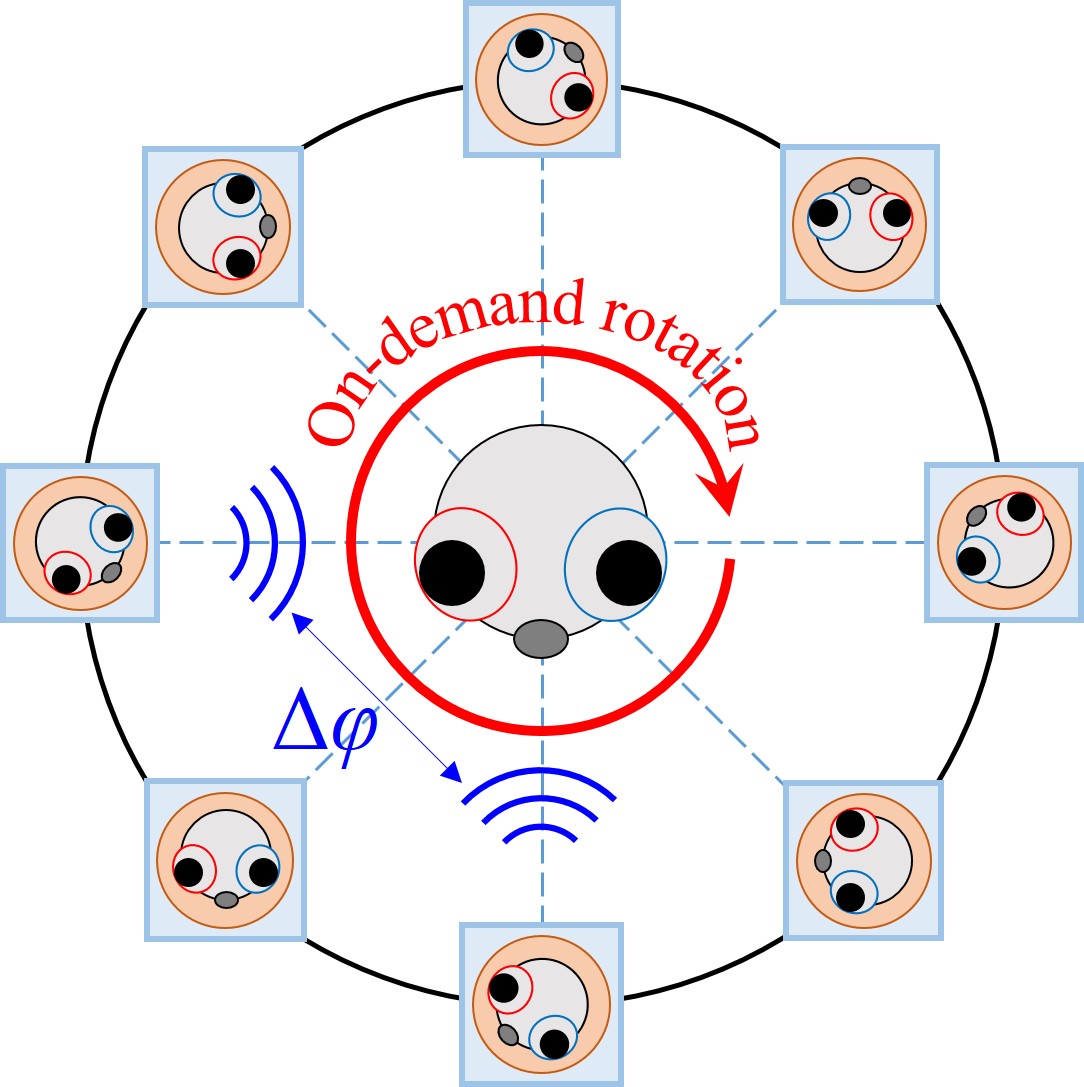
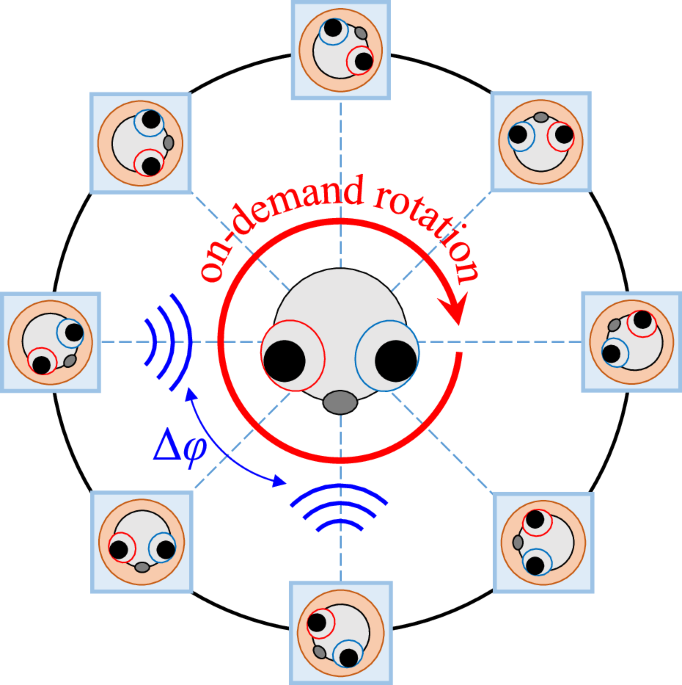
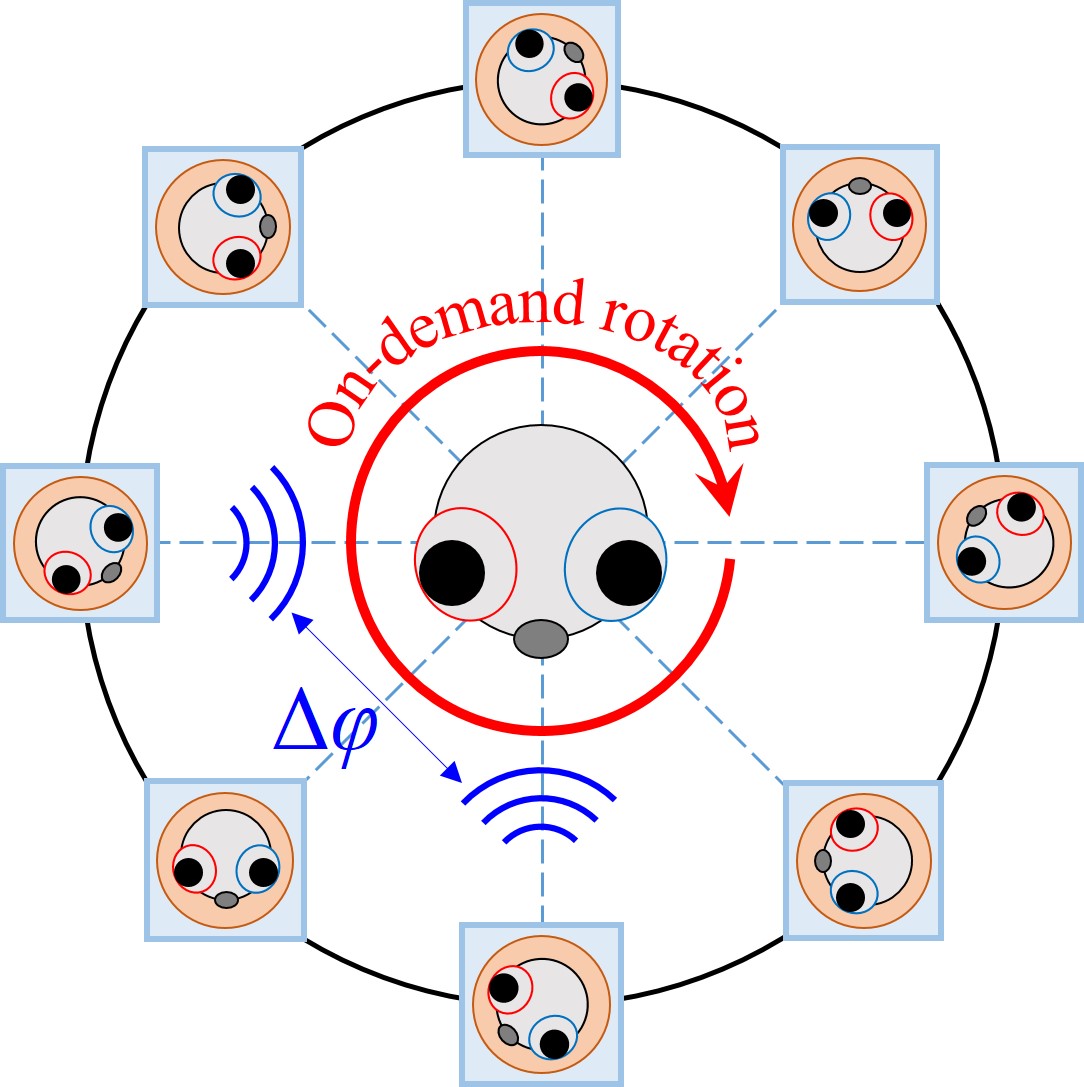
Here is the basic physics: when you excite sound waves in a fluid-filled channel, they form standing waves with regions of high and low pressure. Small particles or biological specimens get pushed toward the low-pressure regions—the so-called “pressure nodes.” Think of these nodes as invisible shelves where objects can rest.
Our insight was simple but powerful: if we could rotate these shelves, the objects resting on them would rotate too. And by using two orthogonally placed piezoelectric transducers with a controllable phase difference, we could do exactly that.
The engineering challenge was significant. We needed to attach two transducers at perfect right angles on the outside of a glass capillary—a tube with a square exterior but a circular interior channel. The square exterior ensured precise alignment, while the circular interior provided a symmetric environment for the acoustic field. Getting the glue right, the alignment perfect, and the frequency matched took months of trial and error.
What surprised us most was how cleanly the relationship worked. When we applied a phase difference φ between the two transducers, the trapped object rotated by approximately φ/2. This meant we could control the rotation angle simply by turning a dial—no complex algorithms, no feedback loops. The physics did the work for us.
We tested our device first on clusters of polystyrene microparticles—essentially tiny plastic beads. The clusters rotated smoothly, following our commands with remarkable precision. But the real excitement came when we switched to living zebrafish larvae.
The first time we saw a zebrafish larva rotate gently inside our glass capillary, responding to nothing but sound waves, we knew we had something special. The larva was anesthetized (we take animal welfare seriously), levitated by acoustic forces, and rotated to any angle we desired. We could view it from the side, from above, or from any angle in between—simply by adjusting the phase difference on our signal generator.
The broader implications are what keep us excited. Beyond the obvious applications in 3D imaging and developmental biology, this platform opens doors to automated phenotype screening, where thousands of larvae could be rotated to standard orientations for rapid analysis. It could enable precise micro-surgery, where a laser is aimed at a specific region of a larva’s body. And it provides a new tool for building microscopic structures from non-spherical building blocks.
None of this would have been possible without collaboration. Our team brought together expertise from Guangdong University of Technology and the University of Southampton—combining strengths in acoustofluidics, piezoelectric materials, and biological applications. The cross-disciplinary nature of this work was essential; none of us could have done it alone.
Looking ahead, we see several directions for improvement. The current uncertainty in angle measurement (±10°) is limited by manual image analysis; we are exploring automated algorithms to improve precision. We also want to push the size limits—our method works well for particles down to about 2 μm, but below that, acoustic streaming forces start to dominate over the trapping forces.
We also plan to integrate our rotation platform with high-resolution microscopy systems for accurate 3D reconstruction of zebrafish anatomy. And we are curious whether the same principle could work for other types of samples—perhaps organoids, tissue spheroids, or even larger organisms.
For us, this project has been a reminder that sometimes the most elegant solutions come from rethinking the fundamentals. We didn’t invent a new way to generate sound or a new material for transducers. We simply asked: what if we rotated the trap instead of the object?
The answer, it turns out, was a whole new way of manipulating the microscopic world.
This Behind the Paper post accompanies our article “On-demand rotational manipulation of microparticles and zebrafish larvae via orthogonally phased BAW acoustofluidics,” published in Microsystems & Nanoengineering[1].
[1] J. Lei, L. Lin, F. Cheng, P. Glynne-Jones, M. Hill, Z. Huang, Z. Yao, and M. Yuan, On-demand rotational manipulation of microparticles and zebrafish larvae via orthogonally phased BAW acoustofluidics, Microsystems & nanoengineering 12, 268 (2026).

Follow the Topic
-
Microsystems & Nanoengineering
This journal, with a target for a high-end journal for years to come, seeks to promote research on all aspects of microsystems and nanoengineering from fundamental to applied research.