When success doesn't stick: How the explanations we give for feedback shape our self-image
Published in Social Sciences and Behavioural Sciences & Psychology





How people explain success and failure
For many years, research has shown that the way people explain the events in their lives is closely connected to their mental well-being. Studies from the 1970s and 1980s identified patterns known as attributional styles, describing people's habitual ways of explaining successes and failures. One pattern that has received particular attention is often seen in people experiencing depression or low self-esteem. These individuals are more likely to attribute successes to external factors, such as luck or chance, while blaming themselves for failures. In other words, when something good happens, they might think, “I just got lucky,” but when something goes wrong, they might think, “It’s because I’m not good enough.” Over time, this creates a one-sided interpretation of experience: successes are discounted and fail to provide evidence of competence or worth, while failures are treated as confirmation of negative beliefs about the self. The way we explain our successes and failures thus can gradually shape the beliefs we hold about ourselves.
The missing link between attributions and learning
Much of the early research on attributions relied on questionnaires or hypothetical scenarios, asking participants to imagine positive or negative events and explain their causes. Even studies that used actual performance feedback typically measured attributions only once, often to examine how they influenced subsequent self-efficacy. As a result, research has largely focused either on stable attributional styles or on single attribution judgments. What we know far less about is how attributions unfold over time: how people repeatedly interpret a stream of feedback, how those interpretations change from one moment to the next, and how they gradually shape beliefs about their own abilities.
Our lab has been studying how people learn from feedback and how they form beliefs about themselves for several years, using computational models to describe these learning processes mathematically. In collaboration with our colleague Prof. Tobias Kube, who is an expert on cognitive mechanisms underlying depression, we examined a simple but surprisingly unexplored question:
What happens in a real-time performance situation when people receive information about themselves that they don’t fully attribute to their own behavior? Also, do people with higher levels of depression or lower self-esteem attribute positive feedback more often to external causes? Does this change how they update beliefs about their own abilities?
Creating uncertainty about feedback: enter the angel and devil robots
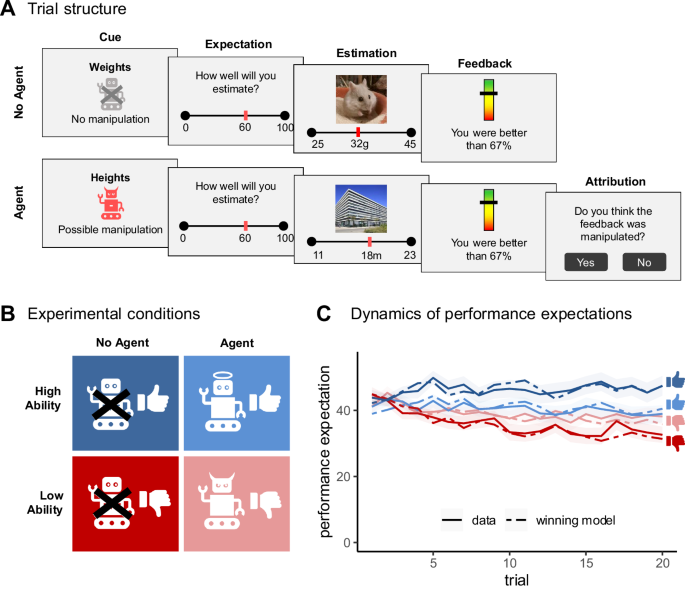
To investigate this, we built on an experimental task developed in our lab called the LOOP (Learning Of Own Performance) task. In this task, participants repeatedly complete estimation tasks. For example, they might be asked to estimate the weight of an animal and then receive feedback such as: “You were better than 45% of the reference group.” After receiving the feedback, participants indicate how well they expect to perform on the next trial. Repeating this cycle, or loop, across many trials allows us to track how beliefs about one's own abilities change in response to feedback over time. For this study, however, we needed something extra: an external source participants could blame when feedback seemed “too good” or “too bad” to be true. This led to the idea of a little robot friend (or foe).
I designed a “computer agent” that occasionally manipulated feedback outcomes. Participants saw an icon on trials where the agent had the opportunity to interfere with the feedback. Importantly, the icon did not mean that manipulation had actually occurred: on some of these trials the feedback was altered, whereas on others it was left unchanged. Participants' task was to decide whether the feedback they had just received had been manipulated. The agent came in two versions: a little angel robot that could improve outcomes, and a devil robot that could worsen them. The robots introduced a crucial ambiguity: if feedback could be externally manipulated, would participants still use it to update beliefs about themselves?
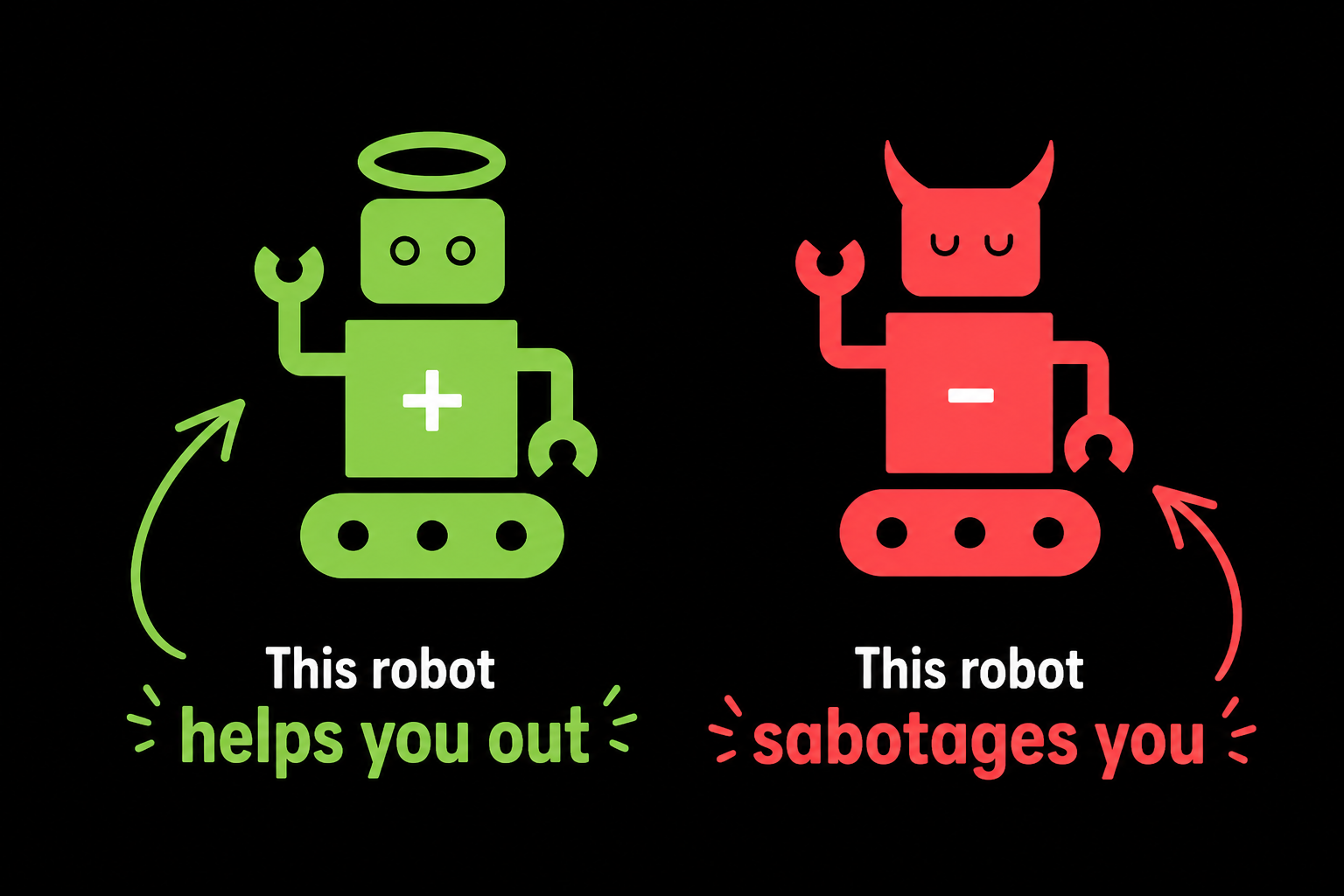
By combining this paradigm with computational modeling, we were able to quantify how people integrated (or discounted) self-related feedback depending on whether they believed it reflected their own performance or the actions of the “agent.” We could also test whether participants with higher self-reported levels of depression and low self-esteem would more readily dismiss good feedback as a manipulation by the “agent”, as suggested by classic psychological research.
When feedback changes beliefs – and when it doesn't
The experiment uncovered three important insights. First, the results of the computational modeling confirmed that attributions matter. The model that best explained participants' learning behavior was the one that incorporated their trial-by-trial judgments about whether the feedback reflected their own performance or the intervention of the agent. Participants did not simply learn from all feedback equally. Instead, they discounted feedback that they believed had been manipulated by the robot. On average, feedback influenced their performance expectations only about half as much when they thought it came from the agent rather than from their own actions.
Second, we replicated a pattern that our lab has observed in several previous studies. Participants with lower self-esteem and higher levels of depressive symptoms showed a stronger negativity bias in learning. In other words, worse-than-expected feedback had a greater impact on their beliefs about themselves than better-than-expected feedback. When forming expectations about their future performance, they tended to learn more from setbacks than from successes.
The third finding was perhaps the most interesting. Participants with higher self-esteem showed what has been called a self-serving attributional bias. When they received feedback that was better than expected, they were more likely to view it as reflecting their own ability. When they received worse-than-expected feedback, they were more likely to attribute it to the external agent and discount its relevance. In contrast, participants with lower self-esteem did not show this pattern. They were less likely to claim positive outcomes as evidence of their ability and less likely to dismiss negative outcomes as externally caused.
Why negative self-beliefs can be so hard to change
Taken together, these findings help explain how negative self-views can develop and persist. People differ not only in how strongly they learn from positive and negative experiences, but also in how they explain where those experiences came from in the first place. Individuals with low self-esteem or higher depressive symptoms appear to face a double challenge: negative feedback carries more weight when updating their self-beliefs, while positive feedback is less likely to be interpreted in a self-enhancing way.
More broadly, our results suggest that attributions of success and failure actively shape how people learn about themselves from moment to moment. By combining computational models with experimental manipulations of feedback, we can begin to quantify these processes and better understand how everyday experiences contribute to the maintenance of self-beliefs that help people thrive – or hold them back.
Behind the scenes
One detail that never makes it into the methods section is our ongoing competition to sneak pets into our figures. Previous papers featured a dog and a cat; this time my hamster Minni made an appearance. If you look carefully through the paper, you'll find her helping us visualize the study methods. We're already discussing which pet will appear next.
The study also had an unexpected side effect: it made some of the authors notice attributional patterns in their own lives. Two co-authors sometimes compete in a football simulation video game. After spending months thinking about how people explain successes and failures, they realized that they were doing exactly the same thing. Every misplaced pass, missed shot, or defensive mistake was quickly attributed to a faulty controller, lag, or the game's infamous “devil robot” that secretly sabotages performance. Yet every beautiful goal was naturally interpreted as evidence of exceptional skill. Curiously, when the other player scored a beautiful goal, the explanation often involved the game's equally mysterious “angel robot” stepping in to help them out. In other words, they found themselves taking credit for their own successes while finding remarkably creative explanations for both their failures and their opponent's achievements. Whether this represents an additional attributional strategy remains an open question, but perhaps that will be another paper.

I study how people make sense of social experiences and how those experiences shape the stories they tell about themselves. I am a postdoctoral researcher and a psychotherapist in training.
Follow the Topic
-
Communications Psychology
An open-access journal from Nature Portfolio publishing high-quality research, reviews and commentary. The scope of the journal includes all of the psychological sciences.

Introducing: Social Science Matters
Social Science Matters is a campaign from the team at Palgrave Macmillan that aims to increase the visibility and impact of the social sciences
Continue reading announcementRelated Collections
With Collections, you can get published faster and increase your visibility.
Replication and generalization
Publishing Model: Open Access
Deadline: Dec 31, 2026
Stress and Health
Publishing Model: Open Access
Deadline: Nov 30, 2026