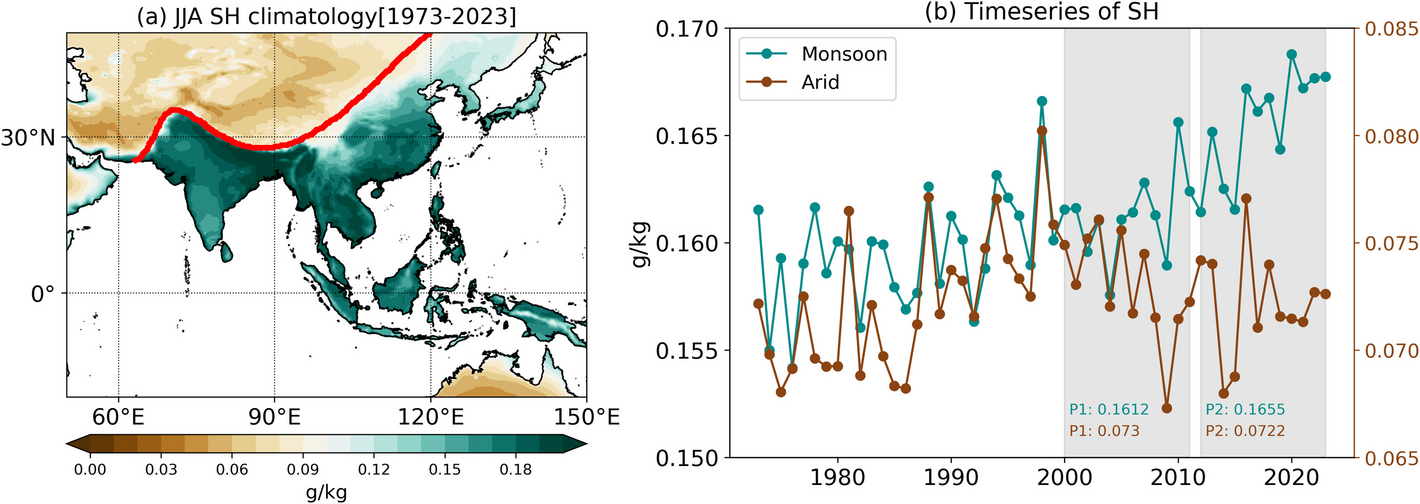

Asia has always lived between the monsoon and the desert, but this year the contrast turned into a spectacle. In July, torrential rain fell on South Korea’s southern provinces—Gwangju alone received more than 400 millimeters in a single day, the heaviest in eight decades. Streets turned to rivers, basements to traps, and the air hung so thick that the heat felt like it was steaming from within. A few thousand kilometers away, parts of Kazakhstan and Turkmenistan, including Ashgabat, were reaching 41 - 43°C1, 2, dry and relentless—the kind of heat that cracks earth and silences birds. What tied these opposites together, a new study argues, is not chaos but physics.
The research, published this month in Climatic Change, draws on five decades of modern global weather data to show that Asia’s climate is splitting along a clear line: the humid heat of the monsoon realm rising fast, and the dry heat of the continental interior intensifying on its own terms. The work is led by Dr. Jina Park, a recent Ph.D. - graduated from the Gwangju Institute of Science and Technology, now at Seoul National University with international research team including coauthors from Kasetsart University in Thailand, the Korea Advanced Institute of Science and Technology, the APEC Climate Center, and Japan’s Institute of Science Tokyo—a truly cross-Asian collaboration reflecting the scale of the question.
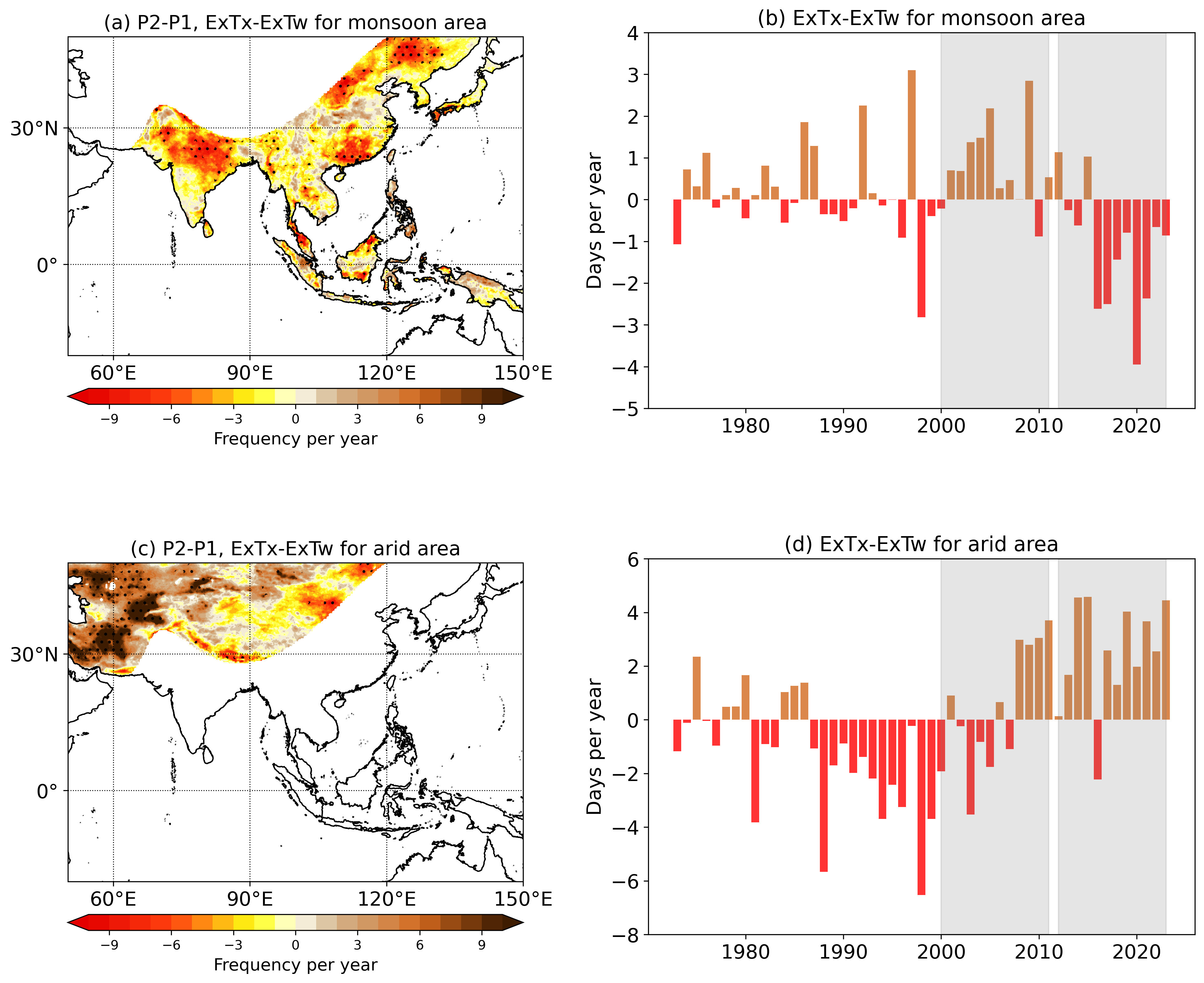
Changes in Tmax-based vs. Tw-based heatwave events between P1 and P2.
Park explains that the analysis distinguishes between traditional “hot-day” extremes, defined by maximum temperature, and the newer metric of “wet-bulb” extremes, which combine temperature and humidity into a measure of physiological stress. “We found that in the humid monsoon belt, the number of days when the body can no longer effectively cool itself has nearly doubled,” she said. “At the same time, arid regions are heating faster in absolute temperature, but with little rise in humidity. It’s as if one half of Asia is drowning in heat, while the other is desiccating.”
The paper’s maps show why. Over the past twenty years, the oceans surrounding Asia have warmed sharply, feeding more moisture into monsoon circulations. That moisture piles into South and East Asia, where sea-to-land winds have strengthened, driving both rainfall and wet-heat extremes. Inland, where those winds fade, the air dries. The result is two kinds of danger shaped by the same planetary energy imbalance.
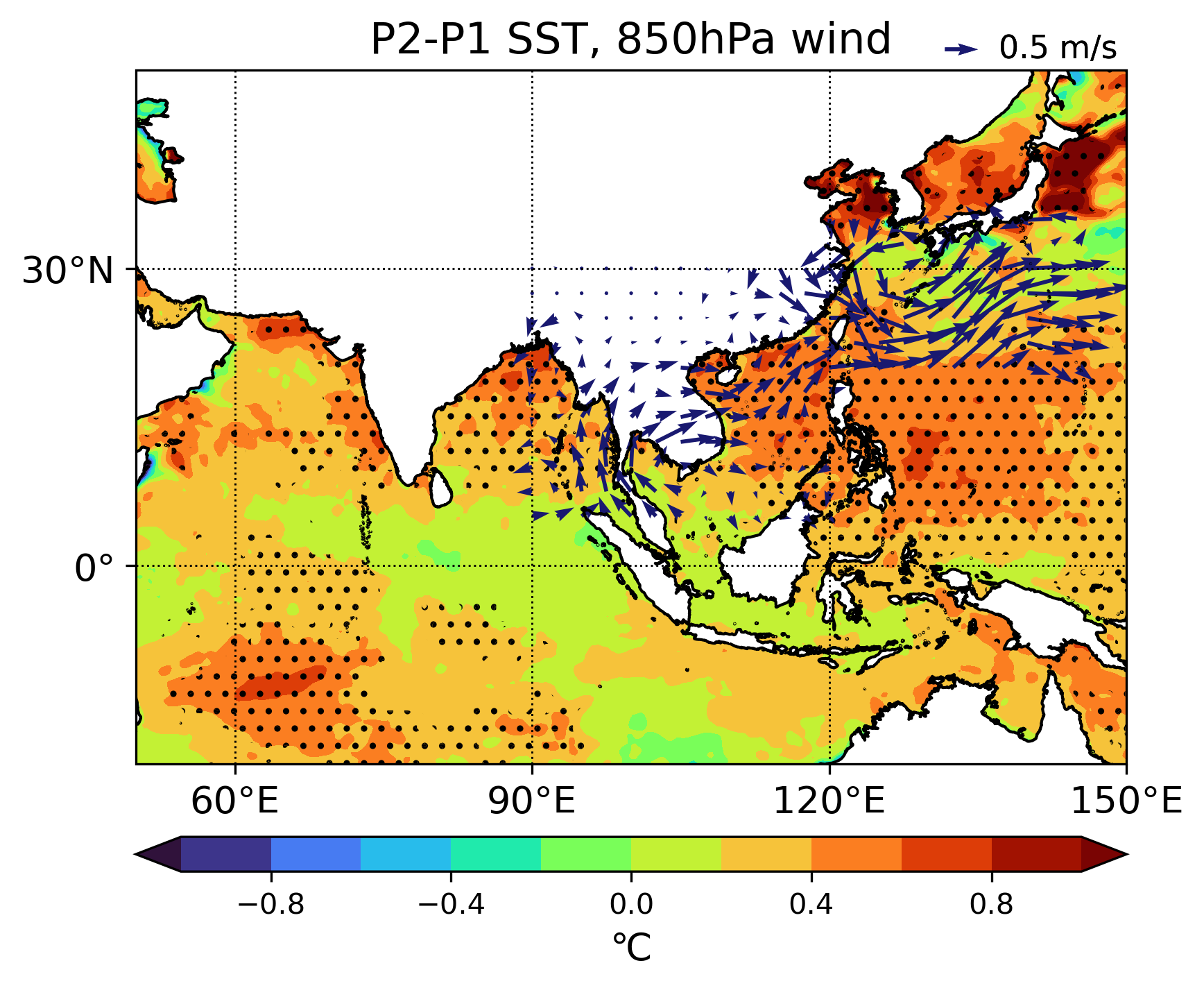
SST anomaly and 850hPa wind change, P2-P1.
“People talk about global warming as though it’s a uniform layer over the planet,” said Jin-Ho Yoon, the project’s senior author. “But what we’re observing is a redistribution of moisture—and that matters more than temperature alone.” Hyungjun Kim of KAIST added that the divergence explains why nations facing the same warming trend are experiencing opposite problems: flooding in Seoul and Fukuoka, power outages from heat stress in Iran3.
For Jina Park, this year’s events were a vivid validation. “The Korean floods and the Iran heatwaves didn’t surprise us,” she said. “They’re the lived expression of what our data show—a continent dividing its heat into two forms, humid and dry.”
The lived consequences are already shaping policy conversations. In South Korea, emergency planners are reviewing drainage designs after consecutive monsoon floods overwhelmed stormwater systems. In Thailand and Vietnam, public-health agencies are testing heat-index warnings based on wet-bulb temperature rather than air temperature alone. And in India’s western states, crop-insurance models are being recalibrated to account for the combined toll of extreme heat and evaporative loss. What once felt like separate challenges—flood, drought, heat—are now understood as connected outcomes of the same shifting climate pattern.
The team avoids alarmist tones, choosing instead to frame their findings as a call for nuance. Humid-heat risk, they note, requires very different adaptation strategies from dry-heat risk. Cooling centers and ventilation save lives in the former; shading and hydration in the latter. Urban planning, health systems, and early-warning networks must now treat these extremes as distinct species of the same evolving climate.
This year, the weather wrote their theory in real time. When Seoul’s July air felt heavy enough to wring, and when the Thar Desert shimmered like glass under the sun, the continent was enacting the physics the team had quantified. “The story isn’t one of apocalypse,” Kim said, “but of contrast. The air over Asia is learning new behaviors. We just need to watch and listen.”
1 https://en.tengrinews.kz/news_overview/heatwave-triggers-storm-warnings-across-16-regions-in-268727/
3 https://apnews.com/article/iran-heatwave-climate-shutdown-1de38b7e10f5145a2065f72cd7fc84ba

Follow the Topic
-
Climatic Change
This journal is dedicated to the totality of the problem of climatic variability and change - its descriptions, causes, implications and interactions among these.