When two COVID-19 treatments go head-to-head: what NHS data can teach us
Published in Research Data, General & Internal Medicine, and Pharmacy & Pharmacology





Both drugs target a part of the immune system called interleukin-6 (IL-6), a signalling protein that plays an important role in inflammation. In severe COVID-19, the immune response itself can become harmful, contributing to lung injury and critical illness. Blocking IL-6 became an important strategy for treating patients with severe disease.
But one important question remained unresolved: was one drug better than the other?
Our new study (funded in part by a National Institute for Health Research Professorship) used routinely collected healthcare data from England and Scotland to compare the effectiveness of tocilizumab and sarilumab among more than 10,000 adults hospitalised with COVID-19 during the Delta and Omicron waves of the pandemic.
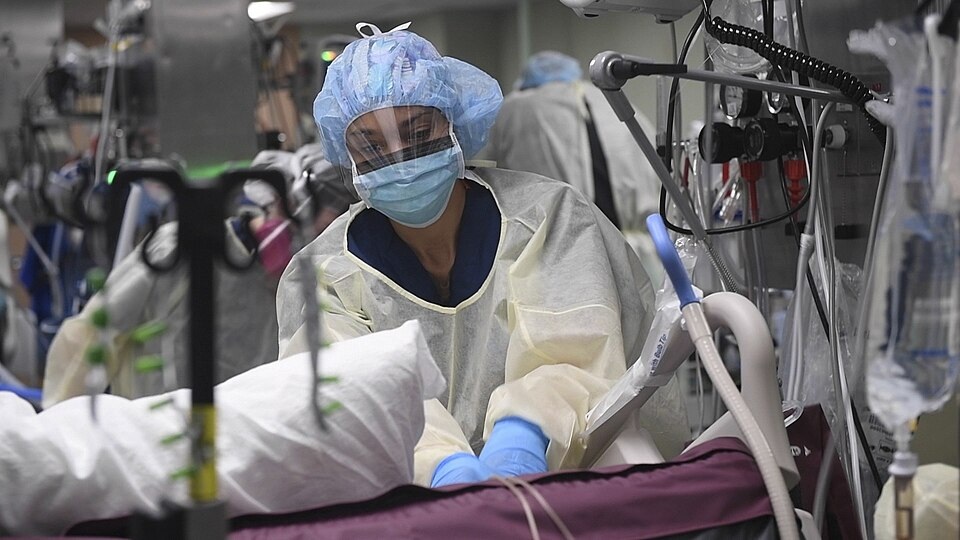
Healthcare worker caring for a patient during the COVID-19 pandemic. Image: Sara Eshleman / US Navy / Wikimedia Commons (Public Domain).
A real-world comparison during the pandemic
Clinical trials had already shown that IL-6 inhibitors could improve outcomes for patients with severe COVID-19. However, direct comparisons between tocilizumab and sarilumab were limited, particularly during later phases of the pandemic when vaccination programmes were widespread and new SARS-CoV-2 variants had emerged.
To address this gap, we used a method called target trial emulation. Instead of conducting a new randomised trial, we used linked electronic healthcare records to recreate as closely as possible the conditions of a hypothetical clinical trial.
The study analysed data separately across two major UK research platforms:
- OpenSAFELY in England
- EAVE II in Scotland
Together, these platforms allowed secure analysis of pseudonymised healthcare records at national scale while protecting patient privacy.
What did we find?
The overall finding was reassuringly clear: we found no meaningful difference between the two drugs.
In England, around one in five patients died within 28 days regardless of whether they had been treated with tocilizumab or sarilumab. Scotland showed a very similar pattern. After accounting for differences in age, underlying health conditions, vaccination status, deprivation, and other factors, there was still no evidence that one drug performed better than the other.
We also found:
- no difference in time to discharge from hospital,
- no evidence that one drug worked better in vaccinated versus unvaccinated patients,
- no major differences during the Delta compared with Omicron waves,
- and no clear differences across age groups, sex, ethnicity, obesity, or underlying health conditions.
These findings support the idea that both IL-6 inhibitors can be considered similarly effective options for treating severe COVID-19 in hospital settings.
Why replication across nations matters
One of the major strengths of this work was the ability to replicate findings independently across England and Scotland.
The English analyses used OpenSAFELY-TPP data linked to hospital admissions, deaths, testing, vaccination, and national COVID therapeutics records. The Scottish analyses used the EAVE II platform, which links prescribing, hospitalisation, laboratory testing, vaccination, and mortality data across almost the entire Scottish population.
Importantly, the analyses were conducted separately within each nation’s data environment rather than simply pooling all the records together. Despite differences in healthcare systems, coding structures, and data sources, the findings were remarkably consistent.
That consistency matters scientifically. Reproducibility across independent datasets strengthens confidence that results are robust and not simply artefacts of one particular database or health care system.
The power of collaboration
This study also highlights the value of collaboration during and after the pandemic. In our paper, researchers from epidemiology, statistics, clinical medicine, pharmacy, public health, and data science worked together across multiple institutions in England and Scotland, including the London School of Hygiene & Tropical Medicine, the University of Bristol, the University of Oxford, Public Health Scotland, the University of Edinburgh, and the University of Strathclyde. These large-scale collaborations which became the norm during the pandemic and have accelerated the quality and speed of large data linkage studies, often with replication across the devolved nations.
Why rapidly linked therapeutics data mattered
A crucial ingredient in this research was the availability of linked COVID-19 therapeutics data.
During the pandemic, the NHS rapidly developed dedicated datasets recording COVID-19 treatments prescribed across England. These datasets could then be securely linked to primary care records, hospital admissions, laboratory testing, vaccination histories, and mortality data. This linkage infrastructure created a uniquely powerful resource for evaluating how treatments were used and how well they worked in routine clinical care.
More broadly, the work demonstrates the value of investing in secure, privacy-protecting health data systems that can support rapid research during public health emergencies but also how routine evaluation of drug safety and efficacy is feasible within existing NHS structures.
Why guideline differences mattered
One reason this study was important is that international clinical guidelines did not fully agree on the role of sarilumab.
The World Health Organization (WHO) COVID‑19 living guideline has continued to recommend both tocilizumab and sarilumab as equivalent treatment options for severe or critical COVID-19.
In contrast, UK guidance initially recommended sarilumab mainly when tocilizumab was unavailable, but later removing the recommendation for sarilumab because of its off-label status.
These differences partly reflected differences in the available evidence. Tocilizumab had been studied more extensively in randomised trials, whereas fewer head-to-head data were available for sarilumab.
This highlights an important challenge in evidence-based medicine. Randomised controlled trials remain the gold standard for evaluating treatments, but they do not always provide complete answers to every clinically important question. During rapidly evolving situations such as a pandemic, trials may end before new variants emerge, before vaccination changes the population context, or before enough evidence accumulates for all relevant treatment comparisons.
In these situations, carefully designed real-world evidence studies can play an important complementary role.
Real-world evidence cannot completely replace randomised trials, and observational studies always carry some risk of residual confounding. However, when robust linkage systems, transparent methods, replication across populations, and multiple sensitivity analyses all point toward the same conclusion, these studies can provide valuable evidence to support clinical guidance and healthcare decision-making.
Looking beyond the pandemic
Although the acute phase of the pandemic has passed, COVID-19 still causes severe illness and hospitalisation in vulnerable groups.
This study provides evidence that tocilizumab and sarilumab appear similarly effective for patients hospitalised with severe COVID-19 during the Delta and Omicron periods. But it also tells a broader story about the future of clinical evidence generation.
The pandemic accelerated the development of secure, large-scale health data platforms capable of answering urgent clinical questions rapidly and at national scale. Studies like this demonstrate how linked healthcare data, analysed carefully and transparently, can complement traditional clinical trials and help inform clinical care in real-world settings.

Follow the Topic
-
Nature Communications
An open access, multidisciplinary journal dedicated to publishing high-quality research in all areas of the biological, health, physical, chemical and Earth sciences.

Related Collections
With Collections, you can get published faster and increase your visibility.
Women's Health
Publishing Model: Hybrid
Deadline: Ongoing
Tumor Microenvironment Crosstalk and Therapeutic Implications
Publishing Model: Hybrid
Deadline: Nov 02, 2026