Where Can Hyperscale Data Centers Still Be Built in the United States?
Published in Earth & Environment, Computational Sciences, and Statistics
The rapid expansion of hyperscale data centers is placing growing pressure on electricity systems, land, and climate-sensitive infrastructure alike. While maps of existing facilities are now available, a more fundamental question remains unresolved: where can additional hyperscale data centers still be built under present-day physical and infrastructural constraints?
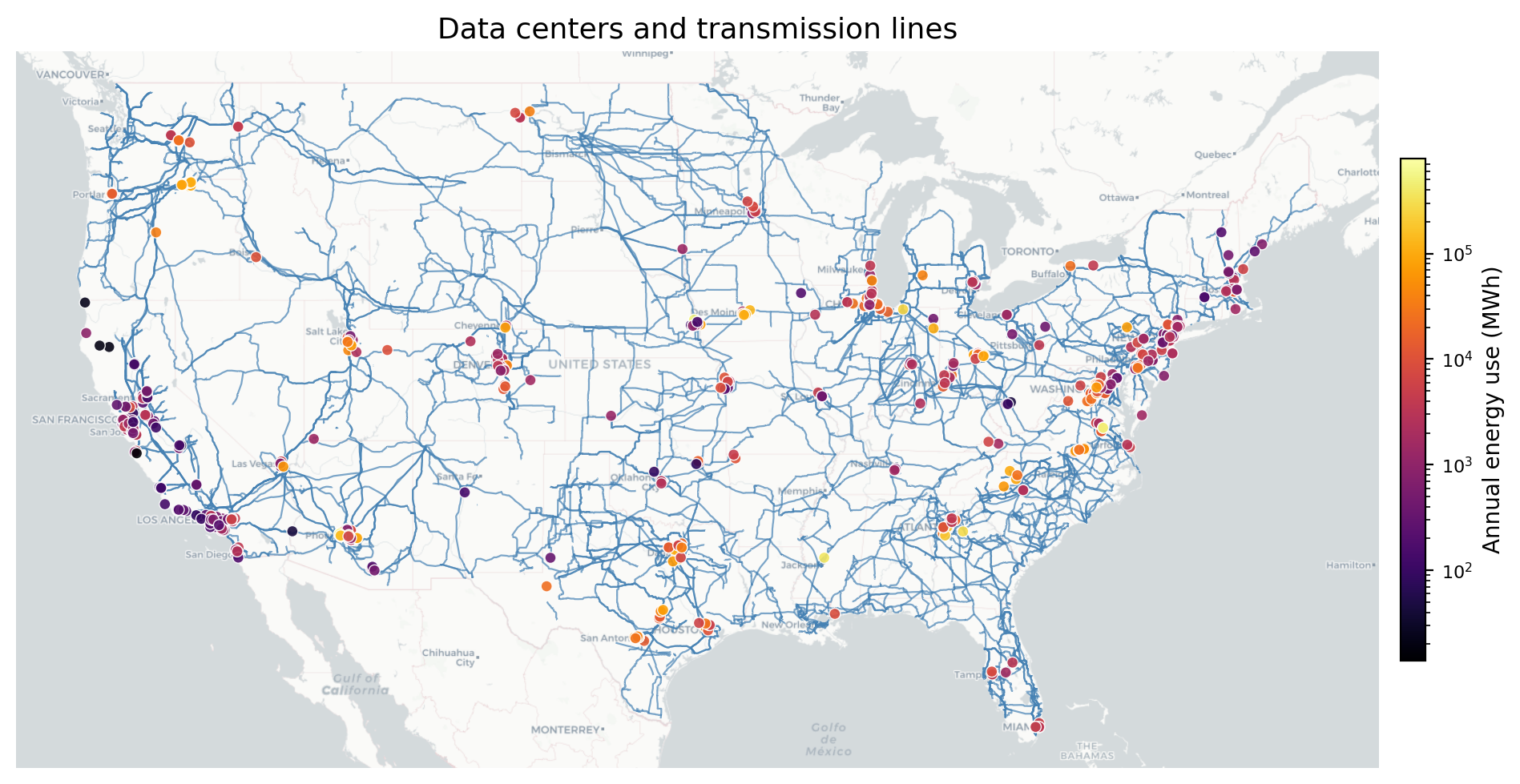
In a new arXiv preprint, I approach this question using a constraint-first, national-scale geospatial framework using a dozen nation-wide high-resolution geospatial data set covering the US. Rather than forecasting demand or optimizing sites, the analysis infers feasibility from revealed hyperscale siting behavior, conditioned on power-grid adjacency, climate and cooling constraints, flood risk, land use, terrain, and regulatory proxies.
Two independent, unsupervised spatial methods — both calibrated exclusively on existing hyperscale environments — converge on a limited feasible land envelope. Translating this envelope using observed hyperscale power densities suggests that total physically feasible U.S. hyperscale capacity lies in the tens of gigawatts rather than the hundreds, under current infrastructure and siting patterns.
These estimates should be interpreted as physical and infrastructural ceilings, not forecasts of construction or investment. Substantially exceeding these bounds would likely require structural changes to the energy system, regulatory environment, or prevailing data center siting practices.
Full paper (arXiv): https://arxiv.org/pdf/2602.02529

With a background in physics and biophysics, Milan earned his PhD in network and data science in 2020. He studied and researched at the Eötvös Loránd University and the Central European University in Budapest, at the Barabási Lab in Boston, and the Bell Labs in Cambridge. He was selected as Forbes 30u30 in 2020. He is an NFT sales contributor on SuperRare and Foundation, an alumni at Eötvös Collegium, and a regular columnist at Qubit and the Data Visualization Society. His first book titled DATA debuted with OpenBooks.
Milan is the current chief data scientist at Baoba. Previously, he was the chief data scientist and co-founder of Datapolis, a research affiliate at the Central European University, a research expert at the European Commission, and a senior data scientist at Maven7.
He was awarded the Scholarship of the Republic of Hungary three times, won multiple prizes at science competitions, and presented his work in peer-reviewed journals and conferences from Nature’s Scientific Reports to MIT.
His work has been featured in Nature Social Science Research, GQ, Times Higher Education, New Scientist, New York Times, TechXplore, The Economic Times, Fossbytes, Futurism, The Times, Towards Data Science,Phys.org, Nightingale, Gamestar, 99 Data Influencers to Follow 2023, the Miami Art Week, and more.