Why Birth Order Matters When Studying Sex Ratios at Birth
Published in Social Sciences, Public Health, and Paediatrics, Reproductive Medicine & Geriatrics
Explore the Research
Checking your browser - reCAPTCHA
Checking your browser before accessing pubmed.ncbi.nlm.nih.gov…
A national statistic can tell us that a demographic pattern exists.
But sometimes, the most important part of the story appears only when we ask a more specific question:
Does the pattern change depending on how many children a family already has?
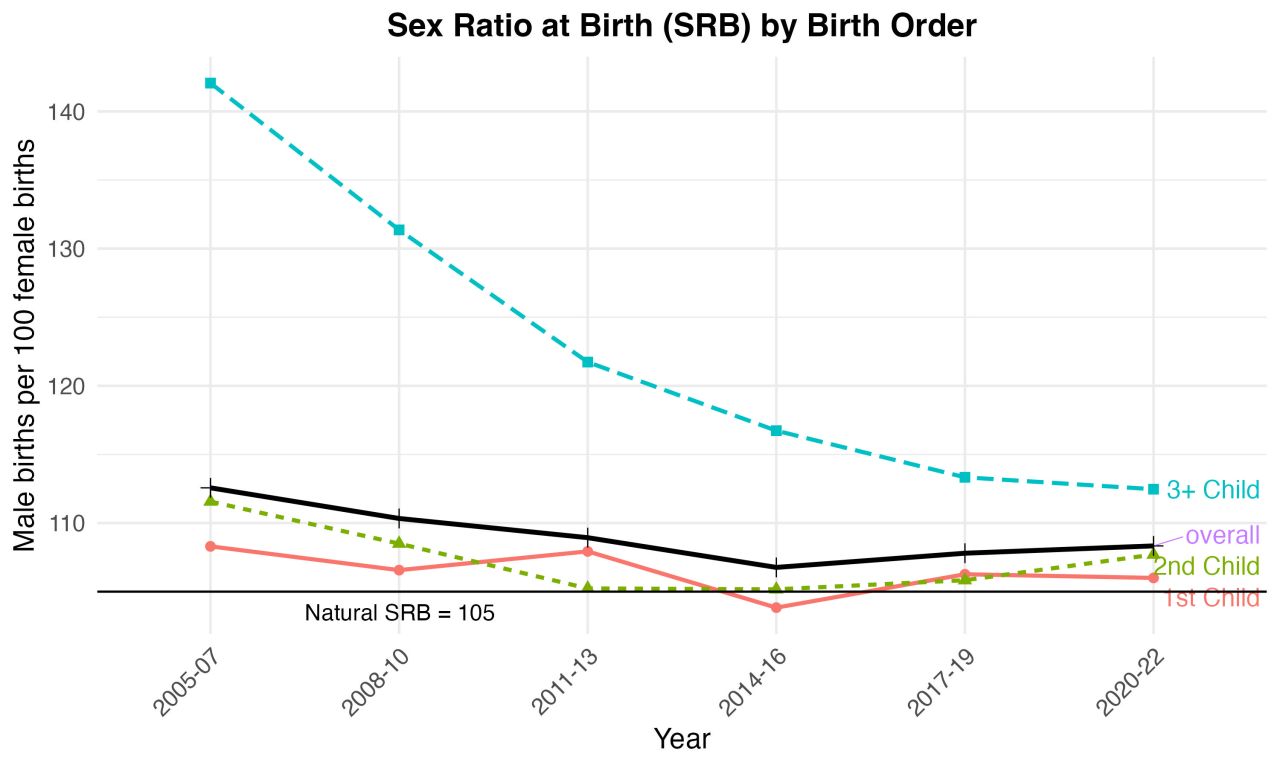
This became an important question in our research on the sex ratio at birth in Georgia.
The sex ratio at birth is commonly expressed as the number of boys born per 100 girls. At the population level, a moderate excess of male births is biologically expected. However, substantial and persistent deviations from the expected range may point to the influence of social, demographic, or reproductive factors.
Looking only at the national sex ratio, however, can conceal important differences.
That is why we examined the data by birth order.
The results were particularly striking among third and subsequent births.
Between 2005 and 2022, the sex ratio among third and subsequent births in Georgia declined from 145.7 boys per 100 girls to 114.3.
The magnitude of this change immediately raised another question:
Why would birth order matter?
One possible explanation lies in the relationship between reproductive preferences and family composition. If families have a strong preference for having a son, the likelihood of continuing childbearing may depend partly on the sex of children already born.
This creates an important demographic mechanism.
A family with two daughters may approach a subsequent pregnancy differently from a family that already has a son and a daughter. Consequently, the sex composition of previous children may become relevant when studying patterns observed at later birth orders.
Importantly, birth-order patterns should not be interpreted as evidence of a single cause.
They are signals.
They tell us where to look more closely.
They can point toward the possible interaction of gender preferences, desired family size, reproductive decision-making, social norms, and the availability and use of technologies that can provide information about fetal sex during pregnancy.
For me, this was one of the most valuable lessons from the analysis:
Demographic data become much more informative when we stop treating every birth as an isolated event.
A birth is also part of a reproductive history.
And reproductive history matters.
Studying birth order therefore helped us move beyond the question of whether the sex ratio at birth in Georgia was unusually high.
It encouraged us to ask a more nuanced question:
How does the demographic pattern change across different reproductive pathways?
That distinction matters.
Because when a population-level pattern is concentrated in particular birth orders, the numbers may be telling us something not only about births, but about the decisions and expectations surrounding them.
And once again, the data did not provide the final answer.
They showed us where the next question should be asked.

Public health researcher and lecturer working across reproductive health, demography, health policy, and health systems. My research explores sex ratios at birth and sex-selective practices in Georgia, alongside broader interests in research methodology and evidence-informed health policy.