Why can a long-lived interface persist between fully miscible fluids?

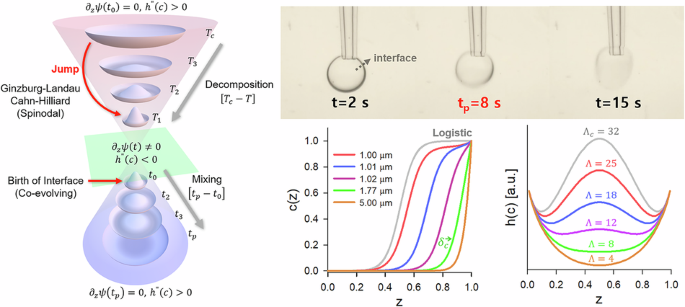

In our recent work, we introduce the Co-Evolving Variational First Principle (CVFP) to explain the emergence, persistence, and eventual decay of long-lived interfaces in fully miscible fluids.
The key idea is that the interfacial concentration field does not evolve on a fixed thermodynamic landscape. Instead, the Euler–Lagrange solution and the underlying free-energy landscape co-evolve self-consistently as a coupled pair. This hidden variational structure gives rise to optimal nonequilibrium pathways through a sequence of quasi-stationary states.
The framework reveals a dual structure between interfacial enthalpy and concentration-gradient energy, explains why long-lived miscible interfaces can form, and predicts their lifetime quantitatively across different fluid systems. It provides a unified description of the birth, persistence, broadening, and rupture of miscible interfaces within a first-principles variational framework.
The universal law behind long-lived interfaces in fully miscible fluids
Communications Physics 9, 300 (2026)
DOI: 10.1038/s42005-026-02869-0

Follow the Topic
-
Communications Physics
An open access journal from Nature Portfolio publishing high-quality research, reviews and commentary in all areas of the physical sciences.

Related Collections
With Collections, you can get published faster and increase your visibility.
Nonlinear dynamics of living systems
Publishing Model: Open Access
Deadline: Nov 09, 2026
Active, Entangled or Confined: Polymer Physics Across Synthetic and Living Matter
Publishing Model: Open Access
Deadline: Dec 31, 2026