Why study the genetics of intelligence?
Published in Social Sciences, Genetics & Genomics, and Behavioural Sciences & Psychology


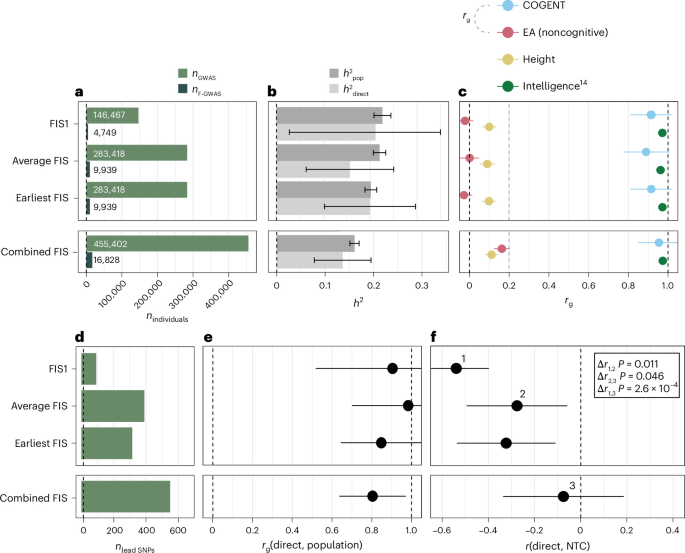

“Drinking coffee and eating cheese are associated with intelligence.” That was the newspaper headline that caught the attention of a radio producer, who approached me about an interview on our new study. We had used more than 80 variables, including information about what people ate and drank, to create ‘virtual’ intelligence test scores for people who had not taken the test. This increased our dataset from around 280,000 to more than 455,000 participants with DNA measures. When I explained that our study did not show that drinking coffee or eating cheese makes you smarter (correlation ≠ causation), the radio producer was no longer interested in doing the interview. We had just published the largest study on the relationship between our DNA and intelligence, but the question that sparked public interest was quite a different one: how can we improve our intelligence?
It is very hard to improve your intelligence. Practising an intelligence test can raise your score, but that does not mean you have improved your cognitive abilities in general. People get better at specific things they practise, with little evidence that this makes them generally smarter. The two activities with good evidence for cognitive benefits overall are education and physical exercise. Education is a sustained activity that, when done well, trains your brain and builds your knowledge. A large meta-analysis found that an additional year of schooling increased intelligence test scores by approximately one to five points, with benefits detectable well into adulthood. Physical exercise has also been shown to improve cognition in adulthood, which makes sense, as the brain is part of the body and depends on it for a steady supply of oxygen and nutrients. This is all considering everyone grows up in a healthy environment to begin with. Improving impoverished environments in early childhood has been shown to produce lasting cognitive benefits.
If there is one thing you can’t improve, it’s your genetics. So why are we so interested in the genetics of intelligence then? Genetics can help us understand how the brain develops and why that development sometimes goes wrong. Identifying genetic variants associated with cognitive abilities shows us where to look for clues about the biological processes involved. We understand relatively little about how the brain makes someone more or less intelligent or why intelligence shares genetic influences with a range of mental health problems. In some cases, puzzlingly, higher intelligence is genetically associated with a higher risk of mental health conditions, such as with autism and anorexia. The larger sample we created helped us identify many more genetic associations, including rare variants with much larger effects than common ones. Some were in genes already known to be involved in neurodevelopmental conditions, yet their effects on intelligence were apparent even in people without a diagnosis.
There is one more fundamental reason why I am interested in the genetics of intelligence, which also helps explain why people are so interested in how to improve their intelligence. We live in societies that strongly reward intelligence. These rewards take the form of educational opportunities, jobs, and income, and are reflected in socio-economic status. The traits that help people attain these rewards have a heritable component. Educational attainment and income are the main measures we use to study socio-economic status. They capture largely the same genetic signal, about half of which is shared with cognitive abilities. Society sorts people into different social layers with different living circumstances. This influences where people move, whom they have children with, how many children they have, and how long they live, which are the main processes that systematically influence the genetic make-up of populations across generations. By rewarding (or punishing) heritable traits in this way, society brings genetic and environmental differences together in a way that can increase social inequalities and makes genetic and environmental influences harder to disentangle.
This also makes intelligence a sensitive and sometimes controversial topic. People care about their intelligence and often seem to link it to a person’s worth, much as society seems to do with socio-economic status. This can become especially toxic when the discussion turns to differences between populations. There are researchers who devote much of their careers to arguing that genetic differences in intelligence explain why some “races” are better than others, with much of this work financed by a white supremacist organisation. They show contested world maps of IQ scores and their correlations with economic prosperity, treating these patterns as evidence of genetic causes. Such maps, however, cannot tell us why populations differ. The same geographic patterns appear when we map access to education, childhood malnutrition, and exposure to infectious diseases, all of which causally affect cognitive development. The Flynn effect, the substantial rise in intelligence test scores across generations, provides further evidence of the importance of environmental conditions. During this same period, educational attainment increased as the educational system improved, even while genetic effects associated with education moved in the opposite direction.
There is much more to learn about intelligence than we currently understand. Why do seemingly different abilities, such as remembering words, solving mathematical problems, and mentally rotating objects, tend to go together? And why are these abilities associated with mental health, sometimes in unexpected ways? Genetics can help us investigate what connects these outcomes at a deep level and how that relates to the way our societies are organized. And perhaps, along the way, we may even become a little smarter by educating ourselves about our intelligence.
Follow the Topic
-
Nature Genetics
This journal publishes the very highest quality research in genetics, encompassing genetic and functional genomic studies on human and plant traits and on other model organisms.

Related Collections
With Collections, you can get published faster and increase your visibility.
Mechanisms and impact of 3D genome organisation
Publishing Model: Hybrid
Deadline: Nov 30, 2026
Human Admixture and Migration
Publishing Model: Hybrid
Deadline: Feb 28, 2027


