Why Water Motion Matters for Drug Binding ?
Published in Chemistry, Physics, and Pharmacy & Pharmacology



The invisible partner in molecular recognition.
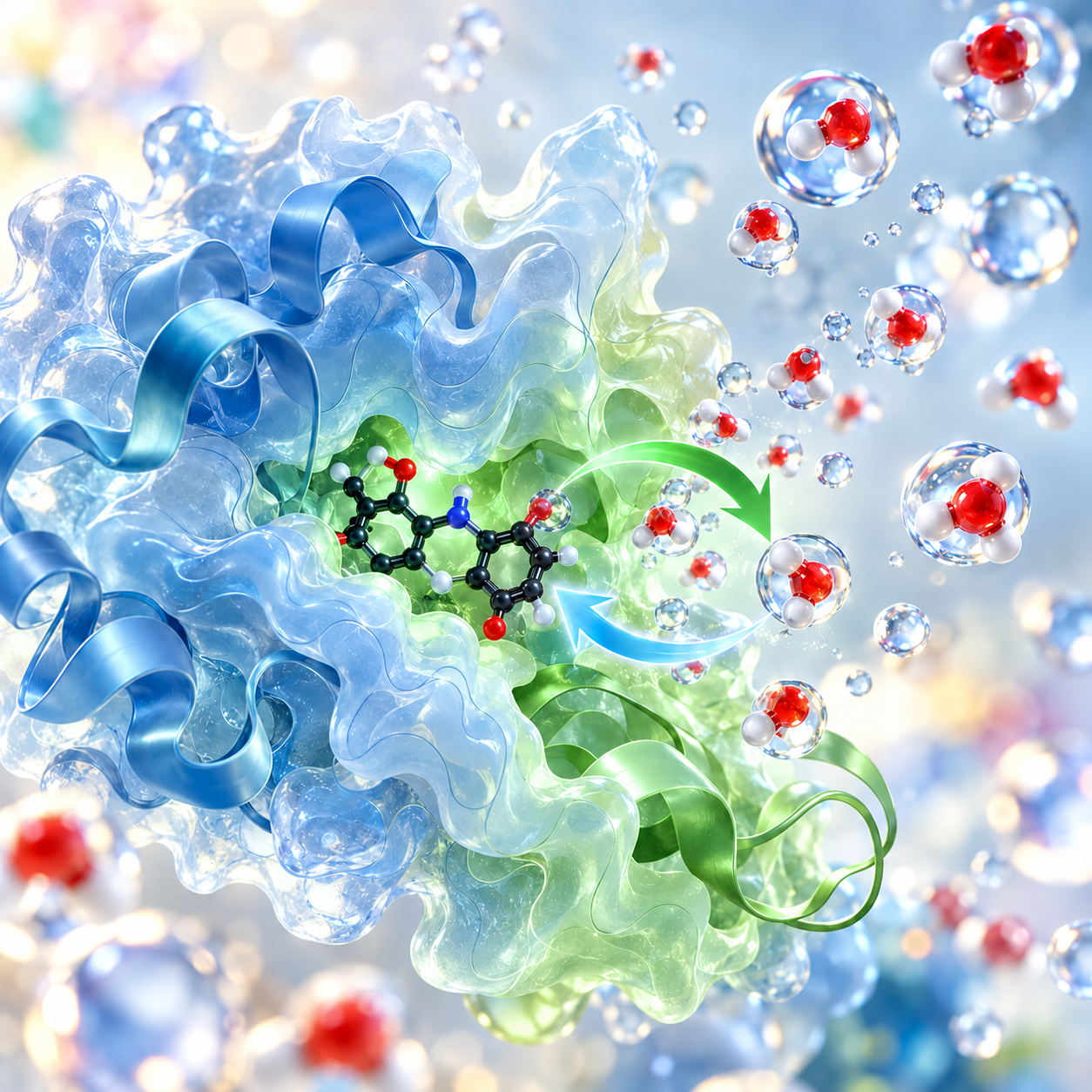
A ligand rarely enters a dry, empty binding pocket. Before binding occurs, the cavity is already occupied by water. Some of these molecules are displaced when the ligand arrives, while others remain and complete interactions that the ligand and protein cannot form directly. In deeply buried pockets, a small number of waters may become sufficiently persistent to behave almost like structural components of the binding site.
Their contribution is not necessarily favourable or unfavourable by itself. A ligand may establish strong contacts with the protein but still pay an energetic cost for displacing or reorganizing water. Conversely, retaining a well-positioned water molecule may stabilize the complex by connecting polar groups through a hydrogen-bond network.
This makes binding-site hydration both important and difficult to simulate. A site can remain continuously hydrated even when individual water molecules exchange rapidly with bulk solvent. In another pocket, a buried water may remain trapped for longer than an ordinary molecular dynamics simulation can observe. Consequently, a calculated free energy may appear stable even though the surrounding solvent has explored only a limited set of configurations.
In our Communications Chemistry study, Enhanced Sampling Enables Binding Site Water Reorganization in Polarizable Absolute Binding Free Energy Calculations, we therefore asked two connected questions: can we accurately predict binding affinity, and does the calculation reproduce the physical behaviour of water inside the binding site?
Turning binding into a controllable process
Absolute binding free energy describes how strongly a ligand prefers the protein-bound state over the unbound state in solution. Observing enough spontaneous binding and unbinding events in a conventional simulation is generally impractical, particularly for buried ligands, because these events can occur on very long timescales.
Alchemical calculations provide a different route. Rather than waiting for the ligand to physically leave the pocket, we gradually modify how strongly it interacts with its surroundings. A coupling parameter called lambda, or λ, controls this transformation. At one end of the pathway, the ligand interacts fully with the protein and solvent. At the other, its electrostatic and van der Waals interactions have been switched off in a controlled manner.
This transformation also creates an opportunity for the surrounding water to respond. As the ligand’s steric and electrostatic influence changes, previously inaccessible regions of the pocket can become available to solvent. When the interactions return, the water network should reorganize toward the states favoured by the bound complex.
Giving the solvent time to respond.
Our framework [1, 2] combines several complementary components. Lambda-ABF treats λ as a continuous dynamical variable. The adaptive biasing force estimates the mean force along this coordinate and progressively reduces the barriers that prevent the system from moving between different stages of the alchemical transformation.
OPES-Explore adds an adaptive bias that promotes broader exploration of the alchemical pathway. Multiple walkers run in parallel and share accumulated mean-force information, improving sampling and allowing us to determine whether the same solvent response appears in independent trajectories.
These biases act on λ. They do not directly force a water molecule to enter or leave a particular site. Instead, repeated exploration of the alchemical pathway gives water, ligand, and protein motions that are coupled to λ more opportunities to relax. This distinction is important: the method facilitates solvent reorganization without prescribing the number, position, or identity of the water molecules involved.
A distance-to-bound-configuration restraint keeps the weakly interacting ligand within the physically relevant bound region, preventing it from drifting into unrelated orientations while the pocket rehydrates. Water atoms are excluded from this restraint, leaving them free to exchange with the surrounding solvent.
The simulations also use the AMOEBA polarizable force field as implemented in the Tinker-HP software [3, 4]. Unlike a fixed-charge model, AMOEBA allows the molecular charge distribution to respond to changes in the local environment. This is particularly relevant for confined water networks, where electric fields and hydrogen-bond patterns evolve as the ligand’s interactions are modified.
Five complexes and many forms of hydration.
We applied the approach to five protein–ligand complexes containing buried or semi-buried hydration sites: the second bromodomain of TAF1, major urinary protein I, the BRD9 bromodomain, and two HSP90-alpha complexes.
Together, these systems cover a spectrum of solvent environments, ranging from sites that communicate readily with bulk water to tightly confined networks embedded within a binding pocket. Across the five complexes, the calculated binding free energies agreed closely with experimental measurements. The simulations also showed that the apparently simple description “hydrated” can correspond to very different molecular mechanisms.
A stable hydration site does not always contain the same water
The TAF1 bromodomain provides a particularly clear example. Its semi-buried pocket contains two crystallographic hydration sites, referred to as W1 and W2. At W1, the original crystallographic water remained associated with the site for most of the 100-ns conventional simulation. W2 also remained hydrated, but through repeated replacement by different water molecules.
The hydration architecture of the pocket can therefore persist without preserving the identity of every water molecule within it. An average occupancy measurement might describe both sites as hydrated, whereas water-identity tracking reveals the difference between long residence and continuous molecular exchange.
The alchemical simulations exposed another aspect of this behaviour. Reducing the ligand’s steric interactions temporarily opened additional space for water to enter the pocket. As stronger ligand–environment interactions returned, hydration became more localized around the polar environment of the binding site. Comparable responses appeared across the independent walkers, showing that the wetting and reorganization were reproducible features of the sampled pathway rather than isolated events in a single trajectory.
When buried water becomes part of the binding architecture
Major urinary protein I provides a contrasting example because its ligand sits inside a deeply enclosed pocket with limited access to the surrounding solvent. Within this cavity, two neighbouring water molecules help connect the ligand to the protein. The first is held in place by hydrogen-bonding groups on the pocket wall, while the second is stabilized through its interactions with both the ligand and the first water.
These waters therefore behave as a cooperative unit rather than as independent solvent molecules. Together with the surrounding protein groups, they form an organized polar bridge that helps stabilize the ligand inside the pocket.
The simulations also showed how local chemistry controls this organization. Water remained tightly localized near the polar region of the pocket but explored a broader and more transient range of configurations near the hydrophobic region. The method could therefore distinguish structurally persistent water interactions from more dynamic solvent behaviour within the same binding site.
Looking beyond the calculated free-energy number.
Agreement with experiment is essential, but it is not sufficient to establish that a binding free-energy calculation has sampled the correct molecular mechanism. We therefore examined site occupancy, water identity, coordination numbers, λ-dependent hydration, agreement among independent walkers, and the local interactions that stabilize persistent water networks.
These analyses help distinguish a genuinely persistent water from a hydration site maintained through rapid exchange. They can also expose a trapped or incompletely reorganized solvent configuration even when the free-energy profile itself appears converged.
This distinction matters for ligand design. Introducing or removing a functional group can determine which waters are displaced, which remain as bridges, and how easily the pocket exchanges solvent with its surroundings. Reliable predictions therefore require these competing hydration states to be explored rather than assumed in advance.
Our results show that, when solvent rearrangement is sufficiently coupled to the alchemical transformation, water exchange and pocket rehydration can emerge without introducing a water-specific collective variable. Additional coordinates may still be necessary when solvent access depends on very slow protein conformational changes that are only weakly connected to λ. Within the systems examined here, however, the framework captured both dynamic exchange in semi-buried sites and persistent cooperative networks in buried pockets while reproducing experimental binding affinities.
The central message is simple: water is not merely the background in which binding occurs, it is one of its actors. To trust a binding prediction, we must understand not only the final number, but also the water motions that give it physical meaning.
Check out our paper:
Enhanced Sampling Enables Binding Site Water Reorganization in Polarizable Absolute Binding Free Energy Calculations.
M. Blazhynska, N. Ansari, L. Lagardère, J.-P. Piquemal, Communications Chemistry, 2026, online (Open Access), DOI: 10.1038/s42004-026-02253-7
References
-
Lambda-ABF: Simplified, Accurate and Cost-effective Alchemical Free Energy Computations.
L. Lagardère, L. Maurin, O. Adjoua, K. El Hage, P. Monmarché, J.-P. Piquemal, J. Hénin, J. Chem. Theory Comput., 2024, 20 (11), 4481-4498
DOI: 10.1021/acs.jctc.3c01249
Free access preprint: arXiv:2307.08006 - Lambda-ABF-OPES: Faster Convergence with High Accuracy in Alchemical Free Energy Calculations
N. Ansari, F. Jing , A. Gagelin, F. Hédin, F. Aviat, J. Hénin, J.-.P. Piquemal, L. Lagardère, J. Phys. Chem. Lett., 2025, 16, 4626–4634
DOI: 10.1021/acs.jpclett.5c00683
Free access preprint: arXiv:2502.17233 - Tinker-HP: a Massively Parallel Molecular Dynamics Package for Multiscale Simulations of Large Complex Systems with Advanced Polarizable Force Fields.
L. Lagardère, L.-H. Jolly, F. Lipparini, F. Aviat, B. Stamm, Z. F. Jing, M. Harger, H. Torabifard, G. A. Cisneros, M. J. Schnieders, N. Gresh, Y. Maday, P. Ren, J. W. Ponder, J.-P. Piquemal, Chemical Science, 2018, 9, 956-972 (Open Access)
DOI: 10.1039/C7SC04531J - Tinker-HP : Accelerating Molecular Dynamics Simulations of Large Complex Systems with Advanced Point Dipole Polarizable Force Fields using GPUs and Multi-GPUs systems.
O. Adjoua, L. Lagardère, L.-H. Jolly, Arnaud Durocher, Z. Wang, T. Very, I. Dupays, T. Jaffrelot Inizan, F. Célerse, P. Ren, J. Ponder, J-P. Piquemal, J. Chem. Theory Comput., 2021, 17, 4, 2034–2053 (Open Access)
DOI: 10.1021/acs.jctc.0c01164
Follow the Topic
-
Communications Chemistry
An open access journal from Nature Portfolio publishing high-quality research, reviews and commentary in all areas of the chemical sciences.

Related Collections
With Collections, you can get published faster and increase your visibility.
Synthetic approaches to carbon nanomaterials
Publishing Model: Open Access
Deadline: Nov 30, 2026
Synthetic Catalysts for Biomedicine and Biotechnology
Publishing Model: Hybrid
Deadline: Dec 31, 2026