World Obesity Day 2026: 8 Billion Reasons to Act on Obesity
Published in Healthcare & Nursing, Sustainability, and General & Internal Medicine





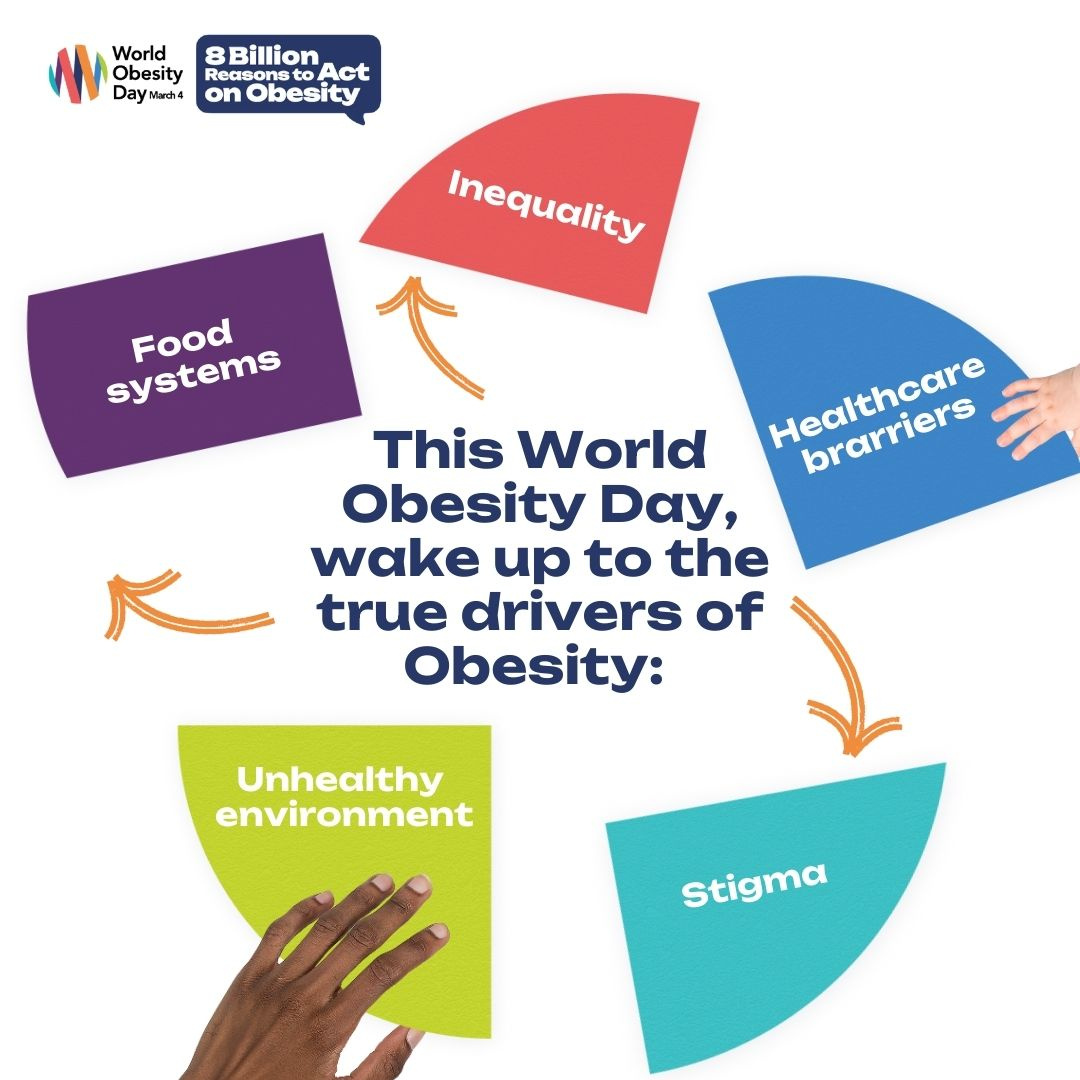 By 2035, half of the world’s population, around 4 billion people, are expected to be living with overweight or obesity. Poverty, stigma, unequal access to education and healthcare, limited availability of healthy food, and environments that do not support healthy living all shape risk and outcomes across the life course.
World Obesity Day 2026 is a call to action for all 8 billion of us. Together, we can change the story of obesity.
Highlights from Springer Nature journals
Mental Health
Research in this category calls attention to the influence of mental health on obesity and vice versa. A systematic review explores the relationship between obesity phenotypes and mental health issues, suggesting that obesity, especially with metabolic issues, is linked to higher risks of mental health problems and lower quality of life. A prospective cohort study analysed data from 219,086 participants from the UK Biobank and found that obese individuals experiencing moderate to high levels of loneliness had a significantly increased risk of developing mental disorders.Together with a qualitative study showing how link workers can help people with severe mental illness overcome challenges to accessing weight management programs, these papers highlight the link between obesity outcomes and mental health.
Support models and interventions
These papers highlight practical, scalable approaches that can make a meaningful difference to obesity levels in populations. Sugar-sweetened beverage taxes have been implemented in various regions to combat obesity and chronic diseases. A recent study focused on Washington State’s 2009 soft drink syrup tax found that it led to a notable decrease in obesity rates, with reductions of 2.2 to 4.0 percentage points relative to a synthetic control group. Another study assessed the effects of a controlled intervention on the nutritional status and ultra-processed food consumption of children with obesity in Brazil. The results indicated a notable decrease in ultra-processed food intake among participants in the intervention group, underscoring the potential of structured dietary interventions. Collectively, they show the value of implementing interventions aimed at improving health outcomes.
Explore more research articles and books here.
Open collections calling for submissions
-
School-based Interventions to Prevent Childhood Overweight and Obesity This collection aims to to inform educators, policymakers, and health professionals about evidence-based practices that can be integrated into school curricula and environments to promote healthier lifestyles among students.
- Impact of ultra-processed foods on nutritional quality This collection aims to highlight robust research to inform dietary guidelines and public health interventions aimed at improving nutrition and health outcomes.
Collections to read again
ISRCTN The UK's Clinical Study Registry
 These studies explore innovative approaches designed to reduce obesity levels, from testing whether AI-powered personalised dietary advice is better than a general dietary advice at improving the health and dietary habits of individuals at higher risk of non-communicable diseases (ISRCTN12293803) to exploring what happens when supermarkets voluntarily restrict price promotions on unhealthy foods (ISRCTN23476580). Together, these studies highlight practical, evidence‑informed tools and strategies being developed to better support people living with obesity and to help prevent obesity in the first place by creating healthier food environments and more personalised, sustainable dietary guidance.
Springer Nature Research Communities
This Behind the Paper post outlines a study by Raubenheimer et al. in BMC Global and Public Health which analysed global interest in semaglutide for non-diabetic weight loss, revealing significant search trends from January 2021 to August 2023 across 27 countries, with notable peaks linked to media events.
The Lifestyle Innovations Based on Youth Knowledge and Experience (LIKE) project in Amsterdam used system dynamics to tackle youth obesity. This Behind the Paper post for the study in Health Research Policy and Systems outlines how Pinzon et al. look at applying a complex systems approach to the global issue of obesity.
Conclusion
If you want to get involved in World Obesity Day this year, you can visit the official website for tools and guidance to help you care for yourself every day, not just on WOD.

Before joining Springer Nature in 2021, Tamara completed an MBio in Biomedical Sciences at the University of Warwick and now manages a portfolio of fully open access journals focused on women's health and implementation science. In addition, she chairs the Springer Nature SDG3 (Good Health and Well-Being) working group.
Follow the Topic
-
BMC Global and Public Health
An open access, transparent peer review journal publishing outstanding and influential research and opinion of broad interest to all professional communities involved in global and public health research, policy-making, implementation and delivery worldwide.
-
BMC Primary Care
Previously known as BMC Family Practice, this is an open access, peer-reviewed journal that considers articles on all aspects of primary health care research.
-
BMC Nutrition
BMC Nutrition is an open access, peer-reviewed journal that considers articles on all aspects of nutritional sciences.
-
Health and Quality of Life Outcomes
This is an open access, peer-reviewed journal offering rapid publication and wide diffusion in the public domain of high-quality articles in the field of Health-Related Quality of Life (HRQOL).
-
Journal of Health, Population and Nutrition
This journal brings together research on all aspects of issues related to population, nutrition, and health. The journal publishes articles across a broad range of topics including global health, maternal and child health, nutrition, common illnesses, and determinants of population health.
-
Population Health Metrics
Population Health Metrics aims to advance the science of population health assessment, and welcomes papers relating to concepts, methods, ethics, applications, and summary measures of population health.
-
Health Economics Review
This is an international high-quality journal covering all fields of Health Economics. A broad range of theoretical contributions, empirical studies and analyses of health policy with a health economic focus will be considered for publication.
-
Health Research Policy and Systems
This journal covers all aspects of the organisation and use of health research – including agenda setting, building health research capacity, and how research as a whole benefits decision makers, practitioners in health and related fields, and society at large.
-
Diabetology & Metabolic Syndrome
This journal publishes articles on all aspects of the pathophysiology of diabetes and metabolic syndrome.
-
Reproductive Biology and Endocrinology
This journal publishes and disseminates high quality results from excellent research in the reproductive sciences.
-
Agriculture & Food Security
This is a peer-reviewed open access journal that addresses the challenge of food security.











Related Collections
With Collections, you can get published faster and increase your visibility.
Sleep health and primary care
Sleep health is a critical yet often overlooked aspect of overall well-being, particularly in the context of primary care. Sleep disorders, including insomnia and obstructive sleep apnea, can significantly impact patients' physical and mental health, leading to complications that may complicate primary care management. Sleep issues are becoming increasingly recognized for their chronicity, widespread prevalence, and influence on other chronic conditions. Therefore, understanding the relationship between sleep health and primary care practices is vital. This Collection aims to explore the intersection of sleep health and primary care, shedding light on innovative approaches to assessment and treatment.
Continued exploration in this area could pave the way for groundbreaking advancements in the management of sleep health care within primary care settings. As more research is conducted, we may see innovative approaches to screening and treating sleep disorders that can assist primary care providers in addressing these issues more effectively and efficiently. Future studies may also illuminate the impact of sleep health on chronic disease prevention and management, ultimately leading to a more holistic approach to patient care. By enhancing sleep health awareness among primary care providers, we can promote comprehensive care that acknowledges the crucial role of sleep.
We invite submissions on a range of topics that include, but are not limited to:
- Management of insomnia in primary care
- Management of obstructive sleep apnea in primary care
- The intersection between sleep disturbances and chronic disease
- Integrated behavioral health approaches to the management of sleep disorders
- Screening tools for sleep disorders in primary care
- Implementation of new models of care for sleep disorders
This Collection supports and amplifies research related to SDG 3: Good Health and Well-being.
All manuscripts submitted to this journal, including those submitted to collections and special issues, are assessed in line with our editorial policies and the journal’s peer review process. Reviewers and editors are required to declare competing interests and can be excluded from the peer review process if a competing interest exists.
Publishing Model: Open Access
Deadline: Jan 07, 2027
Ethics and regulation of AI in primary care
The integration of artificial intelligence (AI) into primary care is rapidly transforming healthcare delivery, enabling more personalized, efficient, and effective patient care. However, the ethical and regulatory challenges associated with the deployment of AI technologies in this context are multifaceted and require thorough examination. Issues such as patient privacy, data protection, informed consent, and the potential for algorithmic bias are at the forefront of discussions surrounding AI's role in healthcare. As AI systems increasingly influence clinical decision-making, understanding the ethical frameworks and regulatory requirements governing their use is essential for safeguarding patient rights and ensuring equitable access to healthcare services.
The significance of addressing the ethical and regulatory dimensions of AI in primary care lies in its potential to enhance patient trust and ensure that AI applications are developed and implemented responsibly. Recent advancements in AI have demonstrated its capabilities in improving diagnostic accuracy and streamlining administrative tasks; however, these benefits must be balanced with robust protections for patient data and ethical considerations regarding decision-making. Furthermore, the lack of comprehensive regulations can lead to inconsistencies in AI application and misuse, which could undermine public confidence in these technologies.
In this Collection, we welcome submissions that span a wide array of topics, including but not limited to:
- Ethical considerations in AI applications
- Data protection and patient privacy in AI
- Informed consent processes for AI use
- Regulatory frameworks for AI in primary care
All manuscripts submitted to this journal, including those submitted to collections and special issues, are assessed in line with our editorial policies and the journal’s peer review process. Reviewers and editors are required to declare competing interests and can be excluded from the peer review process if a competing interest exists.
Publishing Model: Open Access
Deadline: Jan 28, 2027



Please sign in or register for FREE
If you are a registered user on Research Communities by Springer Nature, please sign in