Feeding as a route of toxin entry in southern right whales
Published in Earth & Environment and Research Data

During the austral spring of 2022, a harmful algal bloom developed in Golfo Nuevo, located in Península Valdés, Argentina. What initially appeared to be a typical seasonal event rapidly escalated into a major ecological episode, coinciding with an unusual mortality of southern right whales and South American sea lions along the coast.
The video shown here captures southern right whales feeding at the surface in Golfo Nuevo just days before the first dead individuals were recorded. These observations are particularly relevant, as they provide insight into the mechanisms by which marine mammals may be exposed to toxins during harmful algal bloom events.
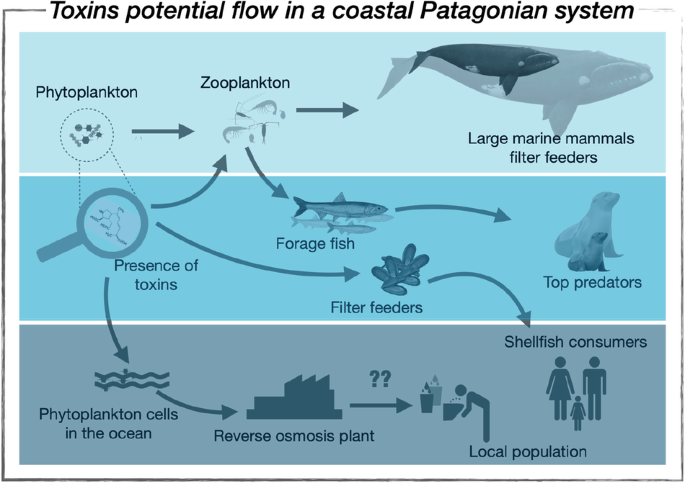
Harmful algal blooms are caused by certain species of phytoplankton capable of producing potent toxins. In this case, the bloom was dominated by dinoflagellates of the genus Alexandrium, known producers of paralytic shellfish toxins (PSTs), including saxitoxin. These toxins can be transferred through the marine food web, starting at the base with phytoplankton and moving upward through zooplankton and fish to reach top predators.
Southern right whales feed primarily on zooplankton, which can accumulate toxins during bloom events. As a result, their diet represents a key pathway for toxin exposure. The footage of whales actively feeding in the same area and time frame as the bloom highlights this connection between feeding activity and potential toxin intake.
Our research aimed to better understand how these toxins move through the ecosystem and how exposure occurs in marine mammals. By analyzing samples from different components of the food web—including phytoplankton, zooplankton, fish, and marine mammals—we were able to document the trophic transfer of toxins across multiple levels.
The findings of this study provide important field-based evidence of how microscopic organisms can have cascading effects on large marine vertebrates. They also highlight the importance of continued monitoring and interdisciplinary approaches to better understand the ecological and health implications of harmful algal blooms.
This video provides a visual representation of a key moment within this broader ecological context: the transfer of toxins to whales through their feeding.
Read the full study here
Learn more about this work in our Behind the Paper post

Follow the Topic
-
Communications Earth & Environment
An open access journal from Nature Portfolio that publishes high-quality research, reviews and commentary in the Earth, environmental and planetary sciences.

Related Collections
With Collections, you can get published faster and increase your visibility.
Ecological resistance and resilience under global change
Publishing Model: Open Access
Deadline: Apr 07, 2027
Hazards in Mountain Regions
Publishing Model: Open Access
Deadline: Nov 02, 2026