A billboard announced a carbon program
Published in Social Sciences and Ecology & Evolution



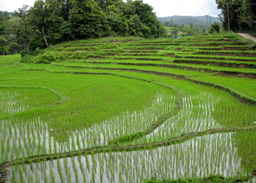
Driving through the forests and farmland of Western Pennsylvania, I saw an attractive billboard announcing a program where forest landowners could earn payments by allowing their trees to continue to grow and sequester carbon. Knowing that forests create many benefits for people other than their owner, it sounded like a great idea.
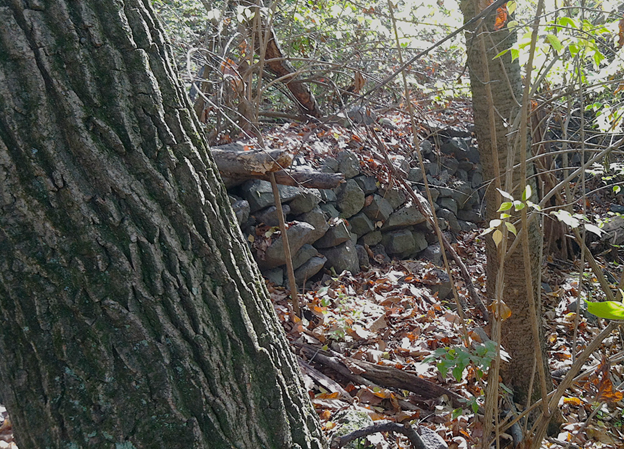
But forests and landowners vary enormously, something I first noticed as a boy wandering the woods behind our house in Eastern Pennsylvania. Stone fences that once bordered fields now ran through mature forests (pictured below). They revealed how land use and forest management evolved with shifting crop prices and rural livelihoods.
Several property lines crossed the hill as well, and the borders highlighted differences in management across owners, whose interests varied as much (or more than) the forests. One owner had towering trees but only cut fallen ones for firewood. Another dotted his forest with tree stands for deer hunting, showing hunting as a priority. Another never visited but had most of the trees harvested one year. Years later I purchased a small parcel of forestland and discovered much of the same on the other side of the state: each of the neighboring parcels and owners had a unique story, much of which is reflected in the trees present—their age, their size and shape, and their species.
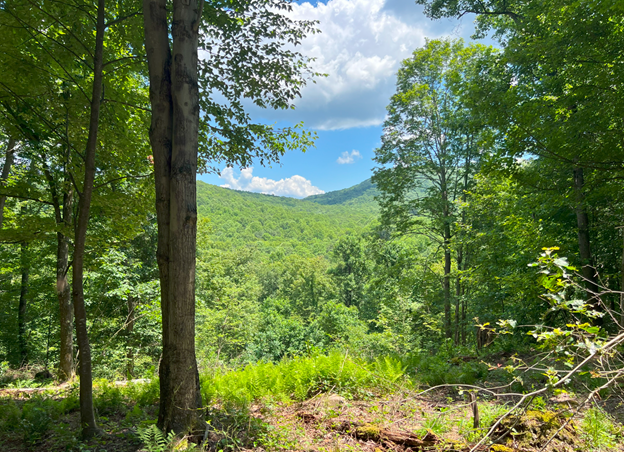
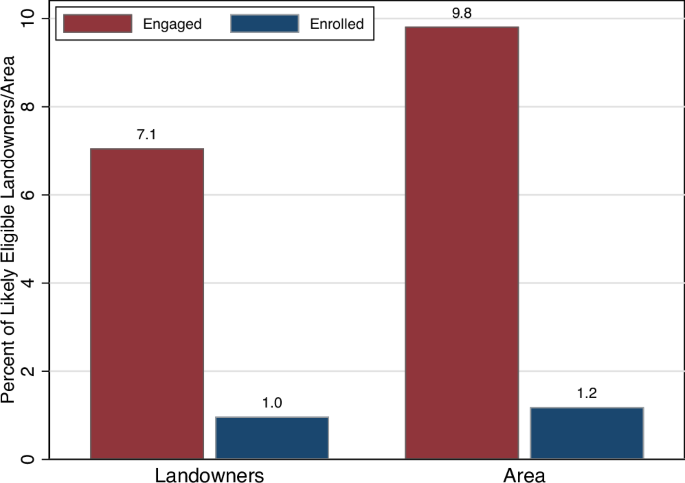
These experiences shaped how I saw the challenge of designing a carbon program. Thanks to the American Forest Foundation, myself and co-authors (Yucheng Wang, Natalia Mushegian, Raphael Calel, and Adam Usmanov) could systematically assess engagement and enrollment in the Family Forest Carbon Program. Our analysis shows that many likely eligible landowners remain unsure whether carbon contracts fit them or their land—at least at current payment levels. That could change as awareness grows and contract terms evolve. What we’ve learned so far is only the beginning.

Jeremy G. Weber is professor at the University of Pittsburgh Graduate School of Public and International Affairs. He teaches and researches public policy, especially the policy and economics of environmental and energy issues. He is the author of Statistics for Public Policy: A Practical Guide to Being Mostly Right (or at Least Respectably Wrong) (University of Chicago Press).
Follow the Topic
-
Communications Earth & Environment
An open access journal from Nature Portfolio that publishes high-quality research, reviews and commentary in the Earth, environmental and planetary sciences.

Related Collections
With Collections, you can get published faster and increase your visibility.
Ecological resistance and resilience under global change
Publishing Model: Open Access
Deadline: Apr 07, 2027
Hazards in Mountain Regions
Publishing Model: Open Access
Deadline: Nov 02, 2026