A Closer Look at Neurabin I in Neurodevelopmental Disorders
Published in Microbiology, Neuroscience, and Cell & Molecular Biology




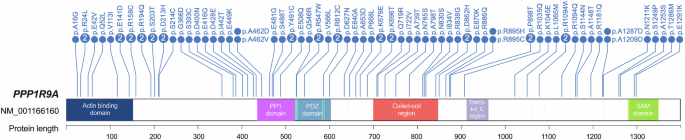

Every year, advances in genomic sequencing identify hundreds of genes associated with neurodevelopmental disorders. Yet discovering a candidate gene is often only the beginning. The much harder question comes afterward: what does that gene actually do?
When we began working on PPP1R9A, this was exactly the question we wanted to answer.
PPP1R9A encodes Neurabin I, a neuron-specific scaffolding protein involved in synapse formation, cytoskeletal organization and neuronal signaling. Over the years, rare variants have repeatedly appeared in individuals with developmental delay, autism spectrum disorder, intellectual disability, and epilepsy. Genetic evidence was accumulating, but biological evidence was not. Like many genes emerging from modern sequencing studies, PPP1R9A had become genetically interesting long before its role in human neurons was understood.
That uncertainty became the motivation for our study.
Rather than asking whether PPP1R9A was associated with neurodevelopmental disorders, we wanted to understand how reduced Neurabin I affects developing human neurons. To answer this, we generated a CRISPR-engineered human induced pluripotent stem cell model carrying a heterozygous loss-of-function mutation and differentiated these cells into cortical neurons.
One of the first surprises appeared under the microscope.
The neurons looked remarkably elaborate, perhaps even more complex than we had expected. Larger cell bodies, extensive neuritic branching, and long neuronal processes suggested that differentiation had proceeded successfully. At first glance, there seemed to be little indication that reducing Neurabin I had fundamentally altered neuronal development.
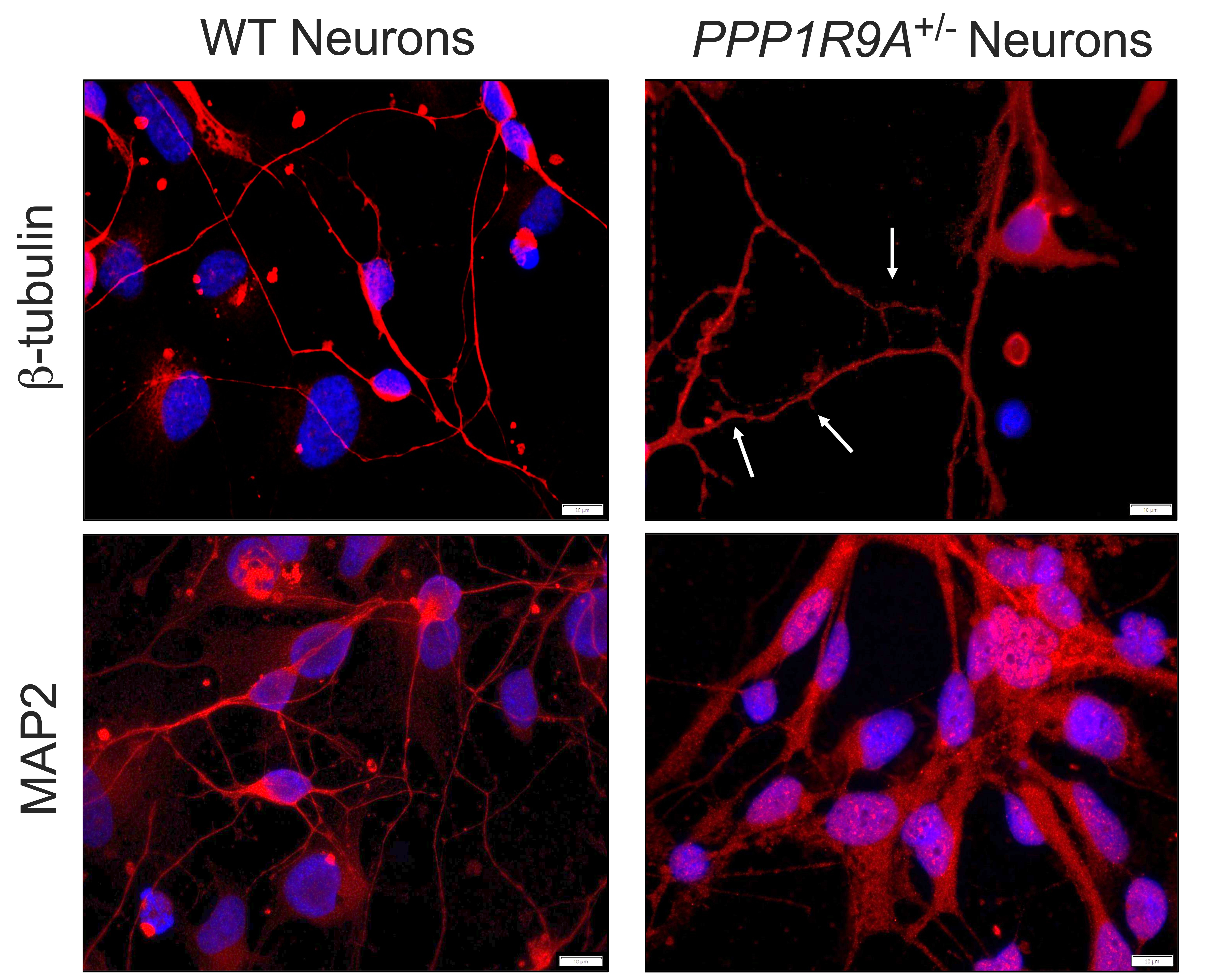
The neurons looked remarkably well developed, but morphology told only part of the story. Representative immunofluorescence images of wild type and PPP1R9A+/− human cortical neurons stained for βIII-tubulin and MAP2.
That impression changed completely once we stopped looking at the neurons and started listening to them.
Whole-cell patch-clamp recordings revealed that significantly fewer PPP1R9A-deficient neurons generated action potentials. Those that did displayed impaired sodium channel recruitment, altered action potential kinetics, and reduced excitability. The apparent contradiction immediately caught our attention. How could neurons that looked structurally mature perform so poorly?

Looking beyond morphology. Whole-cell patch-clamp recordings revealed that significantly fewer PPP1R9A+/− neurons generated action potentials, demonstrating impaired neuronal excitability despite their elaborate morphology.
This paradox became one of the defining moments of the project. It also reminded us why functional studies remain so important. Morphology alone could not explain the biology. To understand what was happening, we needed to look deeper.
Proteomic profiling began to provide answers. Although several structural and postsynaptic proteins were increased, many proteins required for neuronal communication, including the sodium channel subunit SCN3B, presynaptic vesicle proteins, calcium signaling molecules and the AMPA receptor subunit GRIA1, were markedly reduced. Rather than representing enhanced maturation, the increased structural complexity appeared to reflect an imbalance between neuronal growth and functional synaptic development.
"Neuronal complexity did not translate into neuronal function."
Long-read single-cell transcriptomics helped complete the picture. Instead of affecting every neuronal population equally, PPP1R9A deficiency preferentially disrupted cortical excitatory neurons and neural progenitor cells.
Looking back, it was rewarding to see how each experiment added another piece to the puzzle.
Then the next challenge was, could these defects be reversed? To answer this, we tested two complementary therapeutic strategies: restoring full-length PPP1R9A expression and selectively degrading mutant transcripts using allele-specific antisense oligonucleotides (ASOs). While ASO treatment produced only partial molecular recovery, restoring full-length PPP1R9A resulted in broad normalization of transcriptomic and proteomic signatures, including ion channel expression and synaptic signaling pathways.
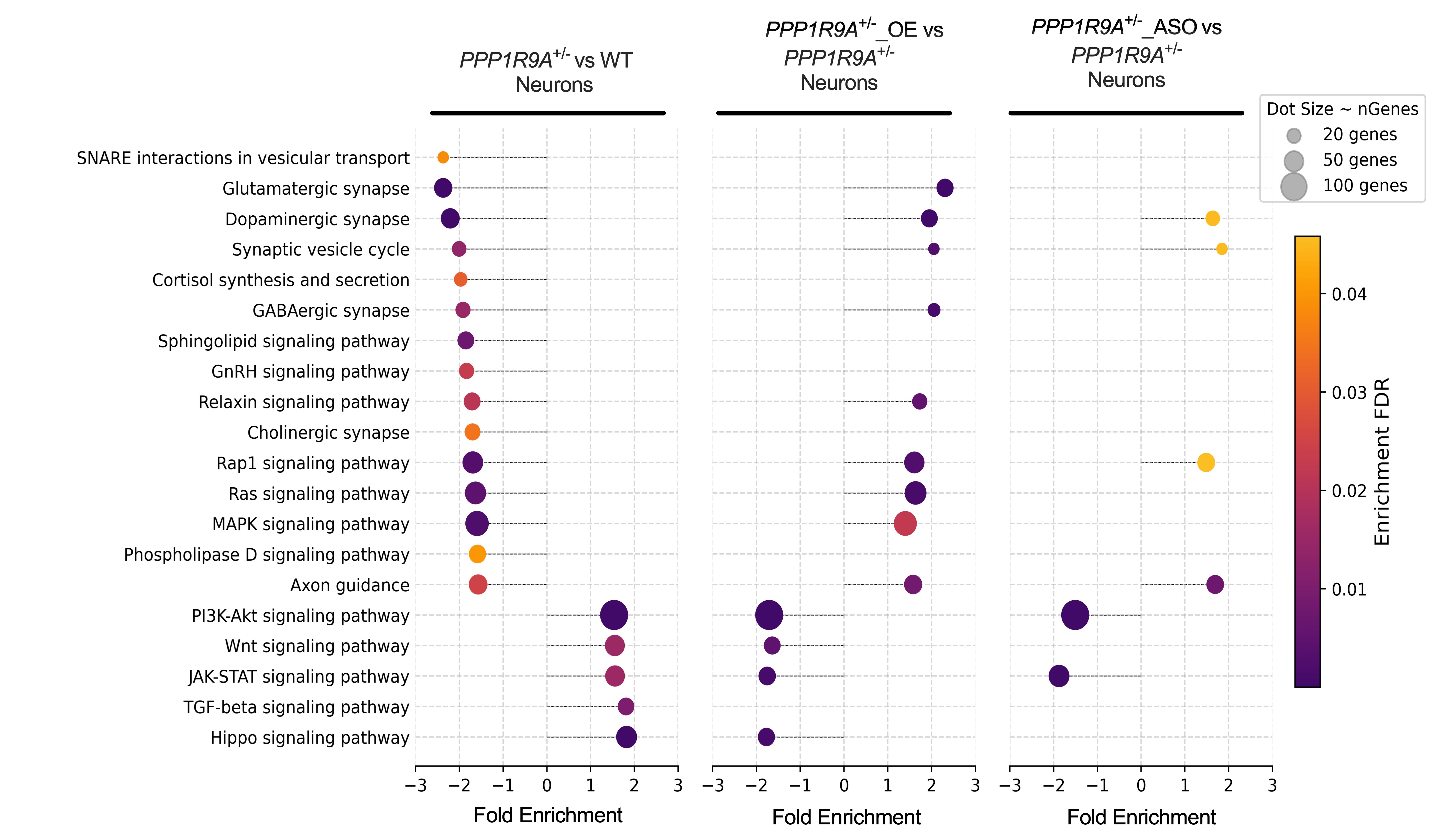
The molecular landscape reflected what we observed in the neurons. PPP1R9A deficiency altered signalling pathways central to neuronal function, many of which responded to therapeutic intervention.
Looking back, what began as a single genetic question evolved into a much broader understanding of PPP1R9A biology. Each stage of the project raised new questions, often taking us in directions we had not anticipated. The neurons challenged our first impressions, electrophysiology revealed a hidden functional deficit, proteomics explained an unexpected paradox, and long-read single-cell transcriptomics identified the cellular states most affected by Neurabin I deficiency. By the end of the study, we were no longer asking whether PPP1R9A was involved in neurodevelopmental disorders but were beginning to understand how.
In many ways, this reflects a broader challenge in human genetics. Modern sequencing technologies continue to identify candidate genes for neurodevelopmental disorders at an extraordinary pace, yet establishing their biological relevance remains a major bottleneck. Functional studies in human models are becoming increasingly important, not only for understanding disease mechanisms but also for improving variant interpretation and identifying potential therapeutic opportunities.
For PPP1R9A, our study provides an important step towards defining the biological role of Neurabin I in human cortical neuron development. More broadly, it demonstrates how integrating human stem cell models with genome engineering, electrophysiology and multi-omic approaches can transform genetic observations into mechanistic insight. As more candidate genes emerge from genomic studies, we hope this work illustrates the value of moving beyond gene discovery to understand the biology that ultimately drives neurodevelopmental disease.

Follow the Topic
-
Molecular Psychiatry
This journal publishes work aimed at elucidating biological mechanisms underlying psychiatric disorders and their treatment, with emphasis on studies at the interface of pre-clinical and clinical research.