A Highly Permeable and Three-Dimensional Integrated Electronic System for Wearable Human–Robot Interaction
Published in Bioengineering & Biotechnology and Materials
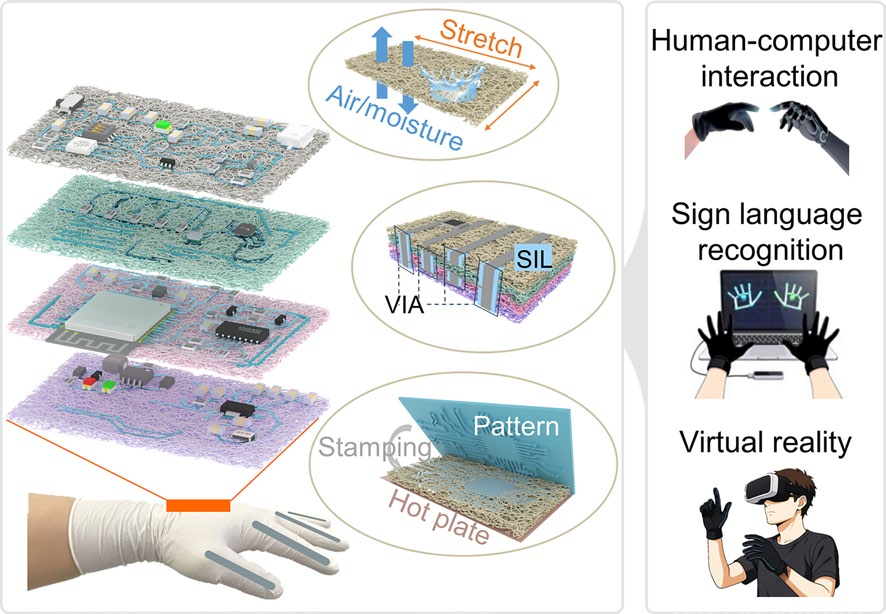
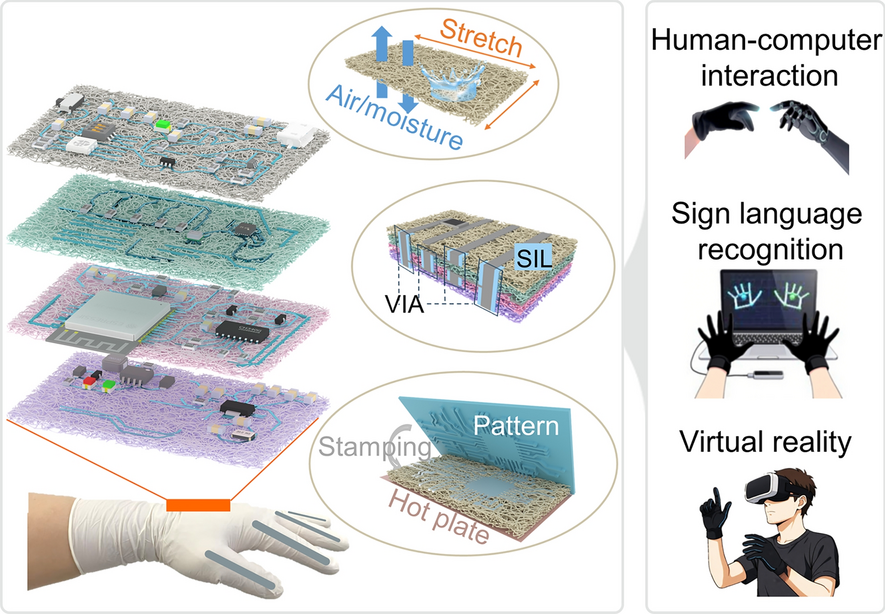

Permeable electronics promise improved physiological comfort, but remain constrained by limited functional integration and poor mechanical robustness. Here, we report a three-dimensional (3D) permeable electronic system that overcomes these challenges by combining electrospun SEBS nanofiber mats, high-resolution liquid metal conductors patterned via thermal imprinting (50 μm), and a strain isolators (SIL) that protects vertical interconnects (VIAs) from stress concentration. This architecture achieves ultrahigh air permeability (> 5.09 mL cm−2 min−1), exceptional stretchability (750% fracture strain), and reliable conductivity maintained through more than 32,500 strain cycles. Leveraging these advances, we have integrated multilayer circuits, strain sensors, and a three-axis accelerometer to achieve a fully integrated, stretchable, permeable wireless real-time gesture recognition glove. The system enables accurate sign language interpretation (98%) and seamless robotic hand control, demonstrating its potential for assistive technologies. By uniting comfort, durability, and high-density integration, this work establishes a versatile platform for next-generation wearable electronics and interactive human–robot interfaces.

Editor of Nano-Micro Letters, which is an Open-Access, peer-reviewed journal reported papers that have at least one dimension ranging from a few sub-nanometers to a few hundreds of micrometers. The journal is published by Springer Nature and indexed by SCI, EI, SCOPUS, Pubmed, etc. The 2024 JCR Impact Factor is 36.3. The 2024 CiteScore is 53.1.
Follow the Topic
-
Nano-Micro Letters

Nano-Micro Letters is a peer-reviewed, international, interdisciplinary and open-access journal that focus on science, experiments, engineering, technologies and applications of nano- or microscale structure and system in physics, chemistry, biology, material science, and pharmacy.
Please sign in or register for FREE
If you are a registered user on Research Communities by Springer Nature, please sign in