A Material Transport Barrier and Pole-to-pole Pathway on Mars
Published in Earth & Environment

Why study Mars, and why investigate its atmospheric material transport?
Mars is a natural laboratory for understanding atmospheric physics, climate transitions, planetary evolution, and habitability. Its thin atmosphere, strong seasonal forcing, active dust cycle, and lack of stable surface liquid water provide insights into how atmospheric processes and climate systems work under conditions distinct from those on Earth, and also advance our understanding of the diversity and evolution of terrestrial atmospheres.
Dust and water vapor are important materials on Mars because they strongly interact with climate, circulation, and the surface environment. Dust absorbs and scatters radiation, changing atmospheric temperatures and circulation, while water vapor links the atmosphere with polar ice, surface frost, and the planet's long-term evolution. Their transport is strongly influenced by Mars’ planetary-scale Hadley circulation, a large north-south overturning flow in which air rises in the summer hemisphere, travels across the planet at higher altitudes, sinks in the winter hemisphere, and returns at lower levels. Hadley circulations also occur on Earth and are often associated with large-scale mixing. Yet observations of Mars reveal planetary-scale differences in dust, water vapor, and trace-gas (e.g., CO and Ar) abundances, suggesting that atmospheric transport does not simply produce uniform mixing.
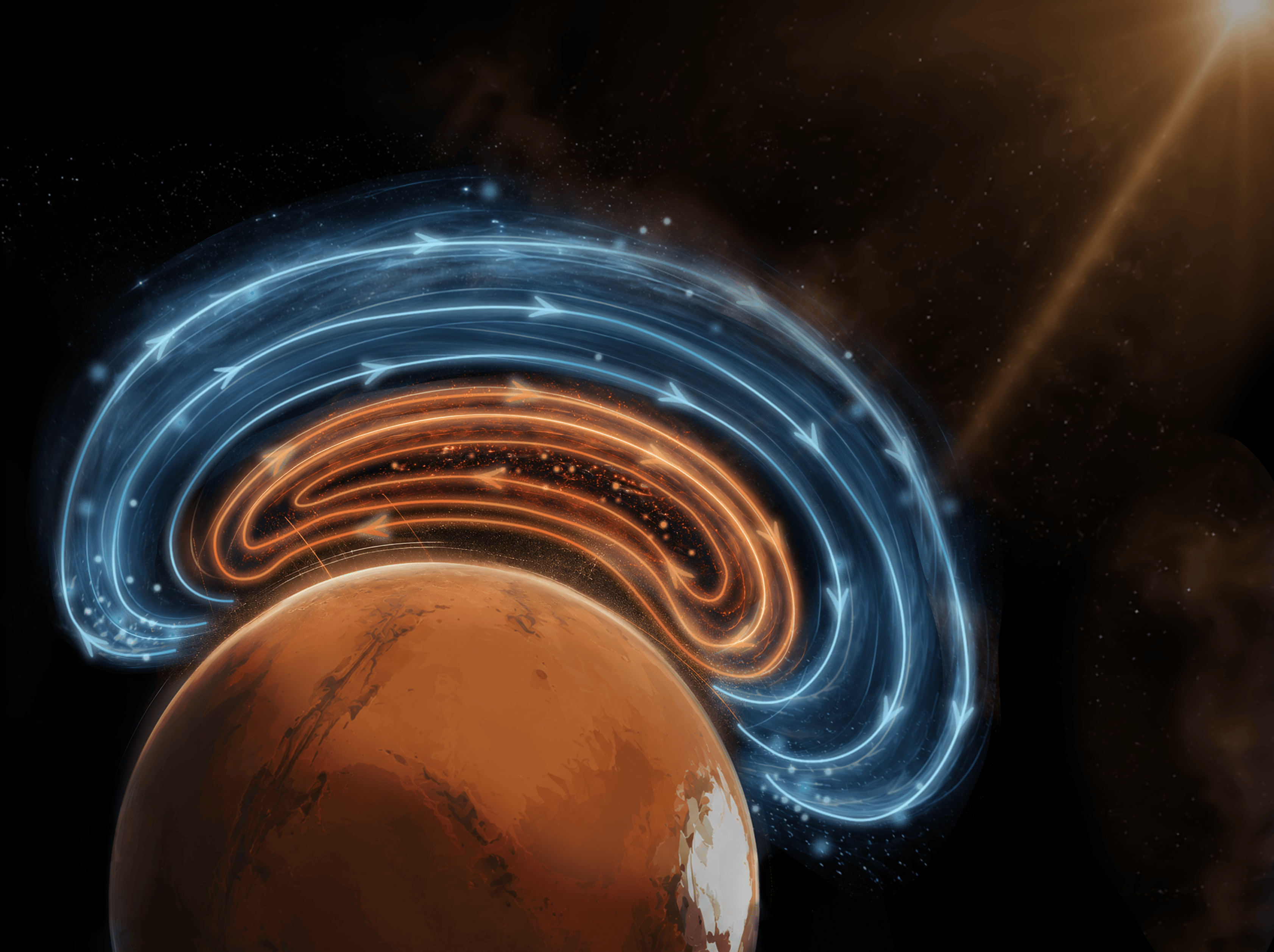
Our particle-tracking experiments show that the boundary of the Martian Hadley circulation behaves as a dynamical barrier extending from the summer mid-latitudes (~60°) to those in winter. Only ~15% of particles released inside and ~20% of those outside can cross the boundary after 30 days. At the same time, air outside the cell can travel through the upper atmosphere from the summer high latitudes (>60°) toward the winter polar region within 10 days. This regime occurs during more than 80% of a Martian year, when the atmosphere is dominated by a single Hadley cell. The circulation therefore produces two contrasting behaviors, material isolation by its boundary and pole-to-pole connectivity along its outer pathway.
Why are Mars, Earth, and Venus different?
Comparing Mars with Earth and Venus helps explain why this transport regime develops. Atmospheric motion can be broadly separated into a large-scale mean circulation and eddies. The mean circulation represents the organized average flow, whereas eddies are fluctuating motions that disturb this flow and mix air between regions. Strong eddies can transport materials across circulation boundaries, while a dominant mean circulation can keep them confined to organized pathways.
Our results show that Mars lies in a distinctive regime. Its Hadley circulation is comparatively dominant, allowing its boundary to act as a transport barrier while maintaining a pole-to-pole pathway. On Earth, eddies play a much greater role and weaken the ability of circulation-cell boundaries to isolate materials. Venus represents another extreme, with strong east-west flow transporting material around the planet along constant latitudes.
These differences are linked to fundamental planetary properties. Mars rotates rapidly (~1 Earth day), allowing Earth-like eddies to develop, but its thin atmosphere (~0.6% of Earth’s surface pressure) adjusts its temperature relatively quickly. These eddies therefore tend not to persist long enough to overtake the planetary-scale mean circulation. More broadly, atmospheric material transport depends on the competition between mean circulation and eddies. Planetary rotation, atmospheric mass, and temperature-adjustment timescales help to predict transport regimes in ancient climates and terrestrial exoplanets, determining whether materials become strongly mixed, regionally isolated, or efficiently connected over planetary distances.
How could these transport patterns affect the Martian atmosphere?
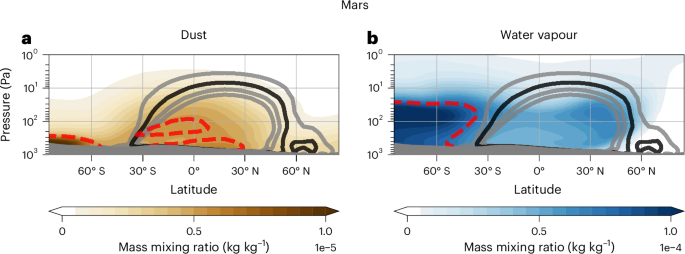
One potential consequence concerns interactions between dust and water vapor. Our results suggest that dust is preferentially confined within the Hadley cell, while water vapor is transported poleward outside it. This spatial separation might reduce contact between water vapor and dust particles that act as condensation nuclei for water-ice clouds, altering where clouds form and influencing atmospheric heating, circulation, and the Martian water cycle.
Along the pole-to-pole pathway, water vapor released from the summer polar region can be transported through the high atmosphere toward the winter hemisphere with some eventually deposited. Given the fact that material reaching higher altitudes may undergo photochemical processes, this transport could contribute to the redistribution of water and its isotopes (e.g., HDO) over longer periods and influence the reservoirs due to hydrogen escape. Our simulations do not directly demonstrate these long-term outcomes, but they identify the dynamical pathways and barriers through which such processes likely occur.
Future research
Our results represent transport above the lowest part of the atmosphere that is directly influenced by the surface, because the tracking stops when particles reach the surface. Thus, near-surface transport is not sufficiently presented in this work. In addition, the long-term effects of this mechanism require further investigations, because most tracers cannot survive the integration for >30 Earth days, and there is no source injecting new tracers.
A key next step is to move beyond idealized passive tracers by including continuous sources, phase changes and/or chemical influences. Individual species with various distributions, including water, dust, and other trace gases, may behave differently even when carried by the same large-scale circulation.
It will also be important to test these transport patterns under other Martian climate states. Global dust storms can strongly modify atmospheric heating and the structure of Hadley circulation, and polar westerly jets may introduce additional transport barriers. Looking further into Mars' past is intriguing as well because long-term variations in obliquity and eccentricity can reorganize the Hadley circulation. Atmospheric barriers and pathways on recent Mars may therefore have differed substantially from those observed today, altering the redistribution of water, dust, and other climate-relevant materials.
Extending this framework across modern, extreme, and climate change may ultimately reveal how atmospheric circulation has shaped both the present distribution of materials on Mars and the planet's climatic evolution.
Follow the Topic
-
Nature Geoscience
A monthly multi-disciplinary journal aimed at bringing together top-quality research across the entire spectrum of the Earth Sciences along with relevant work in related areas.

Related Collections
With Collections, you can get published faster and increase your visibility.
Soil microbiomes and carbon sequestration under global change
Publishing Model: Hybrid
Deadline: Mar 18, 2027


