All-fiber optical nonreciprocity
Published in Physics





Nonreciprocity optical devices that transmit light in one direction but block light in the reversed direction play important roles in photonic circuits and modern communication systems. There are a few ways to break reciprocity, including using the magneto-optical or nonlinear materials, and creating time-dependent structures. While the cases of the materials-relied methods impose particular requirements of strong external magnetic field or power dependence, the time-dependent structures, asking for delicate designs to obtain a propagating index perturbation, are usually realized in on-chip devices. In an optical fiber network, the employment of integrated nonreciprocal devices would introduce extra losses from the fiber-chip interfaces. Solutions of magnetic-free all-fiber nonreciprocity devices, with reduced loss and structure simplicity, are urgently desired.
We proposed an approach to implement nonreciprocal light transmission in an all-fiber device with a remotely switchable isolation direction, a tunable isolation ratio and a tunable bandwidth, which will find many applications in future software-defined reconfigurable optical interconnect networks. The device design adopted the principle of parity-time (PT) symmetry in non-Hermitian systems with balanced gain and loss, where optical nonlinearity can be strongly enhanced due to the highly confined localized eigenmodes.
Considering the simplicity in fabrication and all-fiber requirement, we fabricated an optical isolator of which the structure is illustrated in Fig. 1. Three cascaded fiber Bragg gratings (FBGs) are inscribed in an erbium-ytterbium co-doped fiber (EYDF) to form two mutually coupled Fabry-Perot (FP) resonators. The two FP resonators have an identical geometry with identical resonance wavelength. The gain and loss of the FP resonators are manipulated by controlling the pumping power to make the device work in the PT symmetry breaking regime. In such an operation, the eigenmodes in the resonators are strongly localized, which would strongly increase the gain saturation, making nonreciprocal light transmission significantly enhanced. For an optical signal injected into the device from the gain FP resonator side, it will first experience gain saturation and then a loss in the loss FP resonator, while for an optical signal injected into the device from the loss FP resonator side, it will not experience gain saturation in the gain section since the signal is very weak due to the loss in the loss section. Thus, an optical signal for forward and backward inputs will have unequal gains, resulting in nonreciprocity of light transmission in the device.
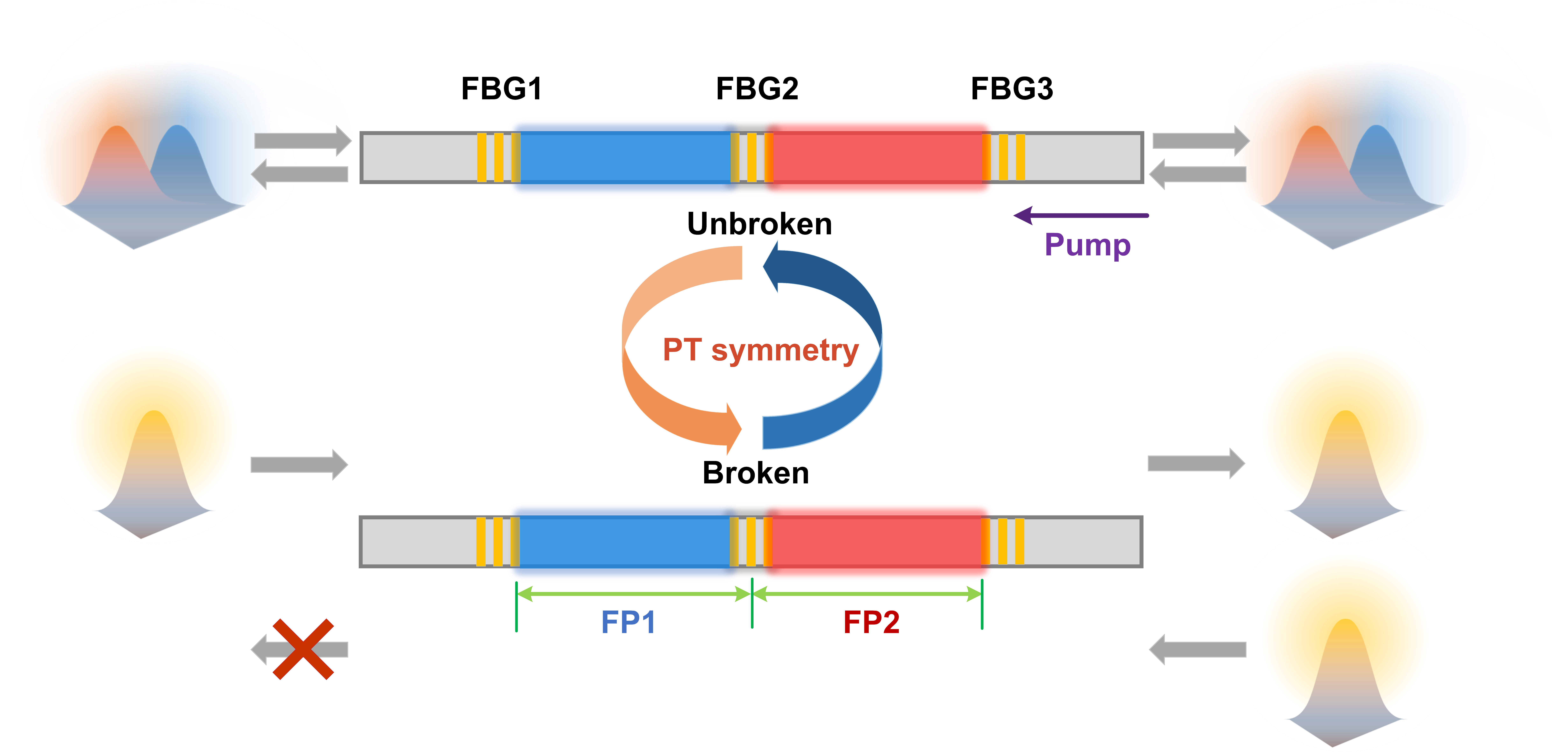
Fig. 1. The device is reciprocal in the parity-time symmetrical regime (top), but nonreciprocal in the parity-time breaking regime (bottom). The gain and loss FP resonators are in red and blue colors respectively.
Before verifying nonreciprocity transmission of the device, we need to characterize the gain and nonlinearity of a single FP resonator. This FP resonator is fabricated with same geometrical parameters as the two FP resonators shown in Fig. 1. We first measure the output power when the input probe power is fixed at -15 dBm while increasing the 980-nm pumping power from 0 to 200 mW. A maximum gain is achieved when the pumping power is 100 mW, and further increase of the pumping power will not lead to increasing gain (Fig. 2a). Then, we fix the pumping power at 100 mW while increasing the probe power from -15 to 10 dBm. When the probe power is less than -10 dBm, the highest gain can be achieved, and further increase of the probe power will lead to gain saturation (Fig. 2b). The results indicate that the gain saturation can be achieved by choosing a proper pumping power and a proper probe power. For a single FP resonator, optical nonreciprocity is not possible, since an optical signal injected into the cavity from either direction will be trapped in the cavity and will experience the same gain.
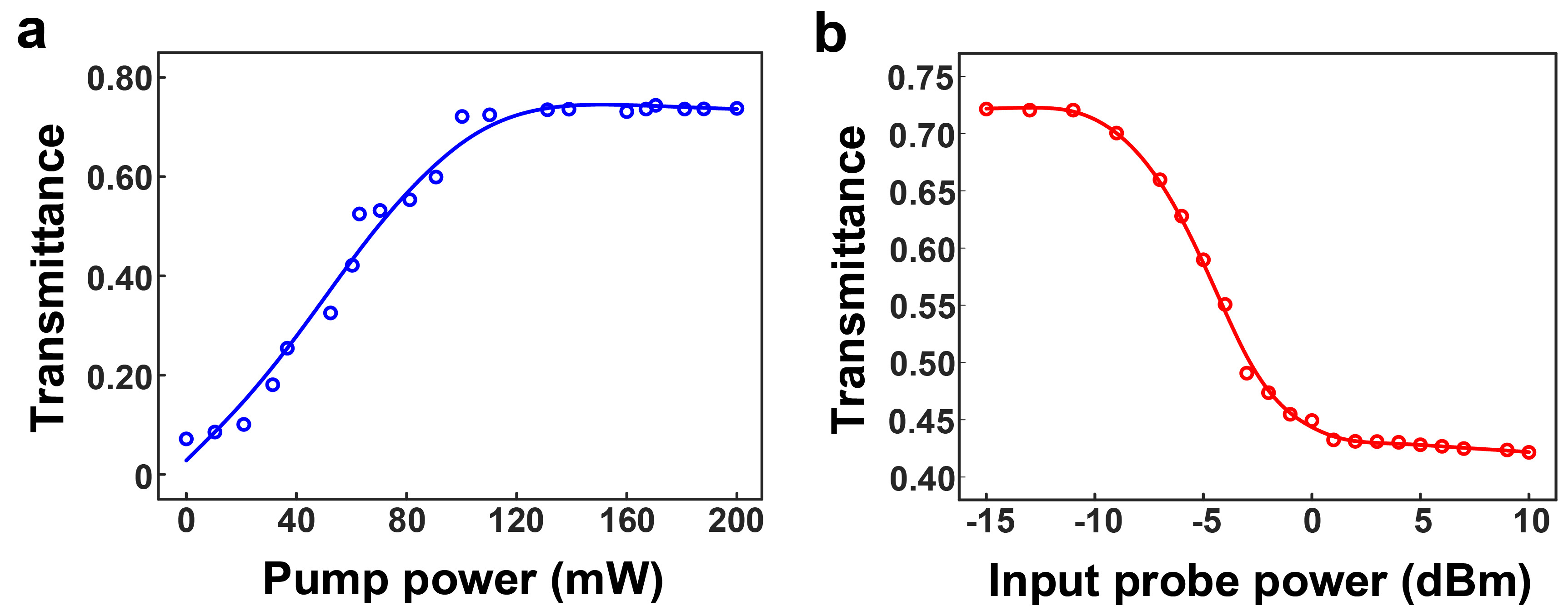
Fig. 2. Gain saturation response of a single FP resonator, (a) with a fixed probe power of -15 dBm, and (b) with a fixed pumping power of 100 mW.
With the knowledge of the gain saturation behavior of a single FP resonator, we can measure the nonreciprocal performance of the all-fiber isolator consisting of two mutual coupling FP resonators. In the experiment, the gain is introduced to FP2 by optically pumping the EYDF. The system become PT-symmetric by adjusting the pumping power to balance the gain/loss ratio between the two coupled FP resonators. The gain mode is strongly confined in the gain resonator, thus enhancing the gain saturation to allow optical nonreciprocity with a high isolation ratio. Compared to the unbroken PT symmetry with reciprocal transmission, when the device is operating in the broken PT symmetry regime, the transmittances for the forward and backward lights are measured to be 0.13 and 0.02, respectively, corresponding to an isolation ratio of 8.58 dB (Fig. 3).
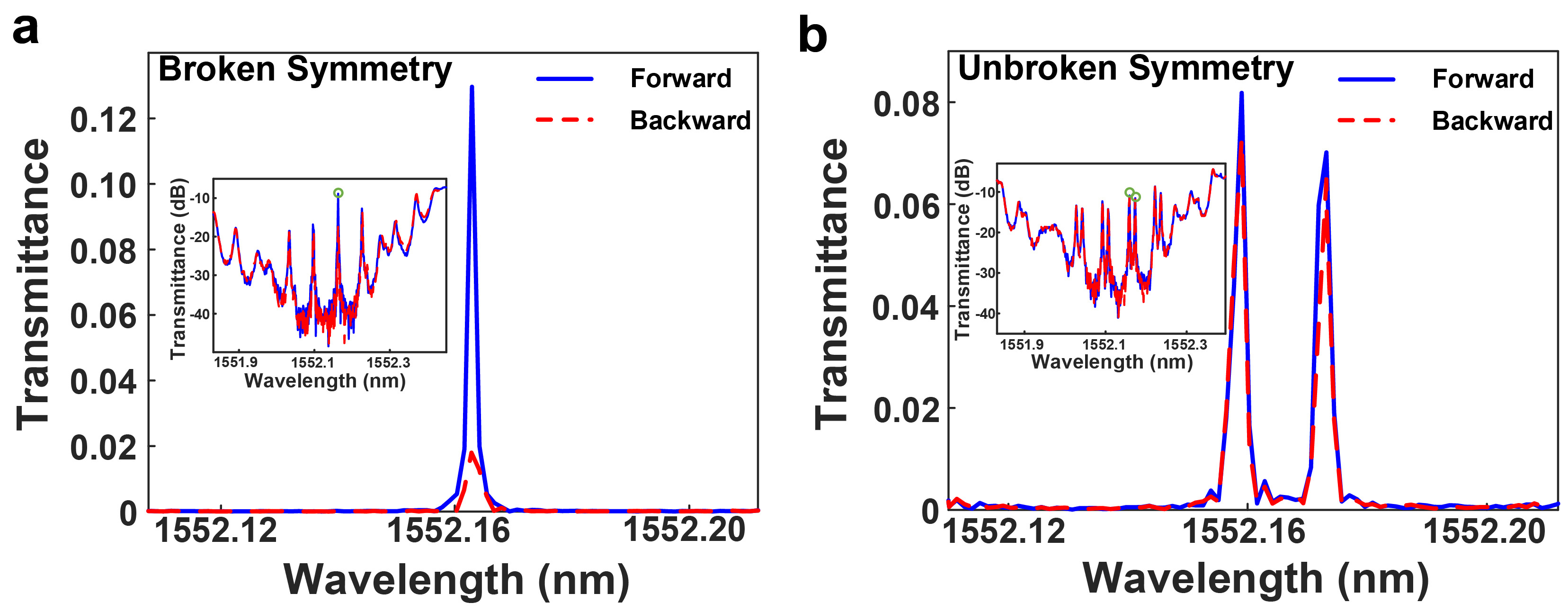
Fig. 3. Experimental results of nonreciprocal light transmission of the device in (a) the broken PT-symmetric regime, and (b) in the unbroken PT-symmetric regime. Insets: the total transmission spectra of the device in a logarithmic scale.
With an optical pump selecting the gain or loss port, the proposed all-fiber isolator is capable to remotely switch the isolation direction. By tuning the pump power, the isolation ratio is tunable; by tuning the bandwidth of the mutual coupling resonators, the isolator bandwidth is tunable. With all those flexibilities and tunability dimensions, the all-optical fiber nonreciprocity can find potential applications in future software-defined reconfigurable optical interconnect networks.
Follow the Topic
-
Communications Physics
An open access journal from Nature Portfolio publishing high-quality research, reviews and commentary in all areas of the physical sciences.

Related Collections
With Collections, you can get published faster and increase your visibility.
Nonlinear dynamics of living systems
Publishing Model: Open Access
Deadline: Nov 09, 2026
Active, Entangled or Confined: Polymer Physics Across Synthetic and Living Matter
Publishing Model: Open Access
Deadline: Dec 31, 2026