Anatomy of a Post-Subduction Collision: A Story from Deep Beneath the Surface
Published in Earth & Environment and Research Data



When we think about mountain building or major earthquakes, we usually picture two tectonic plates pushing against each other. It feels like a simple mechanical story: collision creates crustal thickening/shortening with pressure; that pressure builds mountains; and the stress causes earthquakes. But in the Arabian–Eurasian collision zone, the reality is far more dynamic—and far more fascinating!
Millions of years ago, the northward drift of the African-Arabian Plate closed the Neotethys Ocean, as its dense oceanic lithosphere subducted beneath Eurasia. This initiated a protracted and semi-episodic convergence that ultimately resulted in continental collision. Although the collision of the continents marked the end of classic subduction, tectonic activity and magmatism in the region persisted. The records left behind by these deep-seated processes are complex; the spatiotemporal overlap of collision creates intricate and often ambiguous magmatic, tectonic, and geophysical signatures. We followed these clues.
A River of Hot Mantle Rock Beneath the Crust
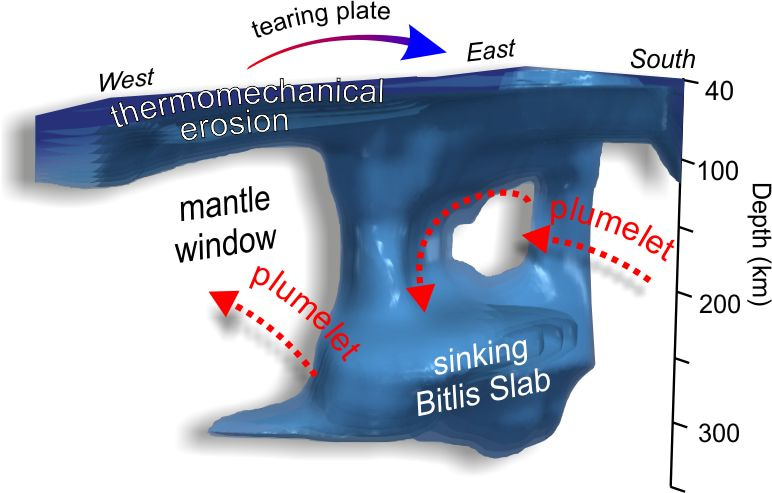
What emerges is a striking image of a focused, southwest-to-northeast mantle flow—called a plumelet—moving from beneath the Arabian foreland toward eastern Anatolia and the Greater Caucasus. This is not a giant mantle plume like those beneath volcanic hotspots. It is more subtle, but no less powerful! It moves laterally through the lithospheric channel like a deep river of hot mantle rock, threading its way through the fragmented remains of old subducted lithospheres.
Imagine an ancient ocean floor, sinking hundreds of kilometers into the Earth—now imagine it tearing apart. Our findings confirm that the Neotethys slab is not a continuous, rigid body. Instead, it is segmented and actively tearing, stretching, and breaking apart. Some fragments may be fully detached and sinking deeper into the mantle (the Bitlis slab), while other parts remain connected and continue to subduct (the Zagros slab). This segmentation fundamentally modifies how stress accumulates along the Arabian–Turkish–Iranian plate boundary.
Earthquakes Tell a Story of Deep Deformations
These deep processes have a direct impact on surface tectonics. Earthquakes are not randomly distributed across the collision zone. They cluster above zones where slab/plate is actively tearing. Meanwhile, areas affected by the plumelet tend to be less seismically active. This contrast reveals that deep mantle flow helps determine where stress accumulates and where it is released.
Subcrustal earthquakes are tightly clustered within the horizontally deforming upper plate, precisely mapping the active tear zone (NW Zagros Basins). In contrast, the plumelet-fed thermally eroded region to the west remains aseismic (lack of dense subcrustal earthquakes beneath the northern Arabian Platform ). This fundamental difference in deformation mechanisms between the eastern and western parts of the collisional front highlights how mantle processes control the spatial partitioning of seismicity.
When Lithosphere Drips
Another remarkable process identified in the study is drip-like lithospheric removal. Beneath the southern Georgian highland—part of the former Tethyan magmatic arc—dense portions of the lithosphere detach and sink into the mantle like a droplet. This process is driven not only by collisional forces but also by convection from the plumelet. As this dense material (Pontide-cold) sinks, anomalously hot and buoyant mantle rises to take its place, heating and thermally weakening the overlying crust.
This mechanism provides important insight into how former volcanic arc settings can evolve into regions of intraplate deformation. It represents a regional-scale example of arc-to-intraplate tectonic transformation, documented here for the first time with comprehensive data-model integration.

A New View of Plate Boundaries
Our research illuminates a completely new concept of the anatomy of a tectonic plate boundary. Post-subduction collision zones are not passive scars left behind by ancient oceans. Instead, they are thermomechanically eroding, dripping, and earthquake-generating dynamic systems. As such, this study tells a deeper story of continental collision. It reminds us that mountains and earthquakes are only the surface expressions of far more intricate processes unfolding within the Earth. Beneath the Arabian–Eurasian boundary, the mantle is not silent; it is flowing, reshaping, and quietly rewriting the architecture of a continent.
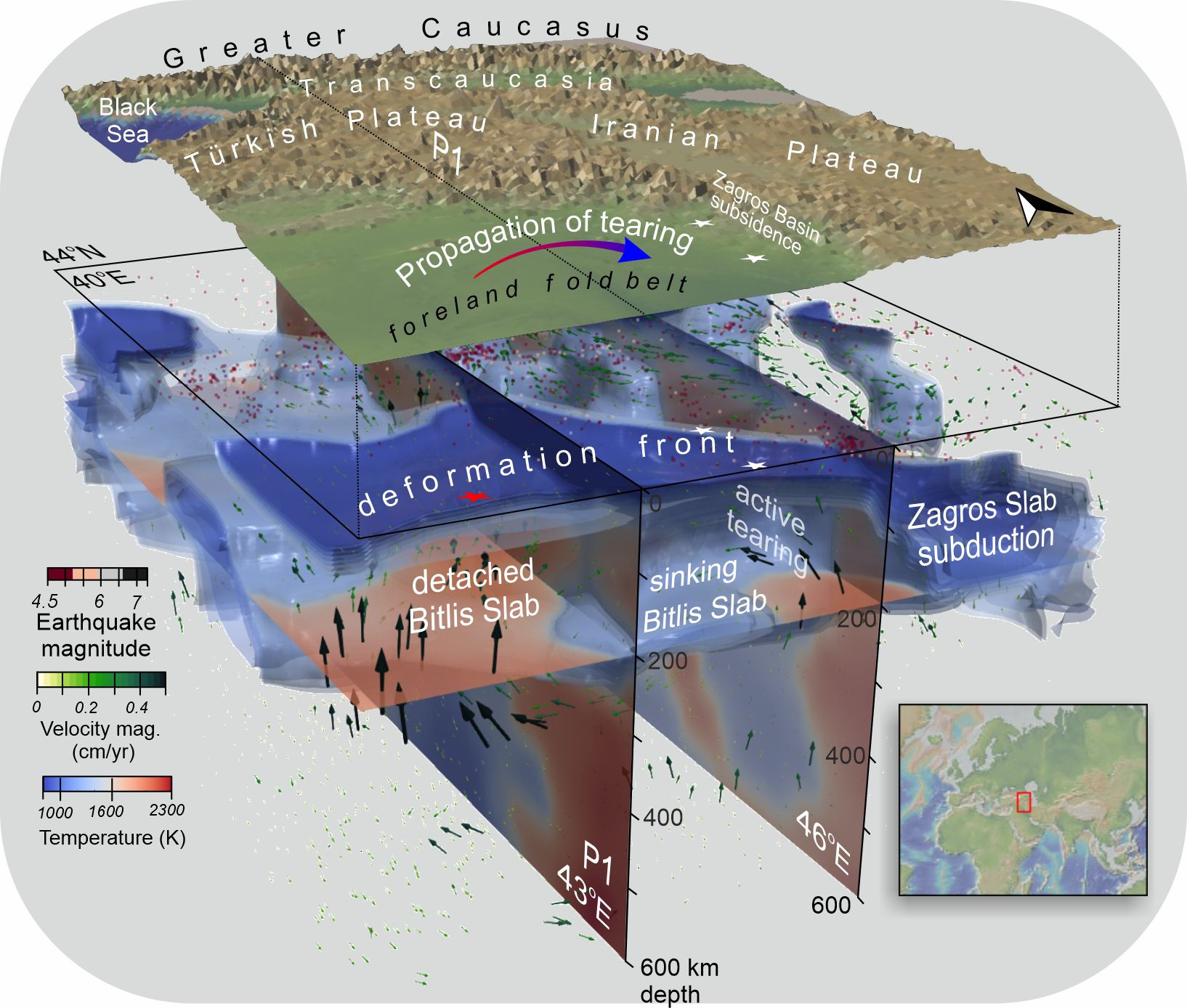
Figure highlights the complex interaction between mantle flow and the actively necking, tearing, and breaking cold Bitlis and Zagros slabs beneath the convergence zone.
This research was supported by The Scientific and Technological Research Council of Türkiye (TÜBİTAK BIDEB-2219) and computational resources from the University of Toronto (Canada) and Compute Canada. Softwares (Matlab, CorelDraw) used in this study was provided by GFZ Helmholtz Center for Geosciences, Germany.
~~~ 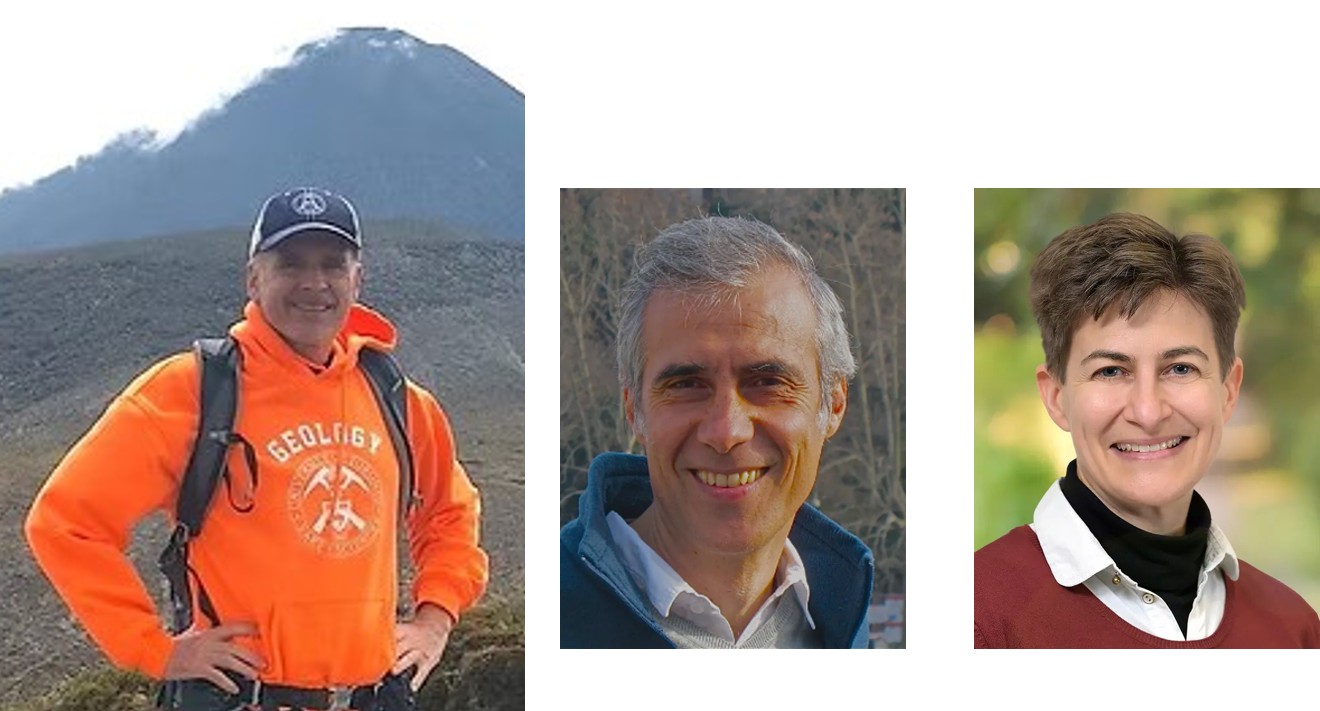
Co-authors from left to right:
Russell N. Pysklywec,
Faccenna, Schildgen
~~~
Read the full paper "Anatomy of a Post-Subduction Collision" in Nature Communications here: https://www.nature.com/articles/s41467-026-70008-y

Follow the Topic
-
Nature Communications
An open access, multidisciplinary journal dedicated to publishing high-quality research in all areas of the biological, health, physical, chemical and Earth sciences.

Related Collections
With Collections, you can get published faster and increase your visibility.
Women's Health
Publishing Model: Hybrid
Deadline: Ongoing
Tumor Microenvironment Crosstalk and Therapeutic Implications
Publishing Model: Hybrid
Deadline: Nov 02, 2026