Andean volcanism, ocean fertilization, marine ecosystem turnover, and global cooling in the Late Miocene
Published in Earth & Environment and Ecology & Evolution
Explore the Research

 doi.org
Error: DOI Not Found
This DOI cannot be found in the DOI System. Possible reasons are:
Where it all began: The origin of the idea linking Andean volcanoes, whales and global climate
The idea behind our recent paper: Carrapa et al., “Andean volcanism, ocean fertilization, marine ecosystem turnover, and global cooling in the Late Miocene”, published in Communications Earth and Environment (https://doi.org/10.1038/s43247-026-03457-4) grew out of a long-standing friendship and collaboration between B. Carrapa (BC) and M. Clementz, which began in 2007, at the University of Wyoming, when BC started her first position as an Assistant Professor. Since then, we have naturally combined our complementary expertise—tectonics and paleontology—to tackle compelling scientific questions and develop creative projects. Central to this collaboration is our shared interest in exploring potential connections between large-scale tectonic processes, particularly mountain building, and their downstream effects on the evolutionary ecology of continental and marine ecosystems. This, not too surprisingly, brought us to the Andes, where we began searching for clues about past environmental conditions—an effort rooted in fundamental, curiosity-driven questions about how landscapes, climate, and ecosystems co-evolve over geologic timescales.
A pivotal moment
What inspired us was the discovery of spectacular whale fossil assemblages at Cerro Ballena, Chile, with over 40 well-preserved marine vertebrate fossils, including large baleen whales, toothed whales, phocids, etc. featured in National Geographic in 2014. N. Pyenson, C. Gutstein and collaborators proposed that iron derived from the Andes through rivers may have fertilized the ocean resulting in harmful algal blooms, contributing to these mass mortality events. However, based on B. Carrapa experience working in the Andes since 2004, it became clear that Andean volcanoes were the missing link between changes in ocean geochemistry and marine ecosystems. Surprisingly, the geochronology of volcanic ashes in the region and the relationships between volcanism, ocean productivity and ultimately climate had been largely unexplored. This was particularly striking given that the Late Miocene was a period of intense Andean volcanism, major ecosystem turnover and global cooling—yet these relationships had not been fully considered in the context of marine productivity and ecosystem change.
From curiosity to hypothesis and confronting scientific skepticism
This realization sparked a new line of inquiry, which led B. Carrapa and M. Clementz to embark on a project driven not by predefined outcomes, but by pure scientific curiosity: could Andean volcanism have influenced ocean productivity, marine ecosystems, and even global climate? Our initial efforts focused on building a robust framework—constraining the depositional environment and age of fossil reach late Miocene deposits (Bahia Inglesa Formation), including Cerro Ballena to better understand the processes behind these remarkable whale assemblages. This included fieldwork in the Atacama region of Chile to look for clues of these connections preserved in the sedimentary record.
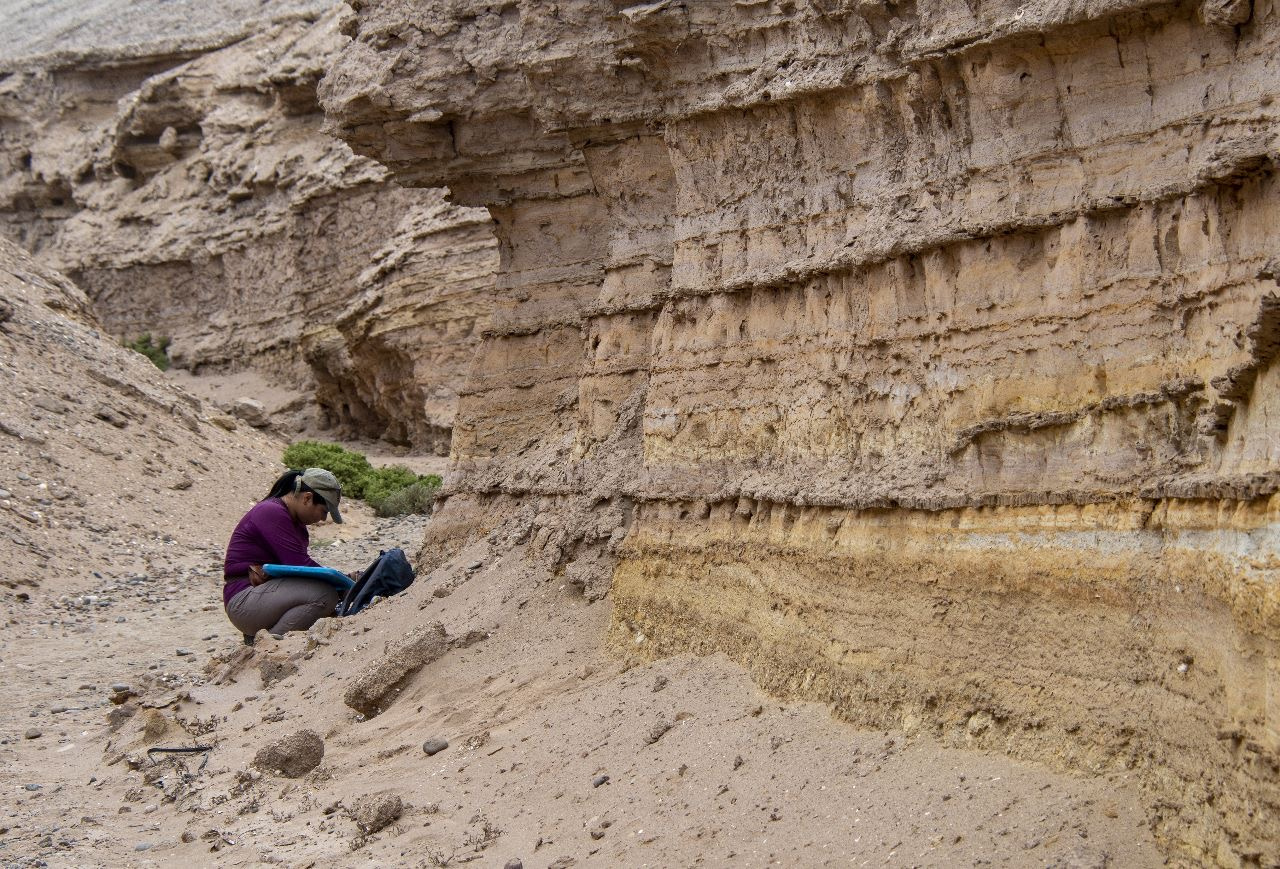
In 2022, we presented this emerging idea in a GSA abstract exploring potential links among Andean volcanism, diatom productivity, marine mammal diversity, and Late Miocene global cooling. Although we had assembled a compelling dataset and narrative, the response from the scientific community was appropriately rigorous. A central critique was clear: correlation does not imply causation. At first, this felt like a significant setback. While many influential studies rely on correlative evidence, our hypothesis—because of its broad and potentially transformative implications—was held to an especially high standard of proof. Such rigor is essential to scientific progress. At the same time, moments like this can reveal less visible dynamics within the research community. Novel, boundary-crossing ideas—particularly those that extend beyond traditional disciplinary frameworks or are led by voices that have not historically dominated the field—can face additional scrutiny. Whether intentional or not, this can disproportionately affect scientists navigating structural biases, including women (and members of the LGBTQ+ community) in science. In hindsight, this skepticism was both a challenge and a catalyst. Rather than viewing this criticism as a barrier, we embraced it as an opportunity to strengthen and expand the scope of our work. Addressing these challenges required moving beyond disciplinary boundaries and developing a truly integrative, mechanistic understanding of the system.
Building a multidisciplinary and international team with diverse expertise
We assembled a diverse and international team of collaborators, including climate modelers (Pedro Di Nezio), paleoclimate (Kaustubh Thirumalai), dust and wind transport (Jordan Abell and Nicolas Cosentino) experts, ocean geochemists (Pam Vervoort and Nick Hulse), geologists (Priscilla Martinez) and paleobiologists (Carolina S. Gutstein). Remarkably, this effort grew organically and was undertaken without dedicated funding—a testament to both the intellectual appeal of the question and the willingness of colleagues to engage in high-risk, curiosity-driven research.
Over the last two years, we held regular virtual meetings that fostered an open and dynamic exchange of ideas. Together, we developed new approaches to test the links between volcanism, nutrient delivery, ocean fertilization (Figure 2), marine ecosystem turnover, and global climate change (Figure 3).
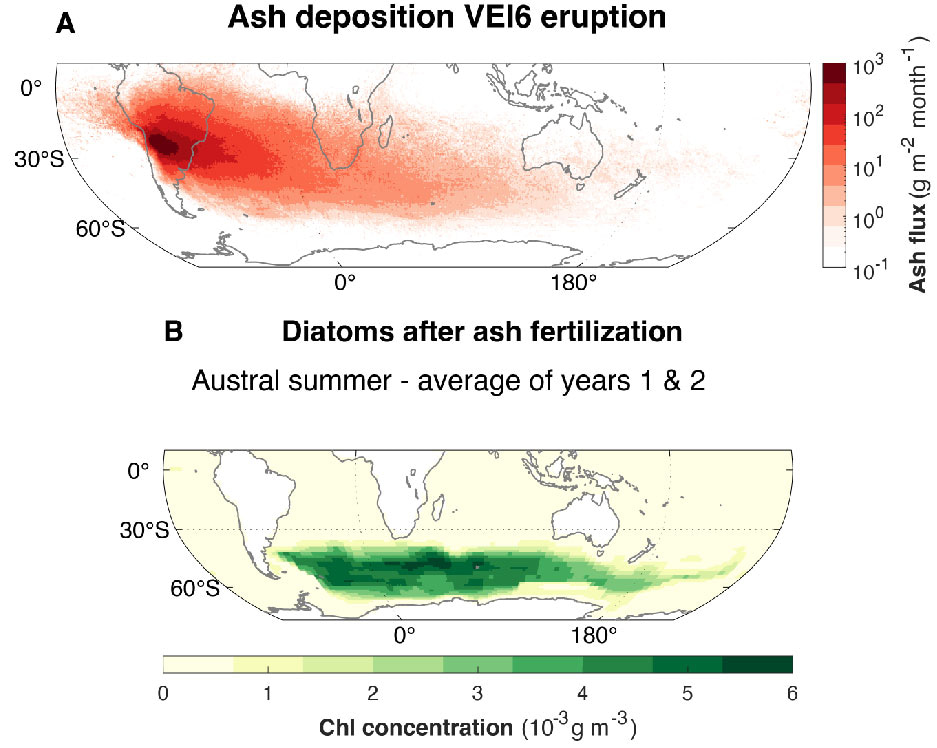
Figure 2. Model simulation showing that A. ash deposition (climatology: 2014-2023) associated with volcanism in the Central Andes (with Late Miocene emission magnitude) corresponds to B. an increase in diatom chlorophyll concentration during austral summer (December to February) averaged for the first and second years after a month-long pulse of nutrients applied on December 1st of year 1.
What began as a speculative idea evolved into a robust, multidisciplinary framework capable of addressing the very criticisms that initially challenged us. The resulting publication stands as a powerful example of how setbacks can catalyze deeper inquiry and innovation. It underscores the value of curiosity-driven science—research guided not by immediate deliverables or funding priorities, but by fundamental questions about how the Earth system operates.
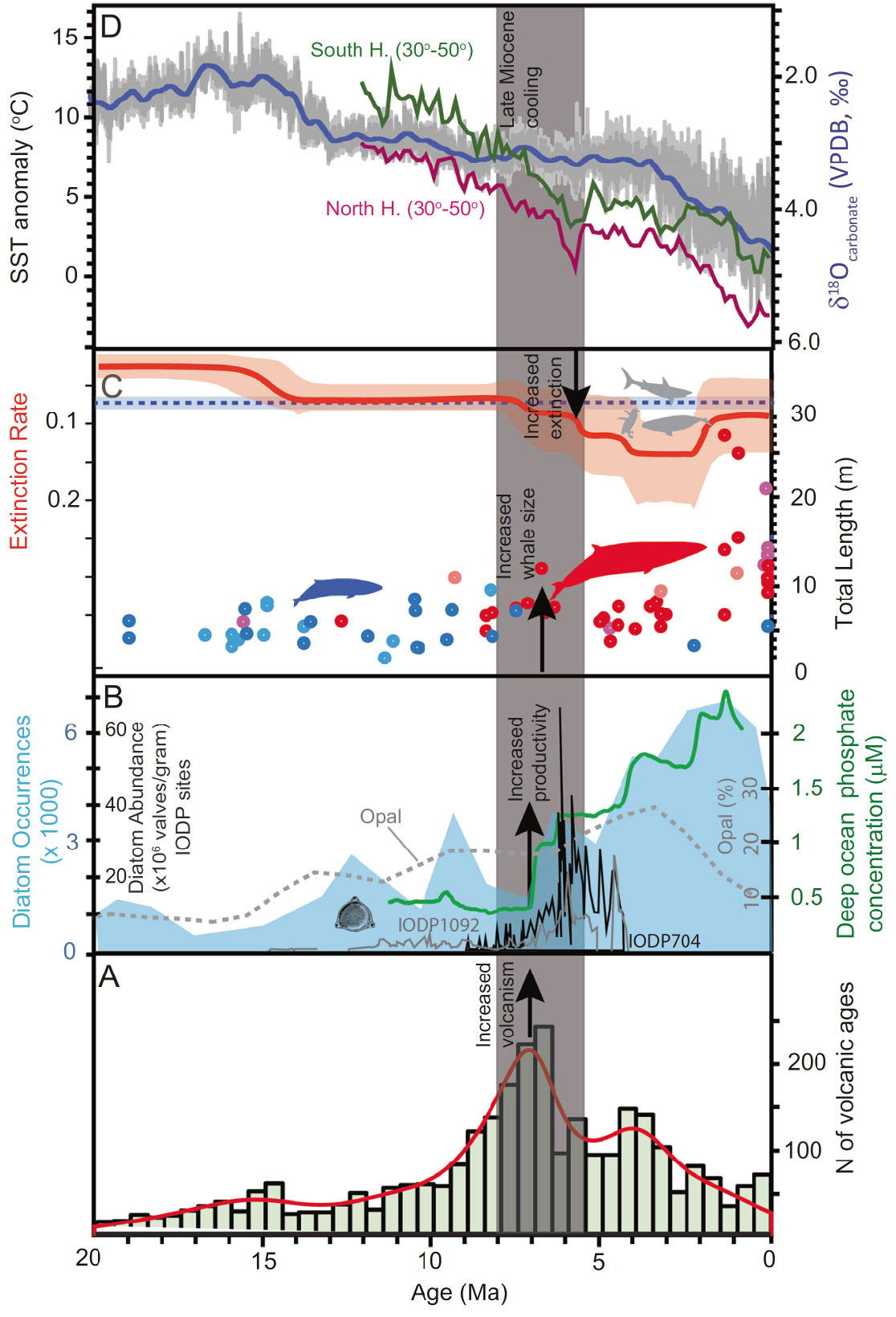
changes on marine vertebrates (C) and sea surface temperatures (D) and the Late Miocene cooling.
For more information and references we refer to the original paper.
Broader implications for science and a message to the community
Our experience highlights a broader challenge in today’s research landscape. Highly integrative, exploratory science is often difficult to fund through traditional mechanisms, which tend to favor well-defined, lower-risk projects with predictable outcomes. Yet it is precisely this type of open-ended, collaborative work that has the potential to generate transformative advances. We hope this story not only sheds light on the scientific process behind our work, but also encourages the community to embrace intellectual risk, value interdisciplinary collaboration, and recognize that some of the most impactful discoveries begin with simple curiosity—and the persistence to pursue it in the face of skepticism.
For colleagues—especially women and other minority groups, who may find their ideas more heavily scrutinized, particularly when venturing beyond their immediate area of expertise—this is also a reminder: do not be discouraged by criticism. Some of the most important scientific advances come from asking unconventional questions and forging connections across disciplines. Continue to push boundaries, advocate for your ideas, and pursue the science that inspires you most. More broadly, this experience has reinforced our belief that the best science emerges from working with trusted colleagues who share intellectual curiosity as a core value.

Follow the Topic
-
Communications Earth & Environment

An open access journal from Nature Portfolio that publishes high-quality research, reviews and commentary in the Earth, environmental and planetary sciences.
Related Collections
With Collections, you can get published faster and increase your visibility.
Climate extremes and water-food systems
Publishing Model: Open Access
Deadline: May 31, 2026
Drought
Publishing Model: Hybrid
Deadline: Jun 30, 2026
Please sign in or register for FREE
If you are a registered user on Research Communities by Springer Nature, please sign in