April Highlights from Mathematics, Physical and Applied Sciences Communities
Published in Earth & Environment, Physics, and Mathematical & Computational Engineering Applications







April brought another month of fascinating stories from the Mathematics, Physical and Applied Sciences Communities, from ancient engineering mysteries and extreme laser physics to groundwater tracing, understanding toxin transfers, and the hidden mathematics inside crushed soda cans. What I always enjoy about these Behind the Paper posts is seeing the human side of research - the unexpected observations, late-night breakthroughs, small moments of curiosity, and questions that researchers simply couldn’t let go of.
This month’s highlights show how science often begins in the most surprising places: a documentary about the pyramids, a hydraulic press video online, unusual isotope signals in rivers, or field observations during an ecological crisis. Together, these stories offer a glimpse into how researchers across disciplines are using creativity, persistence, and new tools to better understand the world around us.
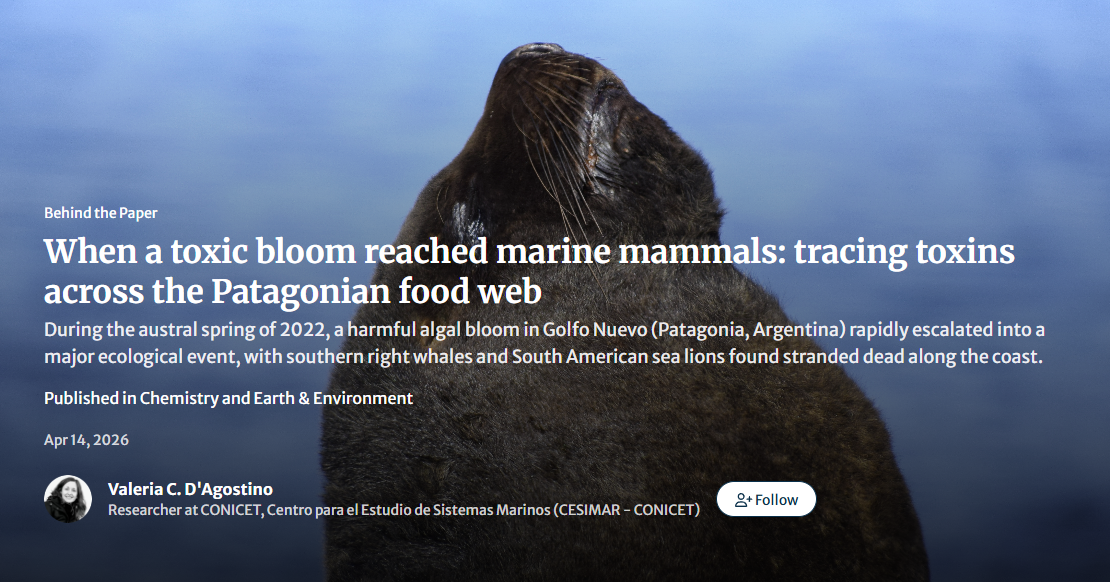
What happens when marine toxins move up the food web?
In a fascinating Behind the Paper post, @Valeria C. D'Agostino takes us inside a dramatic ecological event in Patagonia, where a harmful algal bloom triggered the deaths of southern right whales and South American sea lions. Published in Communications Earth & Environment, the study traces how powerful toxins moved step by step through the marine food web, from tiny plankton all the way to top predators.
What makes this story especially compelling is that the research team was already in the field before the mortality event began, allowing them to follow the toxins in real time rather than reconstructing the event afterward. From whale feeding observations to toxin detection in live whales and even sea lion fetuses, the study reveals just how interconnected and fragile marine ecosystems can be.
Read this Behind the Paper post to discover how processes at the microscopic level can ripple across an entire ocean ecosystem.
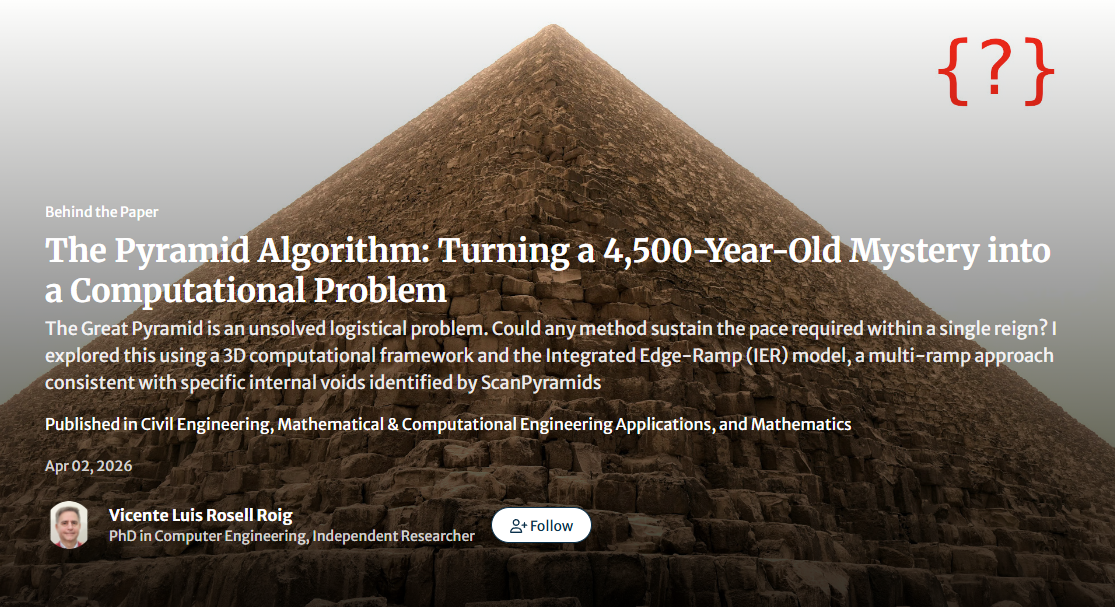
How do you even begin to test a 4,500- year- old construction theory?
For @Vicente Luis Rosell Roig , it started unexpectedly with a documentary, a few sketches on paper, and a question he couldn’t let go of: could any proposed method really keep up with the speed needed to build the Great Pyramid within a single reign? In his Behind the Paper post about a paper from npj Heritage Science, he shares how that curiosity slowly turned into a full computational framework simulating ramps, labour flow, and block transport in 3D.
What I really enjoyed about this story is how iterative the process feels. The model wasn’t built around proving a theory from the start. It evolved through testing, adjusting, and seeing what actually worked under realistic constraints. From multi- ramp systems to possible alignments with ScanPyramids voids, the post offers a fascinating look at how modern engineering tools can reopen ancient questions in completely new ways.
Read the full Behind the Paper post to follow the journey from hand- drawn sketches to pyramid scale simulations.
Could nuclear power plants unintentionally be helping hydrologists study groundwater?
This unexpected question led @Jared van Rooyen and @Oliver Schilling to rethink how we trace water moving between rivers and aquifers. In their Behind the Paper post, they explain how routine tritium releases into rivers create distinct isotope “fingerprints” that can be followed through groundwater systems over time.
The story is a great reminder that scientific breakthroughs sometimes come from looking at familiar systems in a completely different way. Rather than introducing artificial tracers, the team realised the signals already existed naturally within monitored river systems. Their work, published in Nature Water, shows how these pulses can help reveal hidden recharge pathways and groundwater travel times, offering valuable insights for water management and freshwater security.
Read the full Behind the Paper post to discover how an overlooked environmental signal became a continental-scale hydrology tool.
Einstein’s flying mirror and the search for extreme light
@Robin Jakelin Latham Timmis reflects on a long-standing puzzle in high harmonic generation from relativistic plasmas and how a shift in perspective helped move it forward. The idea sounds almost poetic at first: using a relativistic plasma surface as a kind of “flying mirror” to compress and upshift laser light into extreme coherent harmonics.
What makes the story compelling is not only the physics, but the way the breakthrough unfolded at the bench. A small experimental tweak, a sudden burst of unexpected signal on the detector, and that uneasy pause where excitement and doubt sit side by side before confirmation. From there, the work published in Nature connects theory and simulation with experimental evidence for a mechanism that could push laser intensity into entirely new regimes.
Read the full Behind the Paper post to explore how this step may open a path toward next-generation extreme field studies.
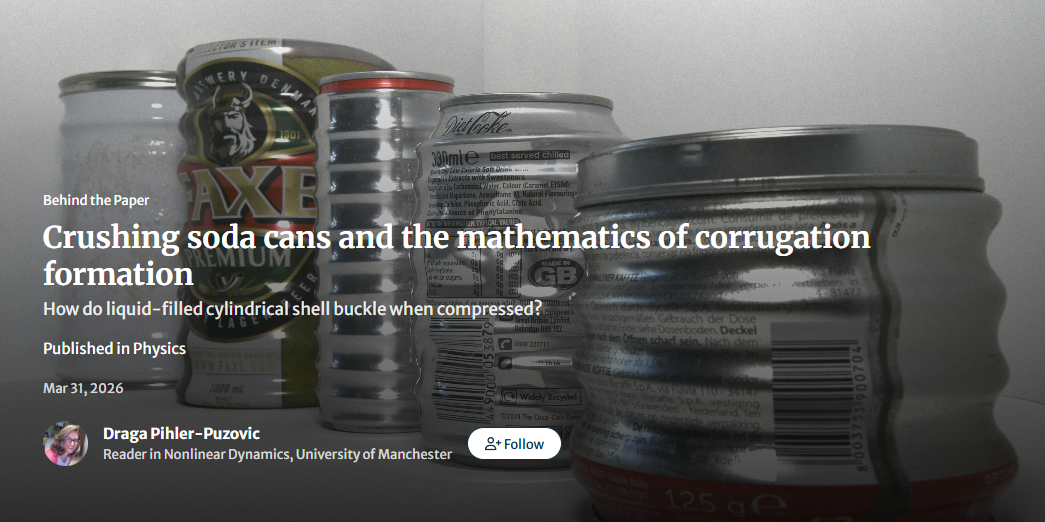
When a soda can doesn’t just collapse, but starts to “write” mathematics into its surface
@Draga Pihler-Puzovic follows a deceptively simple question sparked by hydraulic press videos: why does a liquid-filled can buckle into such perfectly spaced rings instead of collapsing all at once?
What begins as an everyday observation turns into something much richer once you look closer. The experiments, published in Communications Physics, reveal a surprisingly orderly sequence of wrinkle formation, linked to a mathematical structure known as homoclinic snaking. It’s one of those cases where physics and mathematics quietly align, turning a familiar object into a live demonstration of pattern formation under pressure.
Read the full Behind the Paper post to see how crushed cans unexpectedly became a window into the physics of stability and structure.
Looking for more posts to explore?
In April, we celebrated the launch of Discover Earth Observation, a new journal focused on Earth observation and remote sensing research, from environmental monitoring to climate science and sustainable development. We also loved this Community post on the surprisingly creative nicknames researchers give their lab instruments - a fun reminder of the personalities behind the science. And during Lunar New Year, we featured a special spotlight celebrating our growing global communities and members in China, reflecting on research, connection, and community across borders.
You can explore the highlights here:
- New Journal: Discover Earth Observation
- Nicknames for Lab Instruments
- Celebrating Our Global Communities: Spotlight on China During the Chinese New Year
From whale migrations and groundwater systems to relativistic plasmas and buckling soda cans, April’s stories remind us that science is rarely a straight line. Sometimes the biggest breakthroughs begin with a simple observation, an unexpected result, or a question that initially sounds almost too strange to pursue. These posts not only explore the research itself, but also the thinking, experimentation, and curiosity behind it.
We hope you enjoy exploring this month’s highlights and discovering the people and ideas shaping research across the Mathematics, Physical and Applied Sciences Communities.
Explore more research breakthroughs:
Passionate about connecting researchers and amplifying their voices through digital engagement. As Manager for the Research Communities by Springer Nature, I work with researchers to showcase their discoveries and experiences.
With a strong interest in public engagement and creative science communication, I’m dedicated to making research more accessible and inspiring wider conversations around scientific discovery and innovation.
Follow the Topic
-
Nature
A weekly international journal publishing the finest peer-reviewed research in all fields of science and technology on the basis of its originality, importance, interdisciplinary interest, timeliness, accessibility, elegance and surprising conclusions.
-
Communications Earth & Environment
An open access journal from Nature Portfolio that publishes high-quality research, reviews and commentary in the Earth, environmental and planetary sciences.
-
Nature Water
This journal publishes research on the evolving relationship between society and water resources on a monthly basis. It covers the natural sciences, engineering, and social sciences, with a particular interest in regards to interdisciplinary research.
-
Communications Physics
An open access journal from Nature Portfolio publishing high-quality research, reviews and commentary in all areas of the physical sciences.
-
npj Heritage Science
This journal will consider original research papers for the scientific study of heritage, based primarily on physical, chemical and biological measurements and / or computations.
Related Collections
With Collections, you can get published faster and increase your visibility.
Climate extremes and water-food systems
Publishing Model: Open Access
Deadline: May 31, 2026
Relativistic Astrophysical Plasmas in space and the lab
Publishing Model: Open Access
Deadline: Jun 30, 2026


Please sign in or register for FREE
If you are a registered user on Research Communities by Springer Nature, please sign in