Behind the Paper: COVID-19 Containment and Control Reduced Lake Turbidity Around the World
Published in Earth & Environment and Sustainability





The story began in 2020, when we observed a growing body of evidence that COVID-19 containment measures had improved air quality and influenced regional water environments. Motivated by these findings, we turned our attention to a dimension that, at the time, remained largely unexplored on a global scale: the impact of pandemic restrictions on lake water quality, specifically turbidity.
In early 2021, we initially attempted to build multiple linear regression models for each continent to assess how lake turbidity responded to the containment after extensive discussion with Dr. Daniel Odermatt. However, after a productive discussion with Prof. Philippe Ciais, we agreed this approach was insufficient: regional models could not capture the heterogeneous effects of containment intensity across individual lakes. What we needed was a framework that could account for both fixed effects—representing global-scale influences—and random effects—capturing lake-specific variability. The linear mixed-effects (LME) model emerged as the ideal candidate.
Implementing LME models proved far more challenging than anticipated. Throughout 2022, we devoted substantial effort to learning and refining the approach, yet meaningful results remained elusive. It wasn’t until July 2024, during an in person discussion with Prof. David Makowski—an expert in statistics and machine learning—that we arrived at the optimal model structure, specifying the precise combination of fixed and random terms. At last, the results we had been seeking came into view.
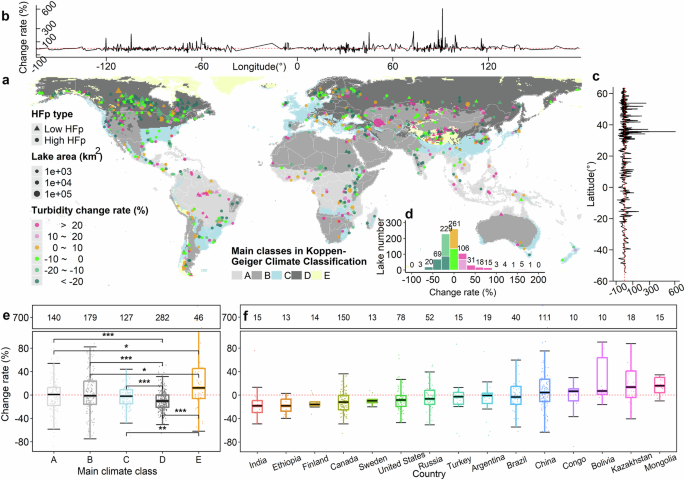
We also recognized that the influence of containment on lakes was mediated by reductions in human activity. Lacking monthly wastewater discharge data for global lake catchments, our colleague Dr. Ting Tang suggested using nighttime light data as a proxy for human activity intensity, and incorporating land use proportions and livestock density into the LME models. We further agreed to stratify lakes into high and low human footprint groups using the human footprint index, enabling separate modeling and comparative analysis of lockdown effects.
When it came to attributing observed changes in global lake turbidity to COVID-19 containment, Prof. David Makowski once again contributed his unique insight and his ability to distill core scientific questions from complex problems. He helped us identify the key findings the paper should most prominently report: Did COVID-19 containment affect global lake water quality? Were the effects positive or negative? Which lakes were most—and least—affected?
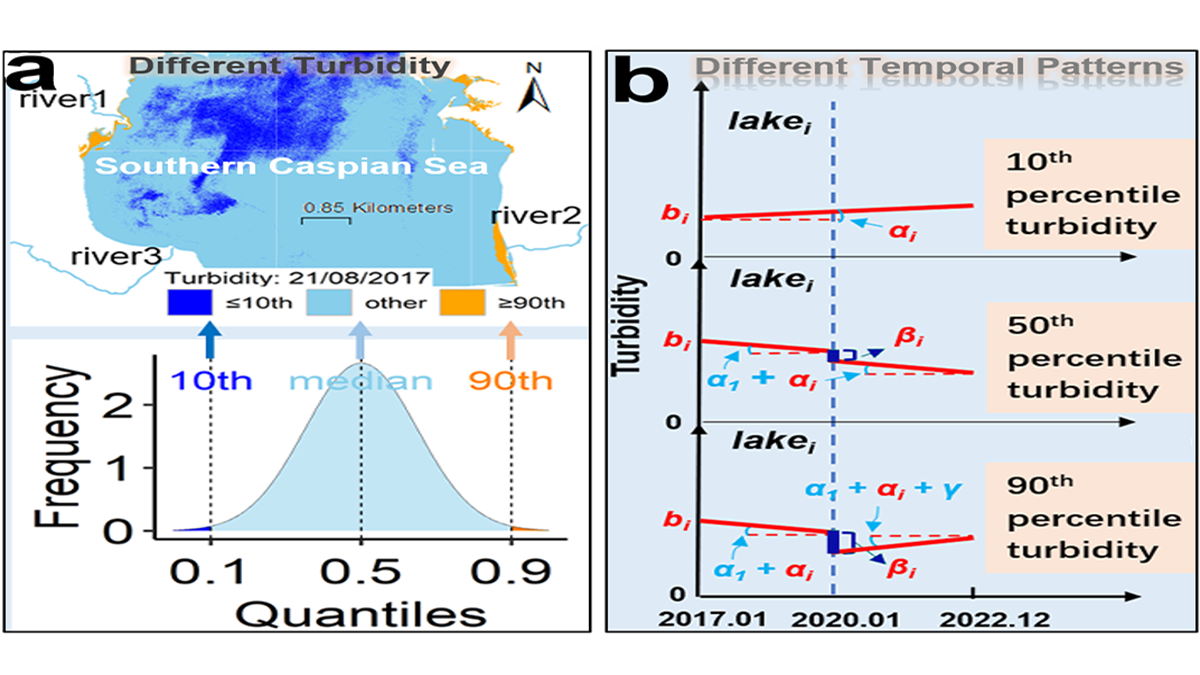
A pivotal breakthrough came when we modeled three distinct types of turbidity separately, rather than relying solely on mean values. We discovered that the most substantial improvements occurred in turbid nearshore and inflow zones, while clearer or moderately turbid waters showed minimal change. This finding allowed us to propose targeted turbidity mitigation and lake management strategies—the aspect of this paper we are most proud of.
Looking forward, we emphasize the need for more comprehensive data on pollutant discharges at the catchment scale. Integrating such data with remote sensing observations, field measurements, and mechanistic models will enable more accurate assessments of how global lake water quality responds to anthropogenic perturbations, including those related to COVID-19 containment. We hope this work will help unlock these possibilities and look forward to the insights such integrative approaches will bring.
Finally, we wish to express our deepest gratitude to the coauthors, whose expertise and dedication made this work possible. We also sincerely thank the senior editor, the reviewers, and the CEE editorial team for their support throughout the review and publication process.
Follow the Topic
-
Communications Earth & Environment
An open access journal from Nature Portfolio that publishes high-quality research, reviews and commentary in the Earth, environmental and planetary sciences.

Related Collections
With Collections, you can get published faster and increase your visibility.
Ecological resistance and resilience under global change
Publishing Model: Open Access
Deadline: Apr 07, 2027
Hazards in Mountain Regions
Publishing Model: Open Access
Deadline: Nov 02, 2026