Behind the Paper: Ensemble ML and SHAP for hybrid polypropylene composites
Published in Materials




What was the problem?
Polypropylene (PP) is everywhere—from appliance housings to automotive trim—but tuning its mechanical performance with eco-friendly reinforcements is still a balancing act. We explored a hybrid system of long flax fiber bundles (LFF), basalt fibers (BF), and rice husk powder (RHP). Each ingredient pulls properties in different directions: BF boosts stiffness, flax can raise strength at modest loadings, and RHP helps processability and sustainability but can soften the matrix if overused. Running a full factorial campaign would be slow and costly, so we asked: could machine learning help us map the design space with only a compact Box–Behnken plan?
Why ensembles, not a single model?
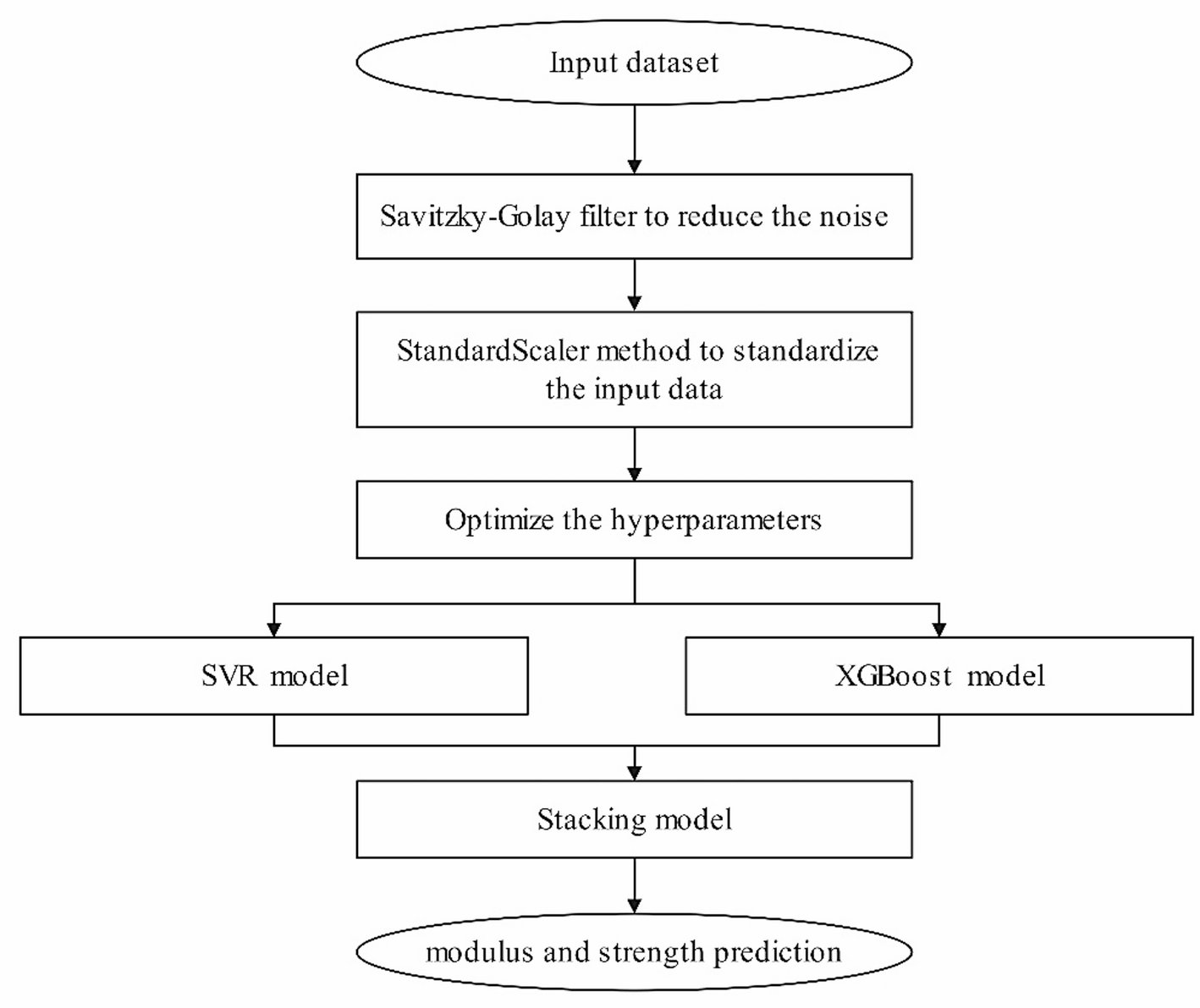
Small materials datasets are noisy and rarely linear. Single learners often overfit, especially when variables interact. We therefore stacked two strong but complementary base learners and tuned capacity carefully with cross-validation. Stacking reduces variance by letting models “vote,” while still capturing non-linear trends. We also kept a strict separation of training, validation, and a 20% hold-out set so our reported skill reflects true generalization inside the tested route.
How did we keep it honest?
Before modeling, we treated the data like we would treat a specimen: inspect it. Histograms, KDEs and boxplots ensured every factor level was represented and flagged one clear modulus outlier (>10 GPa). Pair plots helped us see raw tendencies (%BF and %RHP versus tensile strength/modulus) without hiding behind a model. During training, we used k-fold cross-validation and capped complexity (depth, estimators, regularization) to avoid optimistic results.
Why SHAP (and friends)?
A prediction is only useful if engineers can act on it. SHAP values provide per-feature, per-sample attributions for tree models, telling us how much each variable nudged a prediction up or down. We paired SHAP with permutation importance (model-agnostic), partial dependence (PDP) and accumulated local effects (ALE) to see both global and local behavior. The takeaway was intuitive and actionable: BF dominates modulus gains, but strength benefits from a balanced trio—too much of any one component quickly flattens returns. These insights align with micromechanics expectations about stiffness transfer and embrittlement at high rigid-filler content.
What did we learn for design?
The ensemble reproduced measured trends on cross-validation and on the unseen hold-out set. From the SHAP/PDP landscape we highlighted composition windows where tensile strength improves ~2× over neat PP while modulus climbs strongly: moderate BF with supportive flax plies and controlled RHP. In practice, this narrows down trial-and-error—teams can start within these windows, then fine-tune around processing realities such as fiber length retention or porosity.
Limits you should care about
Our goal wasn’t a universal model for “any” PP composite. We fixed processing (extrusion → hot press → injection molding) to isolate composition effects. That means the model explains variance due to %BF, %RHP, and flax ply count within this route; jumping to a very different line or tool will change the microstructure, and models should be retrained or updated. Also, small materials datasets make uncertainty quantification valuable; future work could add conformal prediction intervals so designers see both a forecast and its confidence band.
Why this matters beyond our system
The workflow—compact DOE, capacity-controlled ensembles, and transparent explanations—generalizes to many data-limited materials problems: bio-fillers in thermoplastics, multi-phase binders, or even cementitious systems. The key is to pair domain priors with honest diagnostics and keep explanations close to mechanisms engineers trust.
A note on sustainability
Flax and rice-husk powder are renewable or waste-derived. Being able to forecast properties with fewer physical trials lowers energy, labor, and scrap. In other words, better data practices are also greener practices.
Where to read the paper
The research article is open access in Discover Materials: DOI 10.1007/s43939-025-00406-4. A shareable link is available via Springer Nature’s initiative: rdcu.be/eQUMB.

Lecturer at Nha Trang University focusing on eco-friendly polymer composites and geopolymer materials.
Follow the Topic
-
Discover Materials
This is a broad, open access journal publishing research from across all fields of materials research.

Related Collections
With Collections, you can get published faster and increase your visibility.
Smart Materials for Biomedical and Healthcare
The rapid convergence of materials science, biotechnology, and artificial intelligence is transforming the landscape of modern healthcare. The emergence of next-generation smart materials engineered to dynamically sense, respond, and adapt to biological stimuli represents one of the most exciting frontiers in biomedical innovation. This special issue aims to bring together pioneering advances, conceptual breakthroughs, and translational research in the evolving domain of intelligent and multifunctional materials designed for healthcare applications. The focus extends beyond conventional biomaterials to encompass adaptive, stimuli-responsive, and bioinspired systems that can autonomously interact with their environment, enabling precise diagnostics, targeted therapy, regenerative healing, and continuous health monitoring.
In recent years, the field has witnessed remarkable progress in the development of nanostructured, polymeric, hydrogel-based, and hybrid materials capable of mimicking natural tissues and dynamically interfacing with biological systems. Smart materials integrated with biosensing, drug delivery, and regenerative functionalities are opening new avenues for personalized medicine, soft robotics in surgery, and bioelectronic interfaces that seamlessly connect with neural and muscular tissues. Equally transformative is the integration of artificial intelligence and data-driven materials design, where predictive modeling and machine learning algorithms accelerate the discovery and optimization of novel materials with programmable and adaptive properties. These interdisciplinary approaches hold enormous potential for precision healthcare, point-of-care diagnostics, and remote patient monitoring. The issue will explore the convergence of bioelectronics, flexible and wearable materials, and energy-harvesting systems for sustainable biomedical devices that can function autonomously within or outside the human body. From biodegradable implants and self-healing materials for tissue engineering to magneto- and photo-responsive systems for controlled therapeutic release, the scope embraces both fundamental science and practical engineering perspectives. Emerging directions such as organ-on-chip platforms, 4D printing of shape-memory biomaterials, and quantum-inspired materials for biosensing further expand the boundaries of what is possible in healthcare technologies.
The Collection aims to foster collaboration among material scientists, biomedical engineers, clinicians, and data scientists to accelerate the translation of laboratory innovations into real-world healthcare solutions. By highlighting cutting-edge research and forward-looking perspectives, it seeks to inspire novel paradigms for intelligent, sustainable, and patient-centric materials systems that redefine diagnostics, therapy, and rehabilitation. Ultimately, the compilation aspires to create a vibrant knowledge exchange platform to drive the next wave of discovery and innovation in smart materials for biomedical and healthcare applications.
1. AI-driven bioinspired composites for dynamic tissue regeneration and autonomous healing response
2. Next-generation piezoelectric and triboelectric nanomaterials for self-powered implantable biosystems
3. Quantum-engineered smart materials for ultrafast biosensing and precision molecular diagnostics
4. Multifunctional biointerfaces integrating neuromorphic computing for adaptive neuroprosthetic applications
5. 4D bioprinted shape-transforming materials for personalized regenerative and surgical interventions
6. Biohybrid soft robotics using responsive polymers for minimally invasive medical procedures
7. Photonic and plasmonic nanomaterials for real-time, noninvasive health monitoring platforms
8. Sustainable and biodegradable smart polymers for green healthcare and environmental biosafety
9. Magneto-responsive nanostructures for controlled gene editing and spatiotemporal therapeutic delivery
10. Cognitive materials coupled with embedded ai for predictive therapeutic decision-making systems
11. Metamaterial-based bioelectronics for high-fidelity signal transduction and neural communication enhancement
Keywords:
• Smart materials
• Biomedical engineering
• Healthcare innovation
• Bioinspired materials
• Stimuli-responsive systems
• Adaptive biomaterials
• Regenerative medicine
• Intelligent materials
• Multifunctional materials
• Personalized medicine
This Collection supports and amplifies research related to SDG 3, SDG 9, and SDG 12.
Publishing Model: Open Access
Deadline: Feb 28, 2027
Materials in Structural Engineering: Challenges and Innovations under Extreme Loading Conditions
In materials science and engineering, the pursuit of robust and resilient materials capable of withstanding extreme loading conditions and demanding service environments is more pressing than ever. The field of structural engineering and related materials and computational engineering disciplines, at the forefront of this endeavor, faces constant challenges posed by natural hazards, complex service environments, and high-temperature exposure. The ability of structural systems and materials to endure such events depends crucially on their properties and performance. Discover Materials, as part of the Discover journal series committed to advancing materials research, provides an ideal platform for addressing these challenges and accelerating innovation across the full spectrum of materials design, modelling, processing, and application.
The Collection, titled “Materials in Structural Engineering: Challenges and Innovations under Extreme Loading Conditions,” aims to delve deeply into the intersection of materials science and structural resilience across experimental, numerical, and applied perspectives. This collection is driven by the urgent need to develop advanced materials, structural systems, and engineering methodologies that can withstand diverse forms of extreme loading, including blast and impact forces, as well as thermal, durability-related, and environmental effects, while ensuring reliable performance across experimental, computational, and real-world engineering applications.
This Collection will encompass a diverse array of topics essential to advancing our understanding and capabilities in structural, materials, and interdisciplinary engineering systems. Key themes include but are not limited to:
(1) Experimental studies on the behavior of structural materials subjected to blast and impact forces, high temperatures, and other severe service conditions, aiming to uncover fundamental mechanisms and develop protective measures;
(2) Analytical modeling approaches to simulate and predict the response of structures under extreme loading conditions, including coupled mechanical and thermal effects, facilitating the design of resilient systems;
(3) Numerical simulations that leverage advanced computational methods to model complex interactions between materials and dynamic forces, including finite element and related numerical techniques;
(4) Application of machine learning techniques to analyze vast datasets and extract actionable insights for enhancing structural resilience and performance prediction.
Additionally, the scope of this collection is broadened to include studies on multifunctional and advanced engineering materials, materials processing, manufacturing processes, and optimization techniques, as well as data-driven and artificial intelligence-based engineering systems, relevant to structural, mechanical, civil infrastructure systems, and multidisciplinary engineering systems.
At its core, this topic collection aligns with Discover Materials’ mission to catalyze innovation in materials research across diverse applications. By publishing pioneering research in structural engineering and related advanced and functional material systems, the collection aims to not only expand our fundamental understanding of materials behavior but also to accelerate the development of materials with enhanced properties for a safer and more sustainable built environment including conventional, advanced, and emerging material systems.
Authors are invited to submit original research articles, reviews, and case studies that contribute to the understanding of structural and functional materials, their processing and performance behavior, and related computational, experimental, and data-driven approaches under extreme loading and engineering service conditions. Submissions should emphasize practical applications and theoretical advancements relevant to the fields of structural engineering, materials science, and allied engineering domains.
This Collection will serve as a valuable resource for researchers, engineers, and policymakers involved in the design, analysis, and implementation of advanced materials and engineering systems, spanning experimental studies, numerical modeling, data-driven approaches, and real-world applications. It aims to foster collaboration and innovation in addressing challenges in structural, mechanical, and materials engineering through cutting-edge research in extreme loading conditions, materials processing, and performance optimization.
Feature Conferences:
(1) 2025 International Conference on Materials, Mechanical, and Civil Engineering Technologies (MMCET 2025), to be held in Tokyo, Japan, from December 17th to 19th, 2025.
(2) 2025 2nd International Symposium on Civil Engineering and Smart Structure Technology (CESST 2025), to be held in Zhengzhou, China, from December 5th to 7th, 2025.
(3) The 4th International Conference on Civil Engineering and Intelligent Construction, to be held in China, on September 23, 2026.
High-quality papers presented at the conference, as well as directly submitted manuscripts, will be considered for inclusion in this Collection, subject to a rigorous peer-review process in accordance with Springer Nature policies. We welcome innovative research that advances knowledge and practice in this critical field.
“This Collection continues to advance experimental, computational, and data-driven innovations toward resilient, sustainable, and high-performance structural systems under extreme engineering demands.” — Guest Editor
Keywords:
Structural Engineering; Extreme Loading Conditions; Blast and Impact Forces; Resilient Infrastructure; Material Performance; Simulations; Finite Element Modeling; High-Temperature Effects; Durability; Composite Materials; Numerical Methods; Artificial Intelligence; Machine Learning; Neural Networks; Optimization Techniques; Civil Infrastructure Systems; Structural Health and Performance Assessment; Materials Processing; Functional and Structural Materials
Publishing Model: Open Access
Deadline: Dec 31, 2026