Behind the Paper: Learning from Seal Whiskers to Build Smarter Flow Sensors
Published in Bioengineering & Biotechnology and Materials

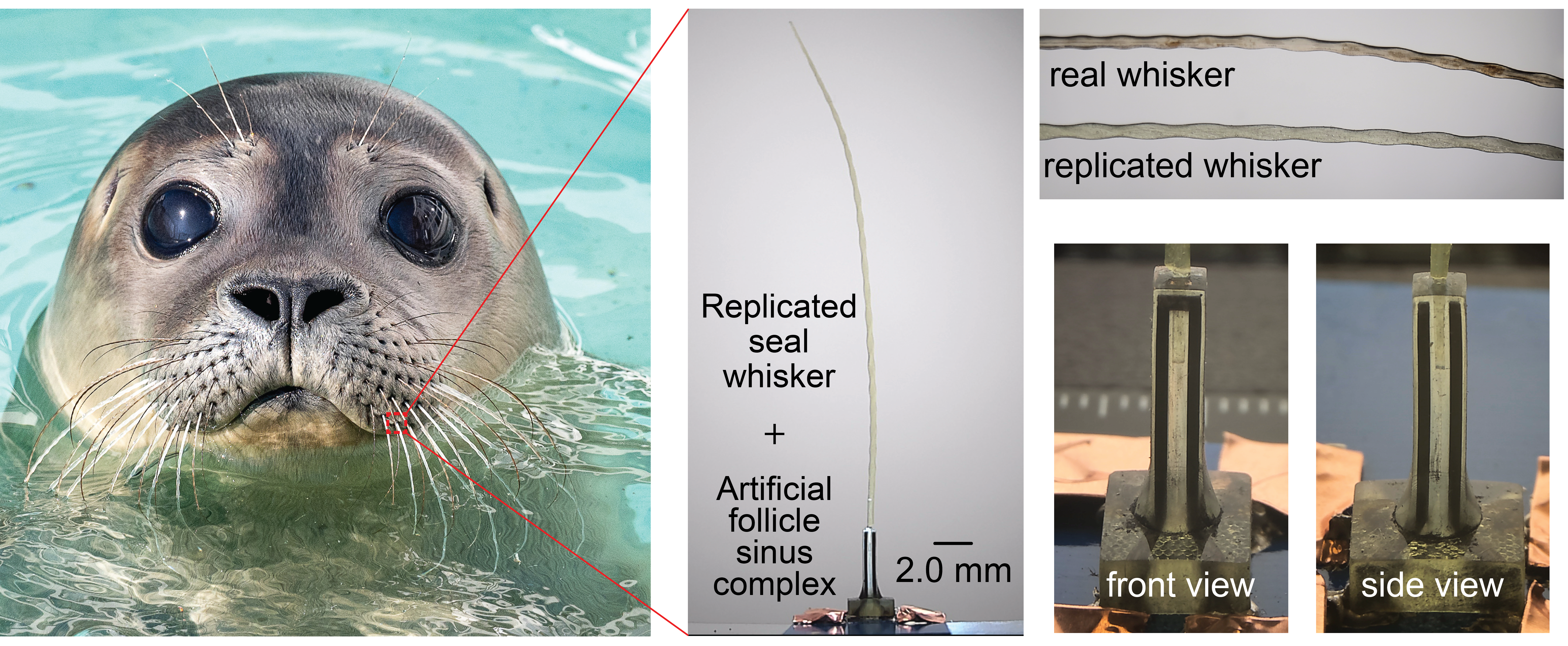

It makes you wonder: could we copy this biology to build better flow sensors?
From Biology to Engineering
Flow sensing is critical in many applications, from underwater robotics to environmental monitoring. However, conventional artificial sensors face a persistent limitation: they struggle to distinguish between self-induced vibrations (VIV) and externally induced signals (WIV). In noisy flow environments, this dramatically reduces sensitivity and reliability.
Seal whiskers offer a compelling solution. Unlike smooth cylindrical structures, their undulating geometry suppresses vortex-induced vibrations, effectively reducing background noise. While this phenomenon has been studied from a biological and fluid dynamics perspective, translating it into a functional sensing device remains a significant challenge. The difficulty lies in integration. Replicating the whisker shape alone is not sufficient. Sensing capability must also be integrated into a soft, scalable, and manufacturable structure.
A Different Approach: Printing Structure and Function Together
To address this, we developed a bioinspired flow sensor that integrates both morphology and sensing in a single system. The core idea is simple but technically demanding:
combine high-resolution 3D printing with embedded piezoresistive sensing elements.
Using projection micro-stereolithography (PµSL), we fabricated soft, high-aspect-ratio whisker structures with realistic geometries derived from biological models. Rather than relying on complex multistep fabrication processes for the sensing base, we fabricated the artificial follicle complex (AFC) in a single printing step with integrated internal channels using a soft resin through PµSL technology. The whisker and AFC were printed separately and then combined to form the final bioinspired sensor. Graphene-based piezoresistive elements were then incorporated into the microchannels of the AFC, allowing deformation at the base of the whisker to be converted into an electrical signal.
This hybrid fabrication strategy offers two key advantages:
- Geometric fidelity: complex, species-specific whisker morphologies can be replicated with micrometer-scale precision
- Functional integration: sensing elements are embedded directly within the structure, eliminating alignment and assembly issues
In short, we move from lithographic MEMS fabrication of sensors to printing sensors.
What Did We Actually Learn?
One of the most crucial conclusions from this study is not only that the sensor works but also the direct relationship between the morphology and performance.
We found out that whisker geometry has an effect on how the system responds to flows, comparing various species' whisker shapes including harbor seals, grey seals, and sea lions.
Phocids' whisker geometries (harbor and grey seals) resulted in a:
- Reduced background vibration (VIV suppression)
- Higher signal-to-noise ratios (SNR)
- Improved detection of wake-induced vibrations
In contrast, smoother whisker geometries (such as those inspired by sea lions) exhibited stronger self-induced vibrations, which masked external signals.
This confirms a key biological hypothesis: the undulating morphology is not incidental; it is functionally critical for sensing.
Beyond the Lab: Testing in Real Flow Conditions
To move beyond controlled conditions, we tested the sensors in both water and air environments. The goal was simple: figure out what these bioinspired designs would do under realistic flow conditions.
One of the main metrics we focused on was the signal-to-noise ratio. Analysis of the frequency content of the sensor response was performed to directly assess the ability of each geometry to discriminate meaningful flow signals from background vibrations. The result was obvious. Bioinspired whisker designs consistently enhanced the detectability of flow disturbances compared to conventional geometries.
Importance of This Work
The research described in this publication combines biological, material science, and sensor technology disciplines. The findings will have implications beyond a single device. First, this research shows that morphology may also be used as a parameter for sensing; therefore, the design space opens up for other types of designs where geometry is optimized in relation to material properties and electronics. Second, it illustrates how additive manufacturing technology can be leveraged in a way that allows designers more creativity when designing sensors, which would otherwise be limited by planar or simple geometries with traditional MEMS fabrication methods. Third, it advances the development of soft, distributed sensor systems that are especially valuable in the context of underwater robotics due to their ability to provide flexibility, durability, and precision.
Reaching this point, however, required addressing several nontrivial challenges. The structure needed to be soft enough to respond to flow, yet robust enough to maintain its integrity. Embedding conductive elements within microscale channels demanded careful control over materials and fabrication. Perhaps most importantly, separating meaningful flow-induced signals from structural vibrations required deliberate experimental design and signal processing.
These issues bring up a vital concept. Bioinspired design involves understanding and adjusting how the biological world operates to fit within the parameters of engineering.
Looking Ahead
There are several directions we are currently exploring. One is integrating these sensors into arrays, enabling spatial mapping of flow fields. Another is coupling experiments with fluid–structure interaction simulations to better understand how morphology shapes vortex dynamics. Ultimately, the goal is to move toward intelligent flow sensing systems that combine morphology, materials, and data-driven analysis.
Engineers have a lot to learn from how nature solves its problems; the challenge will be not only to see how these solutions work, but also to apply them in a technology driven society. As an example, seal whiskers have proven how minor changes to the shape of an object can dramatically enhance the ability of that object to sense its surroundings. By combining bioinspiration with advanced manufacturing, we move closer to sensors that are not only more sensitive but also fundamentally smarter in how they interact with their environment.
Follow the Topic
-
Microsystems & Nanoengineering
This journal, with a target for a high-end journal for years to come, seeks to promote research on all aspects of microsystems and nanoengineering from fundamental to applied research.