Behind the Paper: Where technology meets behaviour to decarbonise supply chains.
Published in Social Sciences, Earth & Environment, and Sustainability




When we began the research that ultimately became Market solutions for decarbonising supply chains in the chemical industry, our team found itself grappling with a recurring contradiction. Low-carbon technologies—from green hydrogen to electrified heat and carbon capture and storage—are technically ready. Yet deployment at scale remains painfully slow, uneven and fragmented. The enabling technology is moving; the system around it is not.
This gap motivated our central question: Why do promising low-carbon technologies struggle to scale inside chemical value chains, even when they appear economically viable on paper?
Our paper was shaped inside a multi-disciplinary environment to focus on Chemicals, and follows two previous Research White Papers exploring the specialist fields in play across the STEM-B research community at Imperial College London. Those were developed more widely with stakeholders across the value chain – putting the University’s strategic approach to Convergence Science into action.
As we progressed, global climate dialogues were echoing the same issues. At COP30, fragmented national priorities stalled stronger fossil‑fuel commitments despite intensified pressure to shift into implementation—demonstrating how ambition falters without shared rules and trusted accounting systems. Similar dynamics appeared at Davos 2026, where supply‑chain decarbonisation moved centre‑stage and leaders launched blended‑finance initiatives requiring tight coordination across sectors. Together, these signals reinforced what our modelling showed: the bottleneck is no longer technological, but behavioural and governance‑related.
Are we mad? Why we started with chemicals:
The chemical sector contributes roughly 5–6% of global greenhouse gas emissions, but what makes it difficult to decarbonise is less its energy use and more its structural complexity. One tonne of ethylene, for example, may undergo multiple transformations, cross borders, and change ownership repeatedly before reaching an end product. This makes emissions hard to track, allocate, and verify—and means that decisions taken by one actor depend heavily on expectations about many others.
Addressing this challenge required a systems perspective that integrates engineering pathways with business incentives, procurement behaviour, investment logic, and regulatory constraints. Traditional academic silos are poorly suited to such interdependent problems. A techno‑economic model may indicate a low‑carbon route is feasible; but whether suppliers adopt it, whether buyers pay for it, and whether emissions reductions are ultimately verified depend on behavioural norms, accounting rules, market incentives, and trust.
By drawing together engineering, business, behavioural science, data science, and sustainability governance, we built a transdisciplinary observatory to explore what drives—or stalls—low‑carbon transitions. Our aim was to develop a market model capable of transferring the value of decarbonised chemicals throughout the value chain.
If this approach works for chemicals, it can be rapidly applied to other complex, high‑emission industrial systems.
Why Insetting matters
Insetting offers a fundamentally different dynamic by keeping both the responsibility and the value of emissions reductions within the supply chain. Instead of directing investment outside the value chain, it channels resources into the very actors who can decarbonise production, strengthen supplier relationships, and accelerate transformation. By retaining this value internally, insetting creates a direct incentive for companies to invest in verifiable emissions reductions where they matter most.
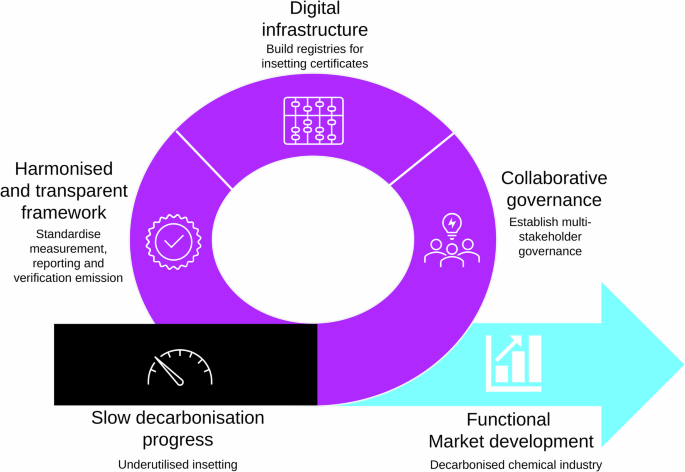
Our research identifies three enabling mechanisms required to make insetting real and scalable:
- Harmonised, transparent accounting frameworks to prevent double counting.
- Digital traceability so reductions can be verified, transferred, and retired with integrity.
- Collaborative governance so actors across regions, sectors, and organisational sizes can participate.
These three elements together allow upstream producers to generate verified reductions that downstream buyers can credibly claim—without needing to segregate materials physically. Our paper proposes a pathway to build these foundations in the chemical sector. It introduces a certificate‑based model where upstream producers generate verified reductions that downstream buyers can claim, even when physical segregation is impossible. This aligns incentives across the chain and helps unlock investment in low‑carbon production.
Rather than evaluating decarbonisation technology in isolation, we embed it in the industrial realities that shape adoption:
- How do suppliers assess switching costs?
- What decision rules do procurement teams follow when comparing conventional and low‑carbon alternatives?
- Which signals from investors accelerate or hinder transformation?
- Do collaborative commitments across a supply chain unlock innovation faster than individual firm actions?
The findings underscore an emerging truth: behavioural and organisational factors shape technology adoption as much as cost curves or engineering feasibility.
Looking forward
Our work shows that decarbonising the chemical value chain—and other heavy industrial systems—is not just an engineering challenge but a systems challenge. Progress depends on new forms of coordination: shared incentives, trusted data, and decision‑making norms that cut across companies and sectors.
Creating this environment requires cooperative, non‑competitive collaboration. Many of the necessary pieces already exist across the ecosystem; the task now is to connect and align them. While our research is grounded in the chemical sector, the approaches we explore—especially insetting, digital traceability, and collaborative governance—are readily transferrable to other hard‑to‑abate industries.
We see an opportunity to work with partners to shape a practical, cross‑sector roadmap: one that builds on existing initiatives, expands beyond plastics and chemicals, and tests new business models that reward verified emissions reductions across value chains. We welcome collaboration from organisations interested in helping to accelerate this next phase of industrial decarbonisation.

Follow the Topic
-
Communications Sustainability
An open-access journal publishing high-quality, editorially selected and peer-reviewed advances in all sustainability-related areas of science, including the natural and social sciences as well as engineering.

What are SDG Topics?
An introduction to Sustainable Development Goals (SDGs) Topics and their role in highlighting sustainable development research.
Continue reading announcementRelated Collections
With Collections, you can get published faster and increase your visibility.
Carbon Dioxide Removal
Publishing Model: Hybrid
Deadline: Jan 16, 2027
Critical materials supply chain sustainability
Publishing Model: Open Access
Deadline: Oct 26, 2026