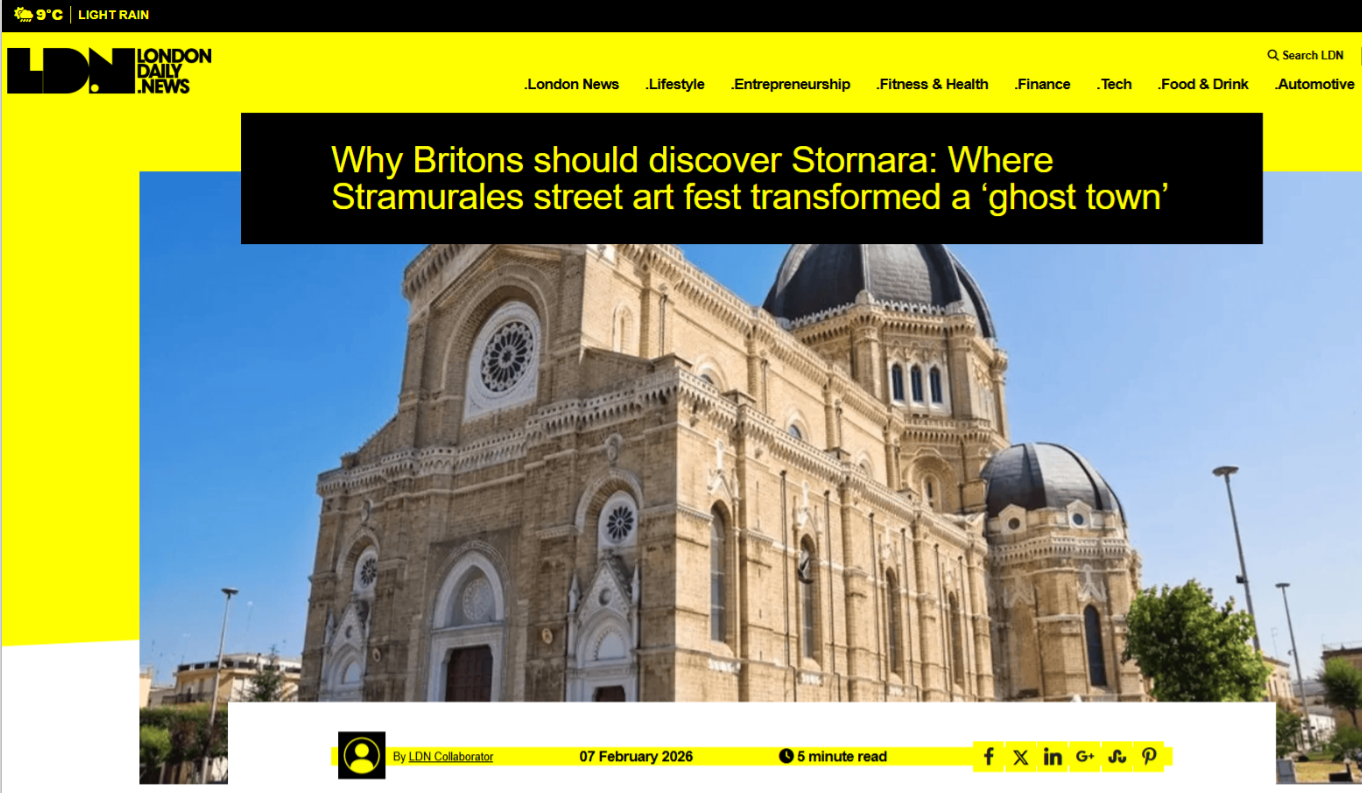
Beyond the Crowded Centre: Slow Tourism, Street Art and Rural Regeneration in Stornara (London Daily News/Stramurales)
Published in Social Sciences and Education
SOURCE: https://doi.org/10.5281/zenodo.18519276
While Italy remains consistently among the top three destinations for British outbound travellers [ISTAT, 2023; VisitBritain, 2023], visitor flows remain highly concentrated. Data from the European Parliament's study on overtourism shows that 5% of destinations account for over 50% of arrivals in Southern Europe, creating what Milano, Novelli and Cheer define as overtourism: excessive pressure on infrastructure, housing and cultural heritage.[Peeters et al., 2018][2019]
This concentration narrows understanding of Italy's cultural diversity and deepens regional economic disparities, particularly between northern urban centres and rural areas of the Mezzogiorno.
The problem of imbalance
The imbalance is not merely logistical. Research on tourism carrying capacity demonstrates that over-concentration produces cultural and environmental degradation, resident displacement and diminished visitor satisfaction [Dodds & Butler, 2019]. For Apulia, ISTAT data shows tourism employment concentrated along the Gargano and Salento coasts, while interior agricultural towns like Stornara in the province of Foggia experience continued depopulation and youth out-migration.
This pattern exemplifies what OECD analyses of rural tourism identify as a missed opportunity: rural areas possess high cultural and gastronomic capital but lack infrastructure for sustainable visitor economies that retain value locally [OECD].[2020]
Stornara as a case of culture-led regeneration
Stornara, a town of approximately 5,000 residents, has pursued an alternative pathway centred on the Stramurales International Street Art Festival, organised since 2018 by the community association Stornara Life APS.
Rather than importing a tourism product, the festival operationalises principles of community-based tourism [Goodwin & Santilli, 2009] and creative placemaking. Over 150 murals have transformed private façades into a distributed open-air museum, co-produced with residents who donate walls, host artists and vote on annual themes.
The literature on street-art tourism is instructive here. Andron and Watzke show that murals, when rooted in participatory governance rather than municipal branding, generate what is termed 'affective atmospheres' - emotional attachments that encourage longer stays and return visits without requiring heavy infrastructure. This contrasts with top-down mural districts, which often accelerate gentrification.[2022]
In seven years of fieldwork in Stornara [2018-2024], I observed that the festival functions as a cultural ecosystem service: it improves aesthetic quality of the built environment, creates communal gathering spaces during its annual production week, and supports micro-enterprises linked to local food production.
Slow tourism and existential authenticity
The shift described aligns with research on slow tourism, originally conceptualised by Dickinson and Lumsdon as an alternative to fast, high-carbon, checklist travel that emphasises connection, duration and locality.[2010]
Slow tourism resonates strongly with contemporary British travel preferences. Post-pandemic studies show UK travellers increasingly seek what Wang terms existential authenticity - experiences perceived as genuine, participatory and socially meaningful, rather than staged performances of heritage. MacCannell's foundational work on staged authenticity remains relevant: visitors differentiate between settings designed for tourists and communities that invite participation on their own terms.[1999][1973]
Stornara's gastronomic traditions - centred on durum wheat, pomodoro and olive oil chains with protected designations - illustrate this. Research on food tourism and short supply chains demonstrates that such embedded food systems contribute to both visitor wellbeing and local economic resilience by shortening value chains [Everett & Aitchison, 2008].
Importantly, this model avoids the extractive logic of mass tourism. Richards and Raymond's work on creative tourism emphasises co-creation over consumption: visitors learn mural techniques, participate in communal meals and engage in intercultural exchange, which strengthens social capital rather than depleting it.[2000]
Implications for sustainable regional development
Stornara does not offer a template to replicate identically, but a set of transferable principles relevant to SDG 8 [Decent Work], SDG 11 [Sustainable Communities] and SDG 12 [Responsible Consumption].
First, it demonstrates that low-infrastructure cultural festivals can redistribute tourism income inland when governance remains local and transparent. Second, it shows that aesthetic regeneration can be preventive rather than promotional: it improves residents' quality of life first, which then creates conditions for responsible visitation.
For policy, the case suggests three lessons supported by literature: invest in community cultural organisations rather than only in destination marketing, measure success through resident wellbeing and place attachment rather than arrivals alone, and integrate street art and food heritage into regional development strategies as recognised by the European Commission's Cultural and Creative Cities Monitor.
Rural Italy does not need to become a 'ghost town' turned theme park. When communities democratically author their own transformation, as in Stornara, tourism becomes a secondary outcome of wellbeing, not its replacement.
References
Andron, S. (2022). Graffiti, street art and the right to the city. Urban Studies. https://doi.org/10.1177/00420980221114279
Dickinson, J., & Lumsdon, L. (2010). Slow Travel and Tourism. Earthscan.
Dodds, R., & Butler, R. (2019). Overtourism: Issues, realities and solutions. De Gruyter.
Everett, S., & Aitchison, C. (2008). The role of food tourism in sustaining regional identity. Journal of Sustainable Tourism, 16(2), 150-167.
Goodwin, H., & Santilli, R. (2009). Community-based tourism: A success? ICRT Occasional Paper 11.
MacCannell, D. (1973). Staged authenticity. American Journal of Sociology, 79(3), 589-603.
Milano, C., Novelli, M., & Cheer, J. M. (2019). Overtourism and degrowth. Tourism Planning & Development, 16(4), 353-357.
OECD (2020). Rural Well-being: Geography of Opportunities. OECD Publishing.
Peeters, P., et al. (2018). Research for TRAN Committee - Overtourism. European Parliament.
Richards, G., & Raymond, C. (2000). The business of creative tourism. Journal of Tourism Studies.
Wang, N. (1999). Rethinking authenticity in tourism experience. Annals of Tourism Research, 26(2), 349-370.
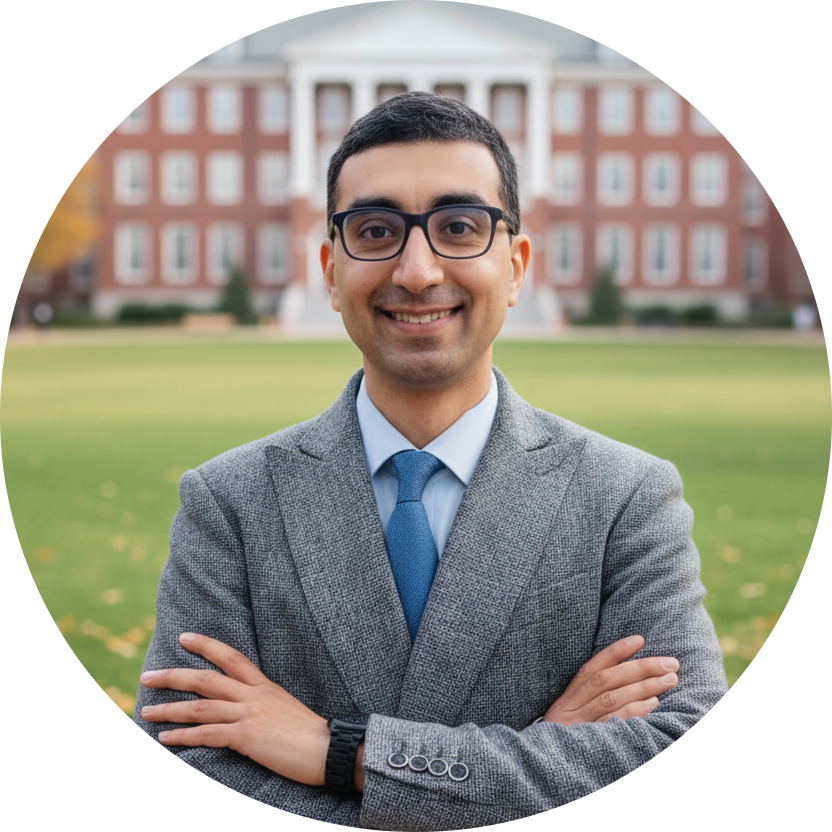
- Pluriennal high-tech practictioner at Google Ireland (Dublin), Apple EU Headquarters (Cork), and Amazon Slovakia (Bratislava).
- Alumnus of Aspire Institute, Harvard Business School.
- Current Member of Harvard Aerospace and Defense Alumni Organization (HADAO).
- Former Member of the White House Historical Association (WHHA).
- Former Member of Yale Club of New Haven (YCNH).
- International Journalist with numerous pieces/interviews featured on London Daily News, New York Post, Los Angeles Journal, The Hill, The Washington Post Opinion, Fox News USA, The Associated Press, The Daily Mirror UK, Metro UK, BBC News World Services, AS USA, Yahoo, AOL, MSN, The Scottish Daily Express, The Daily Record Scotland's Champion, L' Essentiel Luxembourg, 20Minuten.ch, NYC Up Magazine, Yale Daily News, The Stanford Daily, The Psychologist, Popular Archeology, Hollywood Beats Magazine, Opera Gazet, Corriere della Sera, Blog L' Espresso-Repubblica "Fino a Prova Contraria", Blog Nicola Porro, Agenda Digitale.
- Contributing Academic Author to the "Stanford Social Innovation Review" at Stanford University.
- Contributing Academic Author to the Faculty of Law B., University of Oxford.
- Contributing Academic Book Critic to the LSE Review of Books with Executive Education Certificate in Communication from the London School of Economics (LSE) and Political Science.
- Alumnus of the Aspire Institute, Harvard Business School.
- Pro PhD and MBA at the European Open University, Germany.
- Open Researcher and Contributor ID (ORCID):
0009-0003-9392-9213
- Web of Science ResearcherID:
OYE-6074-2025
- Google Scholar:
https://scholar.google.com/citations?user=XALdgW8AAAAJ&hl=it
- Zenodo Author Page Profile:
https://zenodo.org/search?q=metadata.creators.person_or_org.name%3A%22Magaldi%20Sardella%2C%20Luciano%22&l=list&p=1&s=10&sort=bestmatch
- Academia.edu Profile: https://cambridge.academia.edu/LucianoMagaldiSardellaPhD
- ResearchGate Profile:
https://www.researchgate.net/profile/Luciano-Magaldi-Sardella