Biohybrid Nanocatalysts Unlock Efficient C–C Bond Chemistry

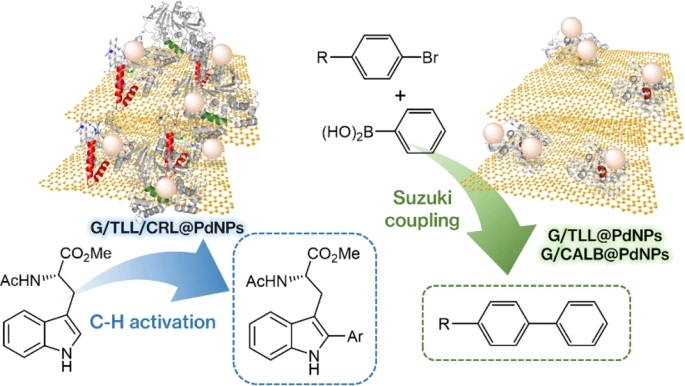
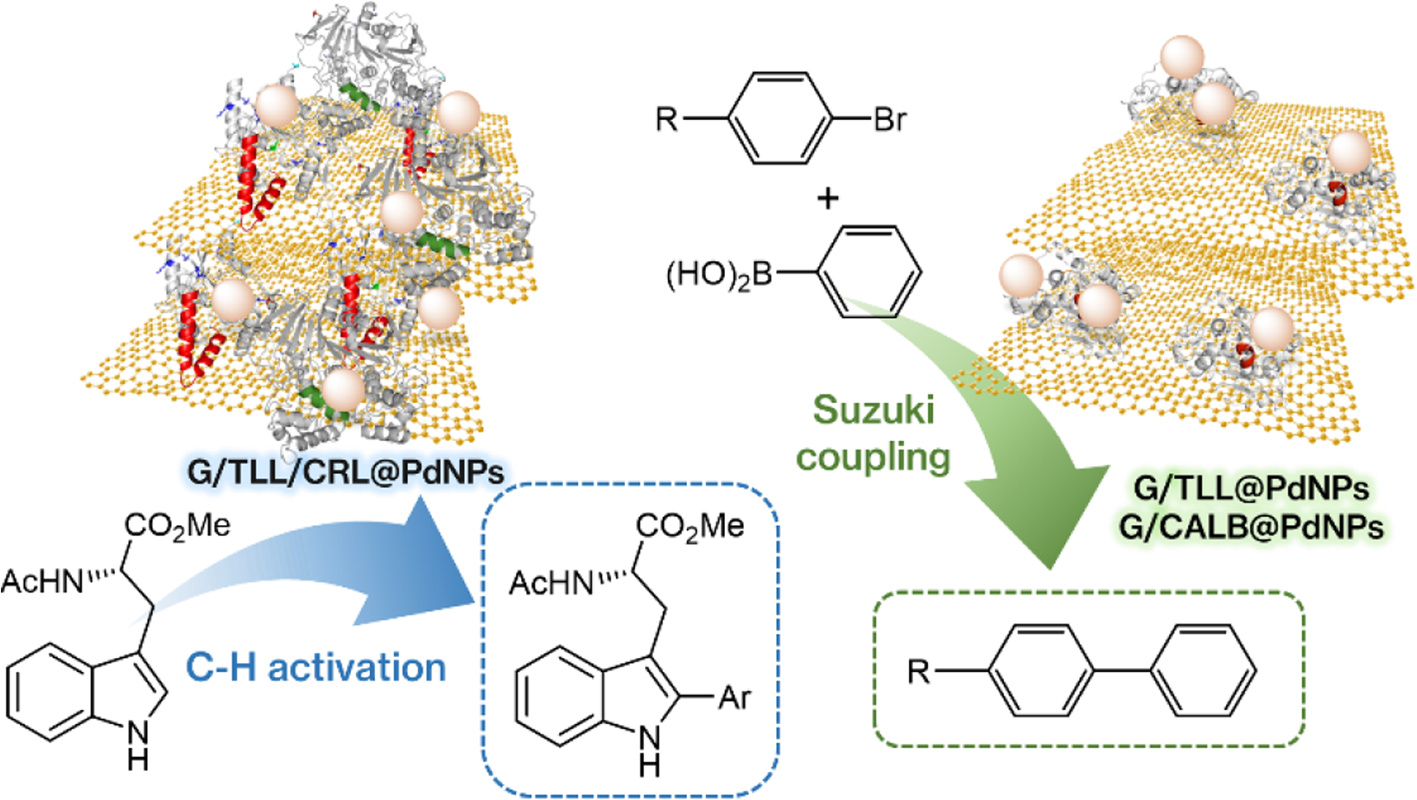

We report heterogeneous enzyme–metal nanoparticle biohybrids prepared by in‑situ growth of Pd and Cu nanoparticles on lipases immobilized over few‑layer graphene, enabling selective and efficient C–H activation and Suzuki–Miyaura coupling under mild, green conditions. By leveraging enzyme scaffolds to control nanoparticle size (≈2–3 nm) and metal speciation (Pd⁰/PdO), we achieve high activity and selectivity in aqueous and organic media at or near room temperature.
Key Highlights
- Hybrid catalyst platform using graphene‑immobilized lipases (CALB, TLL, CRL) to direct the formation of Pd and Pd/Cu nanoparticles.
- Controlled nanoparticle size and oxidation state through enzyme identity and immobilization strategy.
- Dual‑enzyme Pd hybrid achieves >95% yield in selective C‑2 C–H arylation at room temperature, with TOF up to 5000 h⁻¹ (surface‑normalized).
- Pd⁰‑rich single‑enzyme systems show optimal performance in Suzuki–Miyaura cross‑coupling in aqueous media.
- Catalysts are stable, recyclable, and accessible via a simple one‑pot aqueous synthesis.
Significance
This work establishes a scalable and versatile strategy for designing artificial metalloenzyme‑like catalysts in which enzymes function as scaffolds, reductants, and stabilizers of metal nanoparticles. Fixation of enzymes in an open conformation on graphene enables full accessibility of metal active sites and overcomes long‑standing compatibility challenges between biocatalysis and metal catalysis. The demonstrated ability to rationally tune nanoparticle size and oxidation state provides a powerful framework for sustainable and selective C–C bond formation relevant to pharmaceutical and fine‑chemical synthesis.
Authors
Noelia Losada‑Garcia; Clara Ortega‑Nieto; Jose M. Palomo*
Instituto de Catálisis y Petroleoquímica (ICP), CSIC, Madrid, Spain
Corresponding author email: josempalomo@icp.csic.es
Follow the Topic
-
Catal
Catal is an open access journal covering full spectrum of catalysis critical advances. From biocatalysts to heterogeneous catalysts, it integrates fundamental and applied sciences. Catal offers a primary platform for researchers and practitioners in the field.

Related Collections
With Collections, you can get published faster and increase your visibility.
Porous Materials for Sustainable Green Catalysis
The advancement of our collective understanding in the field of porous materials for sustainable green catalysis is crucial as we face urgent environmental challenges and the need for sustainable energy solutions. The integration of porous materials into catalytic processes has opened new avenues for improving efficiency, selectivity and stability while minimizing waste. Significant advances have been made, including the development of zeolites, mesoporous materials, metal-organic frameworks (MOFs) and covalent organic frameworks (COFs), which have demonstrated remarkable catalytic performance in various reactions.
Future research holds immense potential, with speculations ranging from the design of novel porous materials with tailored properties to their application in industrial catalysis, biocatalysis, H2 production and carbon capture technologies. By continuing this research, we can drive progress toward achieving Sustainable Development Goals (SDGs), particularly in clean energy (SDG 7) and climate action (SDG 13), ultimately fostering a sustainable future for our planet.
We invite researchers to contribute to this special Collection by submitting research articles, brief communications, perspectives, reviews, and analyses.
Topics of interest include but are not limited to:
- Synthesis of porous materials
- Catalytic performance evaluation
- Green synthesis methods
- Application in environmental remediation
- CO2 conversion technologies
- Biocatalysis in porous matrices
- Design of multifunctional porous catalysts
- Mechanistic studies of catalysis
Publishing Model: Open Access
Deadline: Dec 31, 2026
National Catalysis Conference 2025
The 22nd National Catalysis Conference, held in December 2025 in Xiamen, China, stands as the largest national academic event in the field of catalysis, bringing together leading scientists from academia and industry to discuss frontier research and emerging technologies across catalytic science.
In collaboration with several internationally recognized researchers from Xiamen University - the main organizer of the conference - Catal will publish a Special Issue featuring selected contributions from the meeting. This joint effort ensures high academic standards and showcases the scientific breadth and excellence presented at the conference.
Potential topics include, but are not limited to:
• Catalytic materials
• Thermocatalysis
• Electrocatalysis
• Biomass and CO₂ conversion
• Industrial catalysis
• Theoretical and computational catalysis
Publishing Model: Open Access
Deadline: Dec 31, 2026