Cactus Thorn‑Inspired Janus Nanofiber Membranes as a Water Diode for Light‑Enhanced Diabetic Wound Healing
Published in Materials
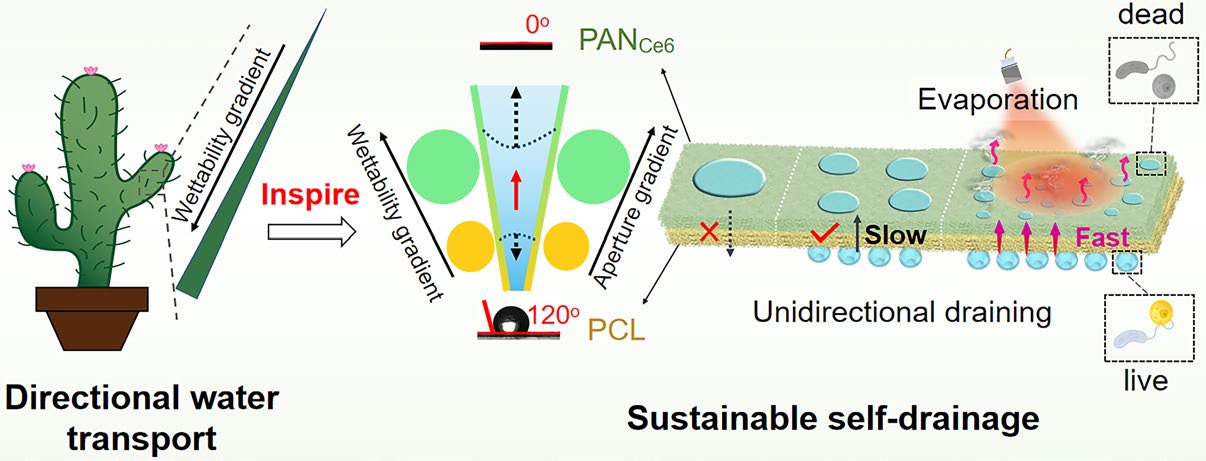


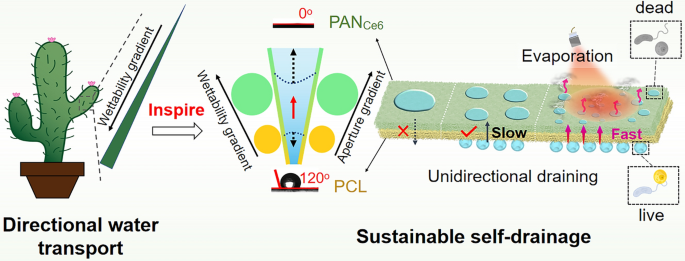

Diabetic ulcers remain a clinical nightmare: chronic exudate fuels infection, inflammation drags on, and amputation looms for one in four patients. Now, a team led by Prof. Zhigang Chen at Donghua University and Prof. Yu Chen at Shanghai University has translated the cactus thorn’s one-way water transport trick into a photonic Janus dressing that drains, disinfects and repairs all at once. Their design, published in Nano-Micro Letters, hits a 96 % healing rate in diabetic mice within 17 days.
Why a “Water Diode” Matters
- Continuous Exudate Clearance: A hydrophobic-to-hydrophilic gradient pumps fluid upward at 0.95 g cm-2 h-1, preventing maceration and wash-out of growth factors.
- On-Demand Sterilization: Embedded chlorin e6 converts 660 nm light into 45 °C heat and singlet oxygen, wiping out 99 % of E. coli and S. aureus without antibiotics.
- Immune Reprogramming: By drying the wound and killing bacteria, the membrane flips macrophages from pro-inflammatory M1 to pro-healing M2, cutting TNF-α and IL-6 by half.
Innovative Design and Features
- Dual-Gradient Architecture: Electro-spun PCL (large pores, 110° contact angle) topped with PAN/Ce6 (small pores, 0° contact angle) creates capillary and wetting forces that act like a diode—liquid only flows out, never back in.
- Light-Enhanced Drainage: Photothermal evaporation boosts the outward flow 1.33-fold, keeping the dressing unsaturated and the wound optimally moist.
- Single-Layer Simplicity: No pumps, batteries or hydrogel reservoirs—just a 100 µm patch that adheres gently and peels off trauma-free.
Applications and Future Outlook
- Chronic Wounds: Validated in type-2 diabetic mice, the membrane accelerates closure to 96 % versus 60 % for gauze, while restoring collagen, vessels and hair follicles.
- Scalable Manufacturing: Continuous electrospinning rolls out meter-scale Janus mats compatible with existing wound-care converters.
- Next Steps: Team is optimizing Ce6 loading for room-light activation and preparing large-animal studies toward first-in-human trials slated for 2027.
This cactus-inspired “water diode” offers a one-step, drug-free strategy to break the infection-inflammation cycle in diabetic wounds. Stay tuned for more translational advances from the Chen–Chen joint lab!

Editor of Nano-Micro Letters, which is an Open-Access, peer-reviewed journal reported papers that have at least one dimension ranging from a few sub-nanometers to a few hundreds of micrometers. The journal is published by Springer Nature and indexed by SCI, EI, SCOPUS, Pubmed, etc. The 2025 JCR Impact Factor is 38.5. The 2025 CiteScore is 58.9.
Follow the Topic
-
Nano-Micro Letters
Nano-Micro Letters is a peer-reviewed, international, interdisciplinary and open-access journal that focus on science, experiments, engineering, technologies and applications of nano- or microscale structure and system in physics, chemistry, biology, material science, and pharmacy.