Call-for-papers: “Machine Learning in Gravitational-Wave Science”
Published in Physics, Computational Sciences, and Statistics



The journals General Relativity and Gravitation and Living Reviews in Relativity have opened a joint Topical Collection on “Machine Learning in Gravitational-Wave Science”, which aims to include review articles and original research.
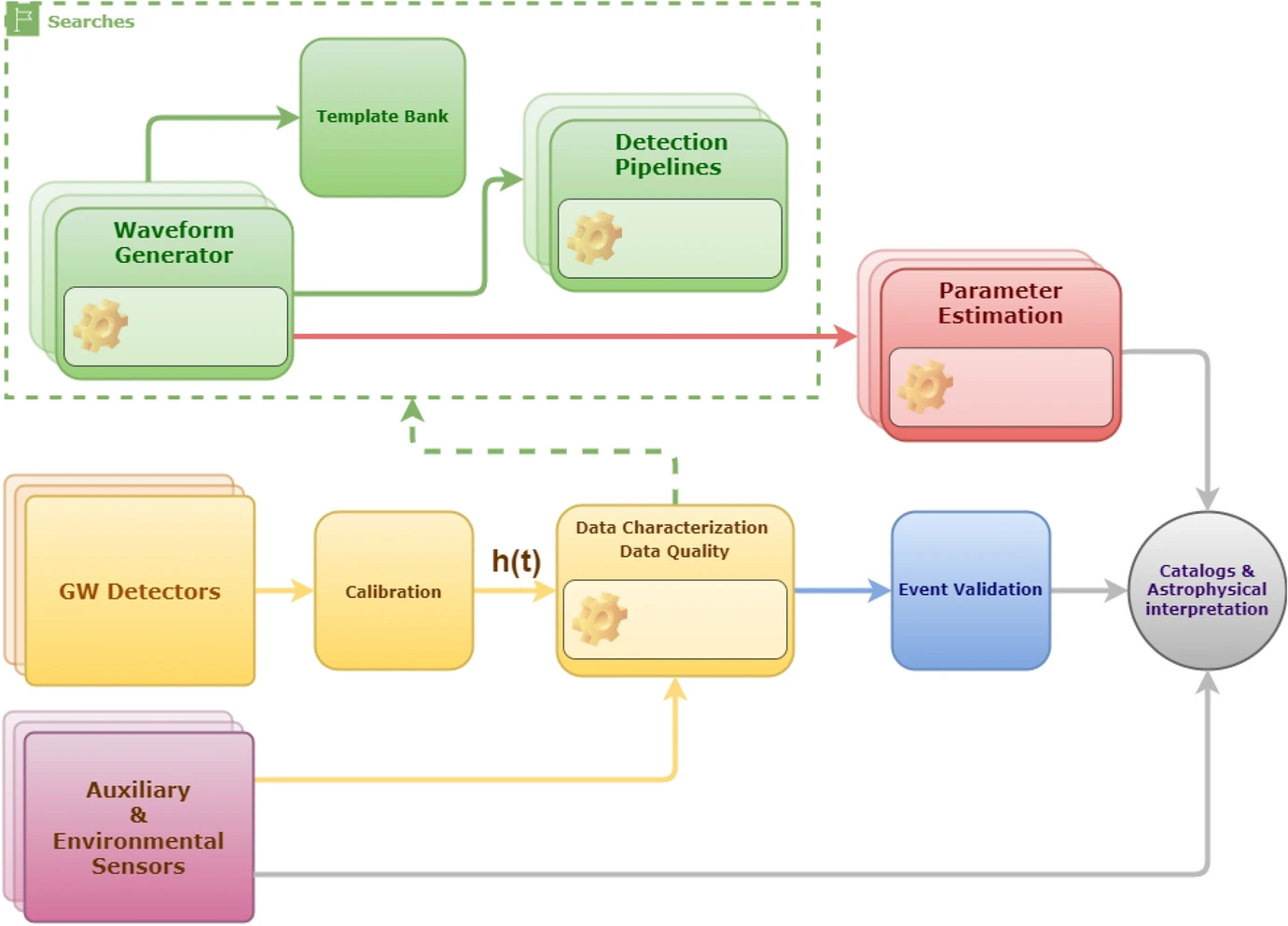
While the recent Living Review “Applications of machine learning in gravitational-wave research with current interferometric detectors” by Cuoco et al. (2025) serves as a general introduction to the topic, we encourage authors to submit their work on specific applications of machine learning methods, neural networks, and deep learning techniques in GW data analysis, including noise reduction and mitigation, signal detection, parameter estimation, classification and interpretation of astrophysical sources to the journal General Relativity and Gravitation.

Follow the Topic
-
General Relativity and Gravitation
General Relativity and Gravitation is a journal devoted to all theoretical and experimental aspects of modern gravitational physics.

Related Collections
With Collections, you can get published faster and increase your visibility.
Geometry of Classical and Quantum Space-Times (Jerzy Lewandowski Memorial Conference)
Based on contributions from the Jerzy Lewandowski Memorial Conference, held from September 15–19, 2025, at the Banach Center in Warsaw, this collection of peer-reviewed articles intends to include review papers as well as original research honoring his memory and continue scientific discussions in the areas that were central to his research passion.
All speakers, as well as selected poster presenters, are invited to submit their papers for peer review to the journal General Relativity and Gravitation. Publication under the subscription model is free of charge, open-access is offered for a fee or under the terms of Springer's institutional agreements.
Publishing Model: Hybrid
Deadline: Sep 30, 2026
Extremal Black Holes and the Third Law of Black Hole Thermodynamics (ICERM Topical Workshop 2026)
This collection is based on peer-reviewed contributions from ICERM's Topical Workshop at Brown University, where researchers in mathematical and numerical relativity gathered to discuss extremal black holes and the implications of a recent disproof of the third law of black-hole thermodynamics. The dynamics and criticality of extremal and near-extremal black holes are particularly interesting in light of recently found instabilities.
The rigorous mathematical proof that an extremal Reissner–Nordström black hole can form dynamically raises questions about the regions of parameter space that do so as well as speculations about extremal Kerr dynamics. Numerical and mathematical work of workshop participants address many of these questions.
All speakers are invited to submit their papers for peer review to the journal General Relativity and Gravitation. Publication under the subscription model is free of charge, open-access is offered for a fee or under the terms of Springer's institutional agreements.
Publishing Model: Hybrid
Deadline: Aug 30, 2026




Please sign in or register for FREE
If you are a registered user on Research Communities by Springer Nature, please sign in