Can defects turn a metal oxide into a plasmonic catalyst?
Published in Materials

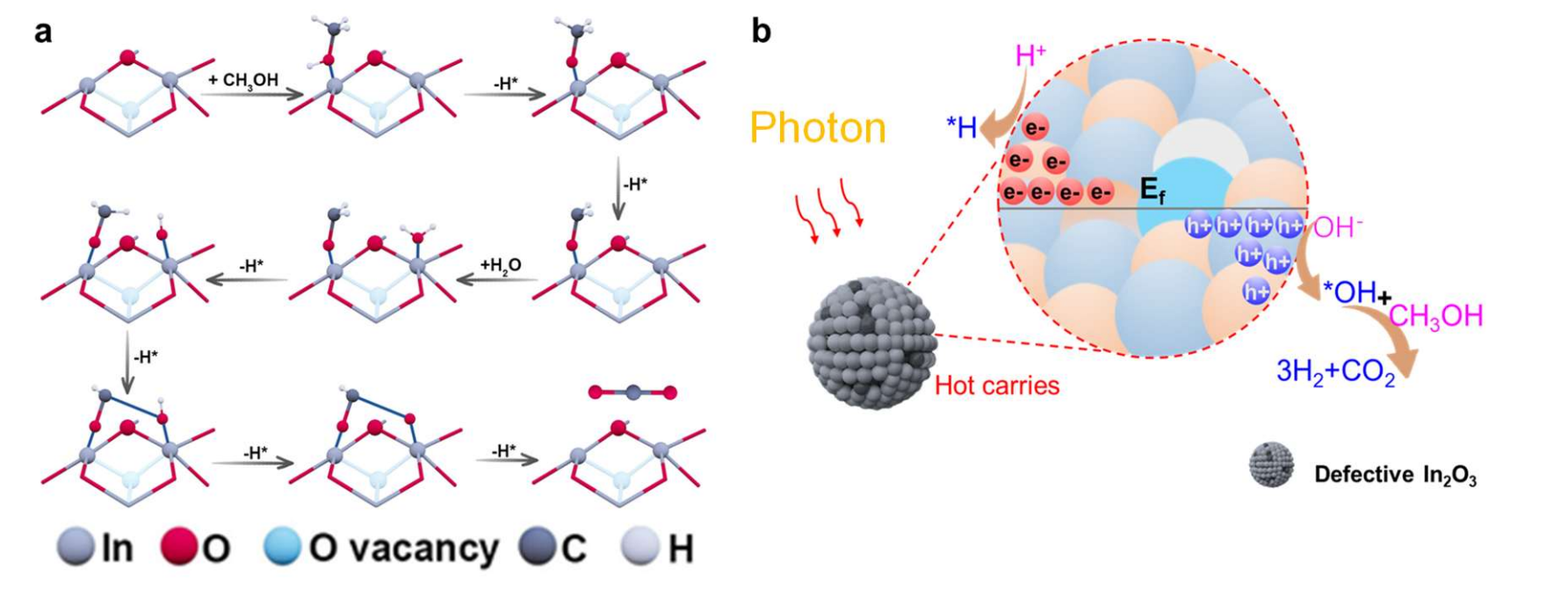
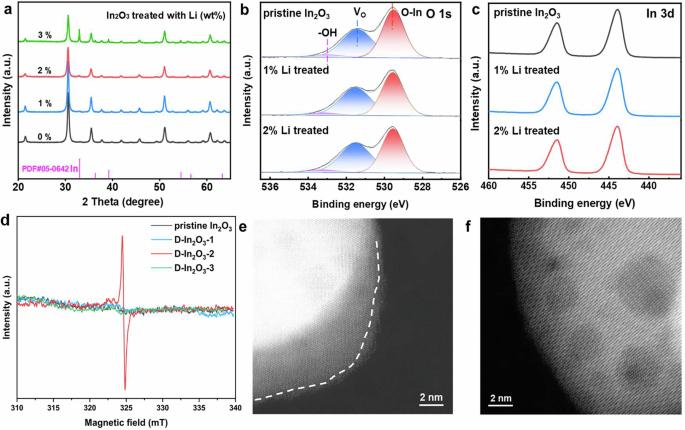

Methanol is an attractive liquid hydrogen carrier, but conventional methanol steam reforming typically requires high temperatures and often relies on precious-metal catalysts. We wondered whether a simple metal oxide could be engineered to harvest light and drive this reaction more efficiently. By using a room-temperature lithium-reduction strategy, we introduced oxygen vacancies into In₂O₃, increasing its free-carrier concentration and giving rise to a broad near-infrared plasmon-like response.
The optimized defective In₂O₃ achieved a hydrogen production rate of 214 μmol gcat⁻¹ s⁻¹ under full-spectrum irradiation, together with high CO₂ selectivity and stable performance over 40 cycles. More importantly, matched-temperature controls showed that photothermal heating alone could not explain the high activity: the apparent activation energy decreased from 75.7 to 27.8 kJ mol⁻¹ under illumination.
Combining in-situ spectroscopy and theoretical calculations, we found that oxygen vacancies not only reshape the reaction pathway but also create an electronic environment that enables light-generated carriers to facilitate key dehydrogenation steps. Our work suggests that defect engineering can turn conventional metal oxides into non-noble-metal plasmonic catalysts, offering a new strategy for light-assisted hydrogen production and solar-to-chemical conversion.
Follow the Topic
-
Nature Communications
An open access, multidisciplinary journal dedicated to publishing high-quality research in all areas of the biological, health, physical, chemical and Earth sciences.

Related Collections
With Collections, you can get published faster and increase your visibility.
Women's Health
Publishing Model: Hybrid
Deadline: Ongoing
Data for AI, AI for Data: cross-disciplinary cleaning, processing and analysis approaches
Publishing Model: Open Access
Deadline: Dec 31, 2026

