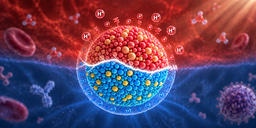
Screening a Million Membranes for Carbon Capture with Machine Learning
Published in Chemistry, Earth & Environment, and Ecology & Evolution

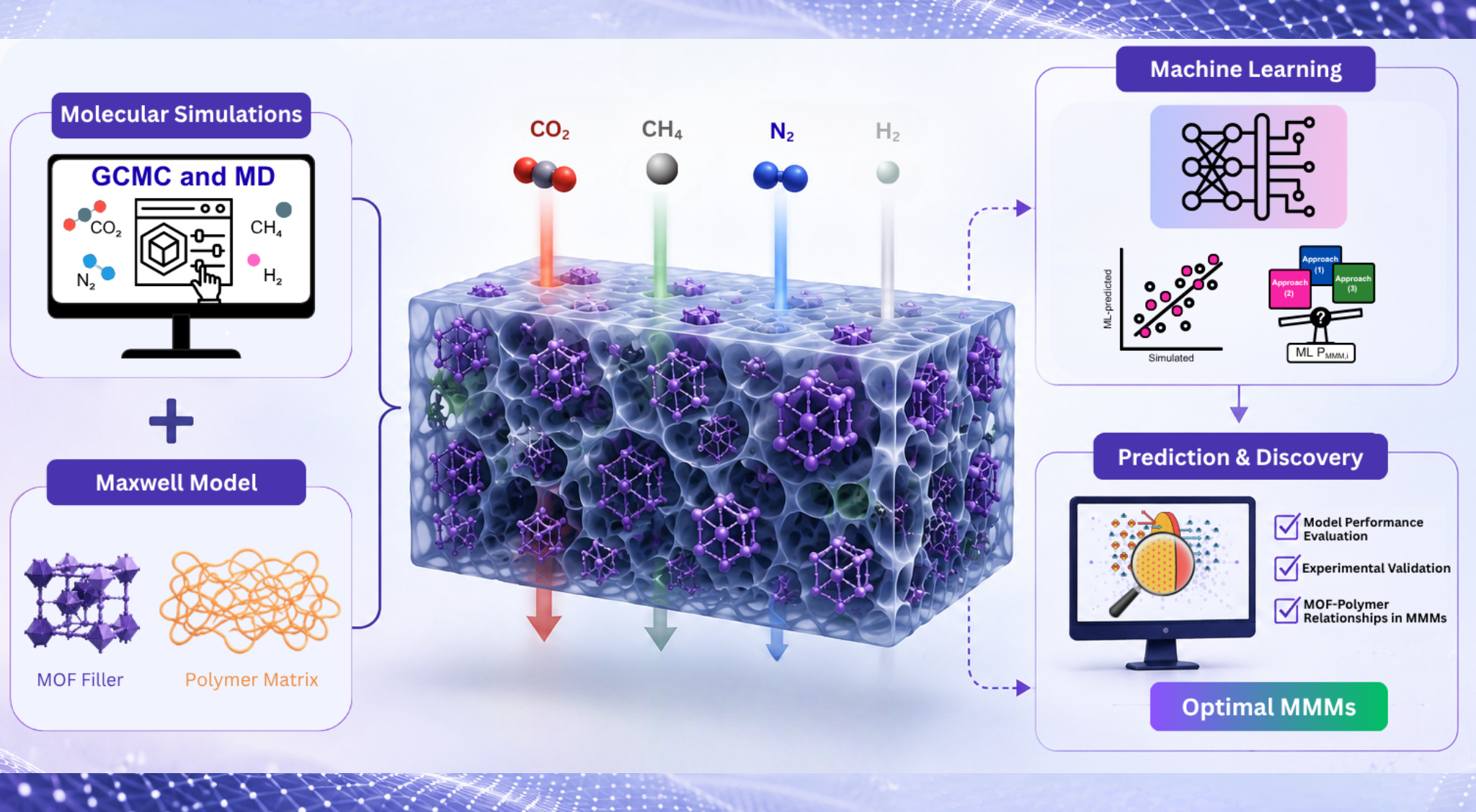

Most membranes used in gas separation industry are made of polymers, because polymers are inexpensive and easy to process. However, polymers face a well-known trade-off between permeability and selectivity. One way to overcome this limit is to add porous filler particles to the polymer to make mixed-matrix membranes (MMMs). We focused on metal-organic frameworks (MOFs) as the fillers in our work. MOFs are crystalline materials made of metal ions connected by organic molecules, and they have ordered pores that can be tuned in size and chemistry to selectively separate gas molecules. The 2025 Nobel Prize in Chemistry was awarded for the development of MOFs since these novel materials can capture carbon dioxide and separate molecules. Placing the right MOF inside a polymer can produce a MMM with high performance. This is where the problem becomes difficult. More than 150,000 MOF structures have been reported to date, and the number keeps growing. Combined with the many available polymers, the number of possible MMMs reaches into the millions. No laboratory can synthesize and test even a small fraction of them since experiments require a lot of time and resources.
Motivated by this problem, we constructed a dataset of 104,196 MOF/polymer MMMs, built from 8,683 MOFs and 12 polymers. The polymers were chosen to cover a wide range from low to very high permeability, so that our conclusions would not be limited to a single type of polymer. Across this dataset we studied four gases, CO2, CH4, N2, and H2, which together cover the separations most relevant to industry, CO2/CH4, CO2/N2, and H2/CO2, which are known as natural gas purification, flue gas separation, and hydrogen purification. Our aim was to provide guidance for experimentalists, pointing them toward the MOF-polymer combinations that look most promising before any synthesis begins.
To estimate how each membrane would perform, we first performed molecular simulations. These calculations track how gas molecules are adsorbed and how they move through each MOF at a fixed temperature and pressure, which gives us the adsorption and diffusion properties needed to predict membrane performance. Simulations are accurate, but they require long times and large computational resources. Running them for every possible membrane would take an impractical amount of time. This is why we decided to use machine learning. Once we had simulation data for thousands of MOFs, we trained machine learning models to predict the behavior of the remaining structures in a fraction of the time. The simulations provide a reliable foundation, and the machine learning provides speed. Together they let us cover far more combinations than either method could on its own. We did not assume there was one correct way to do this. Instead, we developed and compared three distinct machine learning strategies that learn membrane performance at different levels, and we tested all three against both our simulations and a large set of experimental measurements reported for MMMs in the literature. This comparison was the part we found most useful, because it let us see which strategy gives the most reliable and generalizable predictions rather than relying on a single assumption. We found that predicting the gas permeability of the MOF directly, and then combining it with the polymer, gave results closest to both simulation and experiment, while remaining simple and fast.
Using this approach, we screened MMMs for three industrially important gas separations and found that many MOF/polymer MMMs can exceed the Robeson upper bound. By focusing on one highly permeable polymer, we found that the pore size of the MOF is a key factor controlling membrane performance. This turns a long list of candidates into concrete design guidance. The part we are most glad to share is that we made all our models and data publicly available. Researchers without access to large computing resources can use our data to screen MOF/polymer combinations before going to the lab. We hope this lowers a practical barrier and helps more groups design MMMs for gas separations.
Looking back, the most rewarding part of this work was watching a search that seemed impossible become manageable. There are real limitations. Our simulations treat MOFs as perfect, defect-free crystals, while real membranes contain imperfections, so our predictions describe trends and ranges rather than exact values. But as a first filter that directs experiments toward the most promising candidates, we believe this framework can save considerable time and effort and bring useful membranes closer to reality.
Follow the Topic
-
Communications Materials
A selective open access journal from Nature Portfolio publishing high-quality research, reviews and commentary in all areas of materials science.
Related Collections
With Collections, you can get published faster and increase your visibility.
Smart windows for sustainable buildings
Publishing Model: Open Access
Deadline: Oct 31, 2026
2D materials for neuromorphic applications
Publishing Model: Open Access
Deadline: Dec 20, 2026