Cancer-associated Histone H3 N-terminal arginine mutations disrupt PRC2 activity and impair differentiation
Published in Cancer


Oncohistones and Cancer
Our cellular DNA doesn’t function in isolation, but instead exists in form of a highly organized chromatin structure consisting of DNA-protein complexes which are extensively remodeled and modified to regulate diverse cellular processes. Nucleosomes, consisting of 147 bp of DNA wrapped around an octamer of histone proteins serve as fundamental units of chromatin1. Packaging of DNA into nucleosomes not only allows our DNA to fit into a confined nuclear space, but allows it to do so in a highly organized manner wherein nucleosome packaging can regulate the access of genetic information to molecular machinery in the cell, invariably linking DNA-templated processes to chromatin structure.
Chromatin plays a key regulatory role in mediating critical processes such as DNA repair, differentiation and cell cycle, perturbation of which has been associated with numerous pathologies, including cancer2. Regulation of epigenetic states is achieved via multiple mechanisms, a key one being combinatorial pattern of histone post translational modifications (PTMs), in which histones, the core component of nucleosomes get modified to choreograph cellular processes3. Dysregulated epigenetic states arising as a result of mutations in epigenetic regulators that ‘read’, ‘write’ and ‘erase’ histone marks have been observed in several cancer types 4. Interestingly, a number of mutations have been observed in histone genes themselves which are the fundamental substrates of writers, erasers and readers5. Although a multitude of somatic missense mutations in histone genes have been characterized across diverse tumor types, the underlying mechanism by which a majority of these histone mutations contribute to cancer development remains unknown.
Novel Oncohistone H3R Mutations
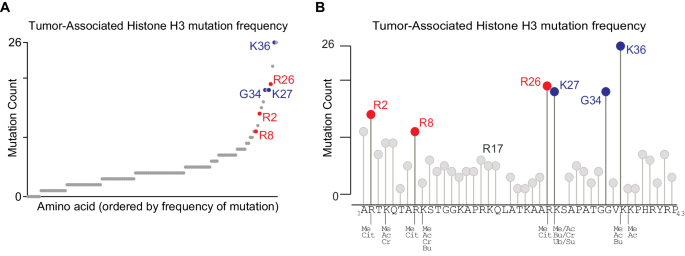
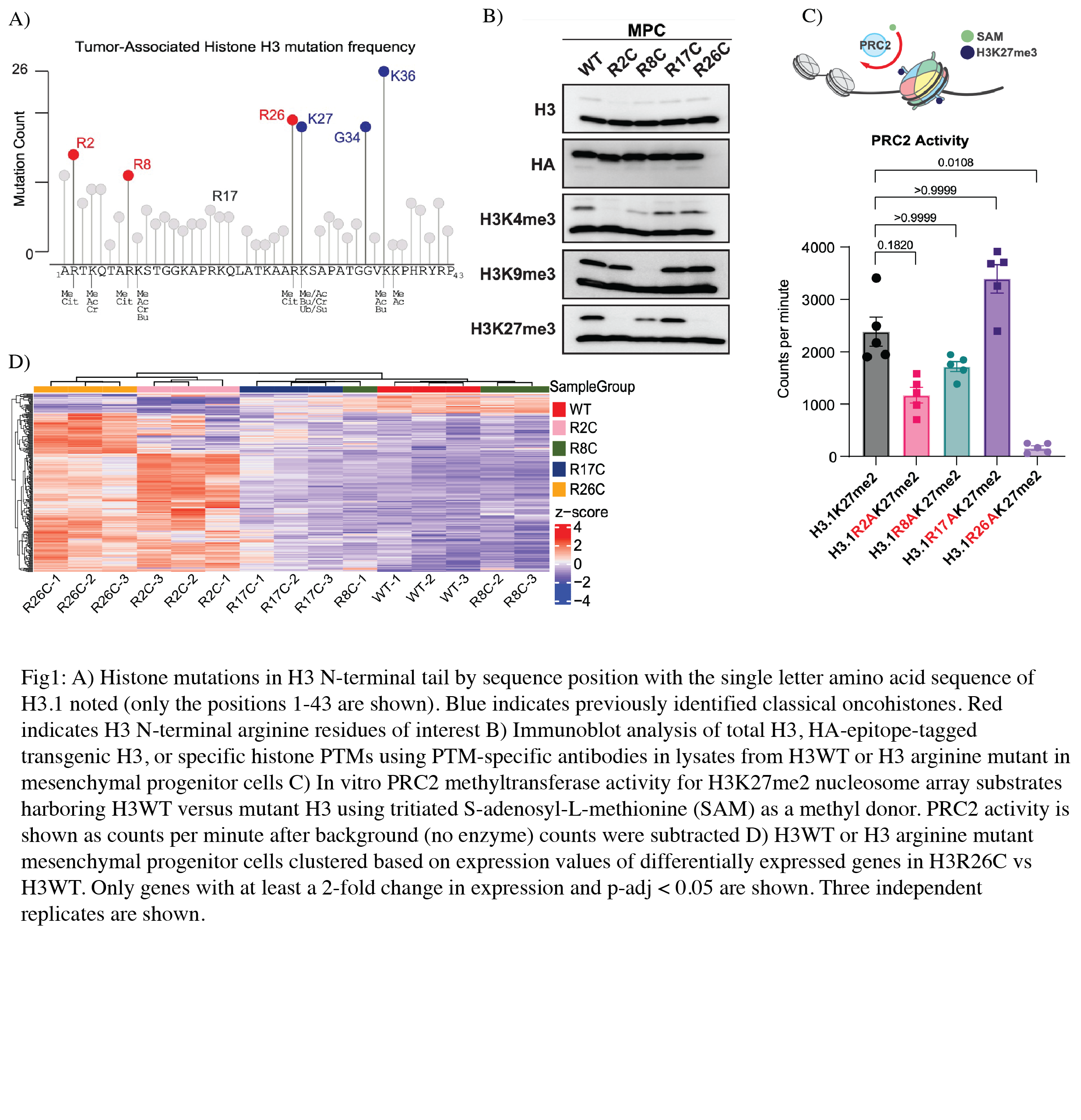
We were motivated to understand how a newly discovered class of cancer associated recurrent histone mutations in arginine residues of H3 N-terminal tail (H3R mutations) function. In our study, we demonstrate that these novel oncohistone mutations perturb the function of a ‘writer’ methyltransferase Polycomb Repressive Complex 2 (PRC2), disrupt the histone methylation landscape, and promote aberrant differentiation. Mutations in arginine residues in H3 are prevalent across different cancer types with rates similar to that of previously identified oncohistone mutations (e.g. H3K27M, H3K36M and H3G34V/L) in a pan-cancer cohort (Fig 1A). Mutant R residues lie close to the sites of critical histone modifications and themselves serve as substrates for post-translational modifications, suggesting that H3R mutations might perturb the reading, writing and erasing of key histone marks.
To test this hypothesis, we generated transgenic murine mesenchymal progenitor cell lines expressing FLAG-HA-tagged WT H3 or H3R mutations (R2C, R8C, R26C). By conducting immunoblot analysis, we observed that H3R mutations markedly altered the pattern of nearby histone modifications in cis based on specific location of H3R mutation. Expression of R8C mutation led to loss of the cognate heterochromatin associated H3K9me3 modification and, expression of R26C led to loss of H3K27me3, a transcriptionally repressive mark. Interestingly, R2C mutation led to loss of H3K4me3, a transcriptionally active mark along with loss of H3K27me3 at a distal lysine residue (Fig 1B). To further investigate the significant reduction in histone PTMs, we assessed the activity of an evolutionary conserved ‘writer’ PRC2 complex which catalyzes H3K27 methylation. PRC2 plays a critical role in regulating gene expression patterns relevant to cell fate and development, and is commonly mutated in cancers6. Using recombinant nucleosome arrays harbouring H3R mutations, we found that PRC2 activity was abrogated by R26A and 49% reduced by R2A (Fig 1C). On profiling the genome wide histone methylation landscape using CUT&RUN, we observed significant changes in gain and loss of H3K27me3 at PRC2 regulated genomic regions in R2C and R26C mutants. R26C and R2C mutants demonstrated significantly different transcriptomes compared to WT with de-repression of genes enriched for pathways regulating developmental and differentiation processes. (Fig 1D). The transcriptional changes mirrored our CUT&RUN findings, with many up-regulated genes demonstrating downregulation of H3K27me3, suggesting that R26C mutant disrupts PRC2-mediated transcriptional silencing. In a stochastic mesenchymal differentiation assay, the R26C mutant exhibited impaired adipogenic and myogenic lineage commitment. Single cell RNA-seq revealed the presence of an exclusive intermediate population with both mesenchymal progenitor and early differentiation markers in the R26C mutant, suggesting a differentiation blockade and altered cell fate. In addition, murine embryonic stem cells expressing R26C formed teratomas with increased ectodermal and reduced mesodermal populations compared to WT, supporting altered lineage commitment.
In conclusion, our data suggests that novel H3R oncohistone mutations disrupt the histone methylation landscape and alter critical chromatin-dependent processes such as transcription and cellular differentiation.
 While H3R mutations are intriguing from a cancer relevant perspective, they also provide an opportunity to gain deeper insights into biology of histone PTM dependent chromatin regulation and gene expression. One way to study the functional role of histone PTMs is to disrupt the activity of writers, readers and erasers that help in establishment and maintenance of histone PTMs. However, such enzymes can have non-histone based activities, making it hard to deduce the direct relevance of histone PTMs in a functional context7 . Oncohistones with specific amino acid substitutions that serve as poor substrates for epigenetic machinery can serve as a tool to gain functional insights into the role of specific histone PTMs. Editing of a critical lysine residue in H3 was recently used to probe the function of H3K27 methylation and acetylation8.One oncohistone that stood out in our dataset was R2C that showed reduced PRC2 activity and loss of H3K27me3 despite being far away from the K27 substrate. It will be interesting to further probe such candidates to develop mechanistic insights into activity of epigenetic regulators such as PRC2.
Reference:
- Luger, K., Mäder, A. W., Richmond, R. K., Sargent, D. F. & Richmond, T. J. Crystal structure of the nucleosome core particle at 2.8 A resolution. Nature 389, 251–260 (1997).
- Epigenetics. (Cold Spring Harbor laboratory press, Cold Spring Harbor (N.Y.), 2015).
- Jenuwein, T. & Allis, C. D. Translating the Histone Code. Science 293, 1074–1080 (2001).
- Zhao, S., Allis, C. D. & Wang, G. G. The language of chromatin modification in human cancers. Nat. Rev. Cancer 21, 413–430 (2021).
- Nacev, B. A. et al. The expanding landscape of ‘oncohistone’ mutations in human cancers. Nature 567, 473–478 (2019).
- Laugesen, A., Højfeldt, J. W. & Helin, K. Role of the Polycomb Repressive Complex 2 (PRC2) in Transcriptional Regulation and Cancer. Cold Spring Harb. Perspect. Med. 6, a026575 (2016).
- Cornett, E. M., Ferry, L., Defossez, P.-A. & Rothbart, S. B. Lysine methylation regulators moonlighting outside the epigenome. Mol. Cell 75, 1092–1101 (2019).
- Sankar, A. et al. Histone editing elucidates the functional roles of H3K27 methylation and acetylation in mammals. Nat. Genet. 54, 754–760 (2022).

Follow the Topic
-
Nature Communications
An open access, multidisciplinary journal dedicated to publishing high-quality research in all areas of the biological, health, physical, chemical and Earth sciences.

Related Collections
With Collections, you can get published faster and increase your visibility.
Women's Health
Publishing Model: Hybrid
Deadline: Ongoing
Tumor Microenvironment Crosstalk and Therapeutic Implications
Publishing Model: Hybrid
Deadline: Nov 02, 2026