Cancer: Gut microbiome provides prognosis for therapy
Published in Microbiology



Around one out of six deaths worldwide is related to cancer. The best known treatment methods include chemotherapy and immunotherapy. These therapies work by inhibiting the further division of cancer cells or by supporting the immune system in killing the tumour cells. However, despite today's well-developed anti-cancer therapies, their efficiency is not as high as desired.
We know that the intestinal microbiome plays an important role in therapeutic success. So all the microorganisms living in our gut can somehow influence the outcome of therapeutic measures in cancer treatment. To this end, we analysed metagenomic sequencing data from the stool samples of cancer patients treated with chemotherapy or a combination of chemotherapy and immunotherapy. The experimental group consisted of patients with eight different types of cancer – a novelty since comparable studies have so far concentrated on only one type of cancer.
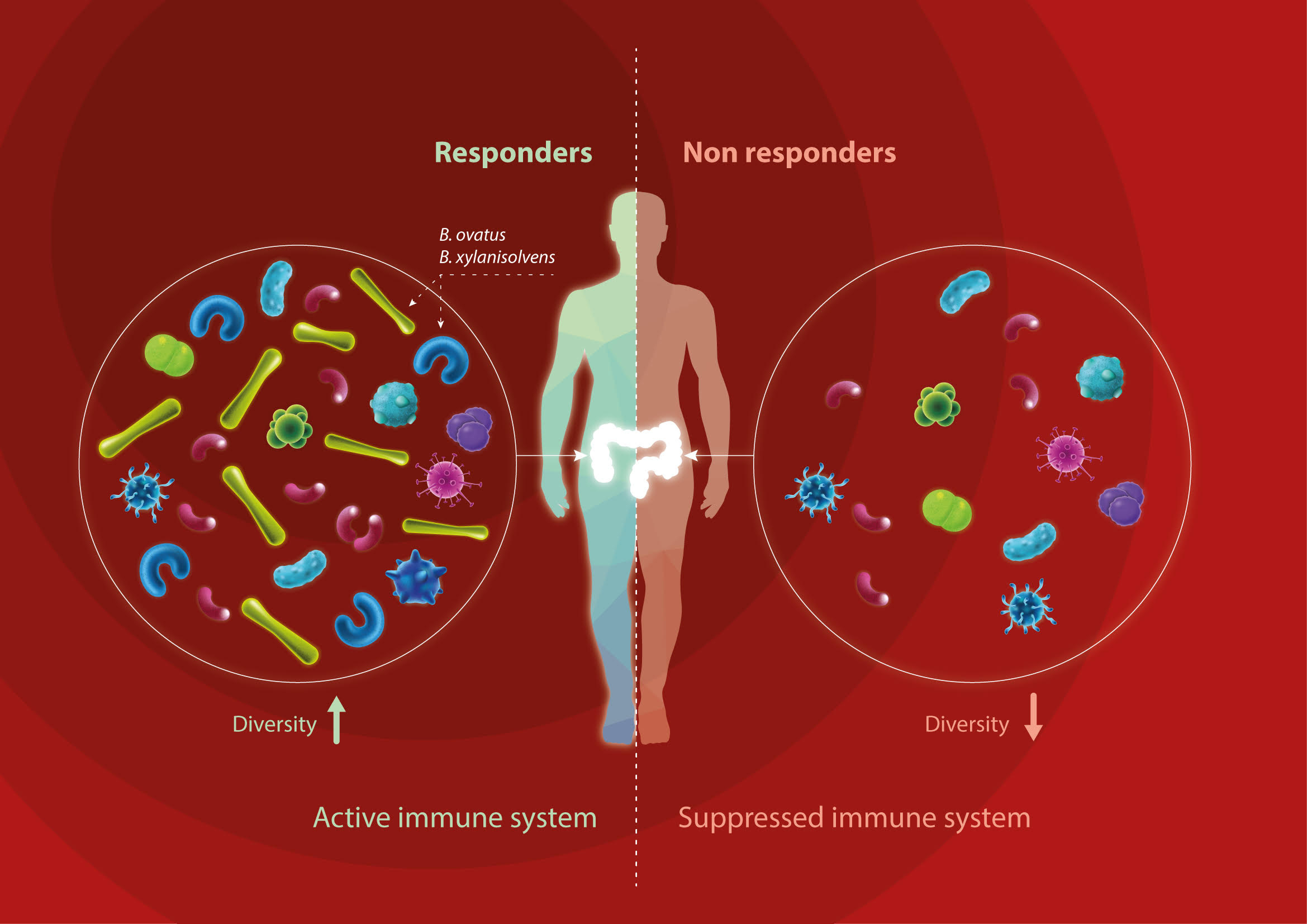
Fig. 1. Human gut microbiota is associated with patients response to anti-cancer treatment.
Nevertheless, we were able to identify some common features in the stool analysis. The intestinal microbiomes of those cancer patients who responded well to the therapy show a greater microbial diversity. In addition, the bacterial species found in their intestine differ from those of patients who responded less well to therapy. More specifically, the species Bacteroides ovatus and Bacteroides xylanisolvens have a positive effect on the course of therapy, whereas Clostridium symbiosum and Ruminococcus gnavus were found in higher amount in the patients whose anti-cancer therapy was less successful. With the help of these findings, our team has developed a prediction model based on machine learning. This model makes it possible to calculate the probability of successful anti-cancer treatment before therapy begins, regardless of the type of cancer. Moreover, the model proved to be highly accurate in another patient group.
We also tested the effect of these responder bacteria (Bacteroides ovatus and Bacteroides xylanisolvens) in experimental mice with lung cancer induced. Feeding the mice with those bacteria helped increase the efficacy of erlotinib (an anti-cancer drug) and further reduced the tumour volume by 46% compared to the control. Such enhancement of chemotherapy efficacy may be achieved by synergistically upregulating the expression of chemokines, CXCL9 and IFN-γ, involved in the recruitment of immune T cells.
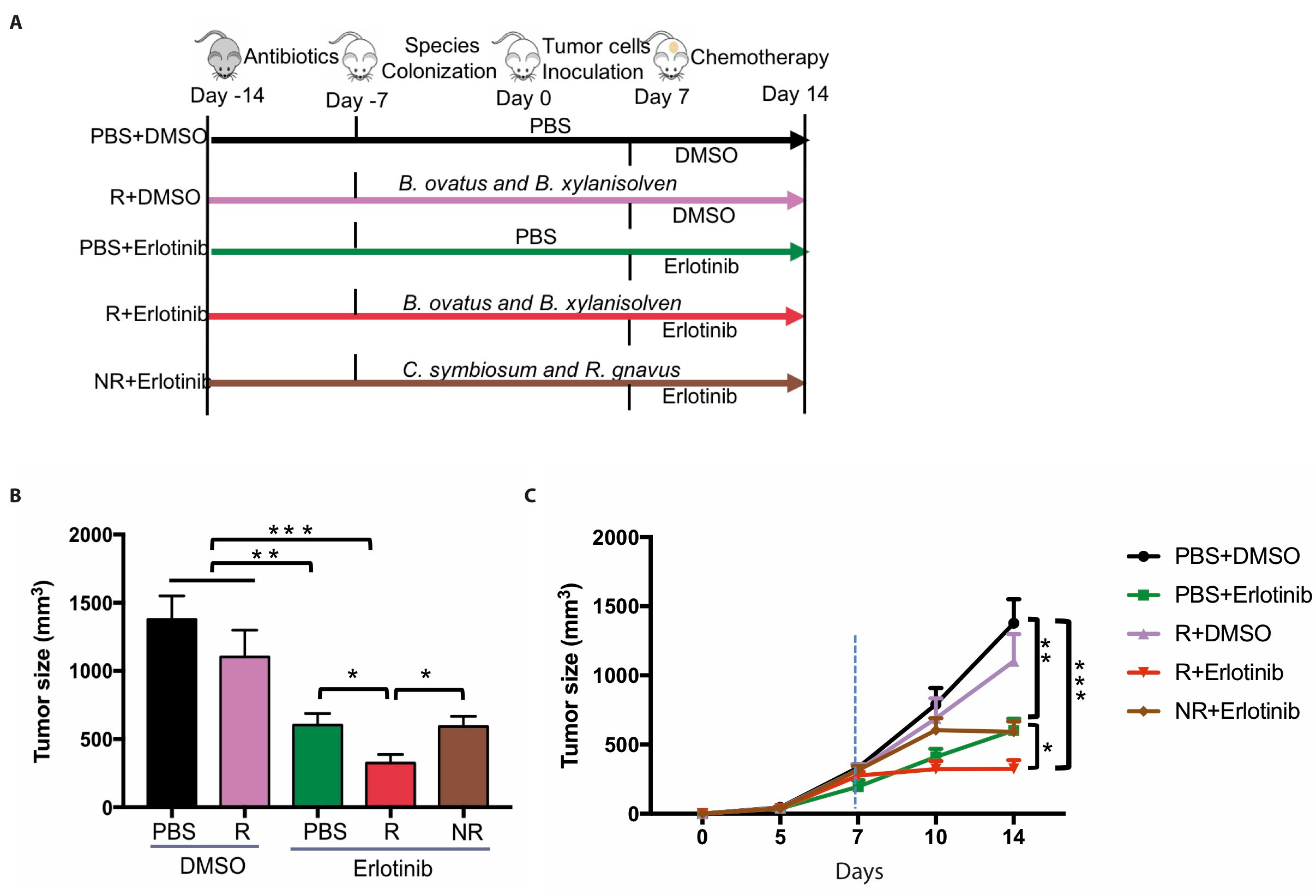
Fig. 2. Increased anti-tumor efficacy of chemotherapy in the presence of B. ovatusand B. xylanisolvens. (A) Experimental design: Male 6-week C57BL6/N mice (n=5-8) were treated with antibiotic cocktail in drinking water for 1 week before bacterial oral gavage. Control PBS, B. ovatus and B. xylanisolvens, and C. symbiosum and R. gnavus were orally gavaged into mice 1 week prior to tumor cell inoculation. A total of 107 Lewis lung cancer cells in 200 µl PBS were subcutaneously injected into the mice to induce tumor formation. Mice were treated with erlotinib(60 mg/kg body weight) once the tumor size reached approximately 250-500 mm3. Time in days is relative to tumor cells injection. (B) Tumor size measurement at day 14. (C) Tumor growth curve after Lewis lung carcinoma cellinoculation. Dark dots indicate the application of erlotinib.
Our study suggests a predictable impact of specific members of the gut microbiota on tumour growth and cancer treatment outcomes with implications for prognosis. For better therapeutic outcomes, the administration of specific probiotic bacteria could be a potential supplemental treatment in combination with anticancer therapies.
For more details please check: https://microbiomejournal.biomedcentral.com/articles/10.1186/s40168-020-00811-2
Predictable modulation of cancer treatment outcomes by the gut microbiota. Microbiome 8, 28 (2020)

Follow the Topic
-
Microbiome
This journal hopes to integrate researchers with common scientific objectives across a broad cross-section of sub-disciplines within microbial ecology. It covers studies of microbiomes colonizing humans, animals, plants or the environment, both built and natural or manipulated, as in agriculture.

Related Collections
With Collections, you can get published faster and increase your visibility.
Oncobiome
This collection of papers delves into the burgeoning field of oncobiome research, exploring the intricate relationship between cancer and the microbiome. The oncobiome encompasses the diverse microbial communities residing in and on the human body, which influence cancer development, progression, and treatment responses. By examining these interactions, our aim is to unravel the complex mechanisms through which the microbiome impacts oncogenesis and therapeutic outcomes.
This compilation highlights cutting-edge research, offering insights into potential diagnostic markers and novel therapeutic strategies, thereby advancing our understanding of cancer biology and paving the way for innovative, microbiome-targeted cancer treatments.
This is a cross-journal collection between:
Experimental Hematology and Oncology
Articles will undergo the standard peer-review process of the journal to which they are submitted and are subject to either the BMC editorial policies or those of BJC Reports. Articles will be added to the Collection as they are published. The Editors have no competing interests with the submissions which they handle through the peer review process. The peer review of any submissions for which the Editors have competing interests is handled by another Editorial Board Member who has no competing interests.
Publishing Model: Open Access
Deadline: Ongoing
The Apple Microbiome
Microbiome and Environmental Microbiome are calling for submissions to our Collection on the Apple Microbiome.
With world apple production estimated at 84 million tons, the microbiome of the apple has significant implications for agriculture, food security, and human health. Understanding the complex interactions between apple plants and their associated microbial communities can lead to improved crop management strategies, enhanced fruit quality and longevity, and sustainable agricultural practices. Recent advances have highlighted the role of specific bacteria and fungi in promoting plant health and resilience against specific pathogens. Moreover, detailed profiling of these microbial communities, revealing their diversity and functional potential facilitate exciting future developments, such as the identification of beneficial microbial consortia for biocontrol and the formulation of tailored probiotic treatments for both plants and humans. By advancing our collective understanding in this area, we can work towards a more sustainable and resilient agricultural system.
Topics of interest include but are not limited to:
-Microbial diversity and function associated with apples
-Effects of soil health and rhizosphere interactions on apple production
-Impact of climate change on the apple microbiome
-Role of the apple microbiome in fruit quality
-Microbiome-driven strategies for disease resistance
This collection is open for submissions from all authors on the condition that the manuscript falls within both the scope of the collection and the journal it is submitted to.
All submissions in this collection undergo the relevant journal’s standard peer review process. Similarly, all manuscripts authored by a Guest Editor(s) will be handled by the Editor-in-Chief of the relevant journal. As an open access publication, participating journals levy an article processing fee (Microbiome, Environmental Microbiome). We recognize that many key stakeholders may not have access to such resources and are committed to supporting participation in this issue wherever resources are a barrier. For more information about what support may be available, please visit OA funding and support, or email OAfundingpolicy@springernature.com or the Editor-in-Chief of the journal where the article is being submitted.
Publishing Model: Open Access
Deadline: Sep 30, 2026