





My third PhD paper has finally been published!
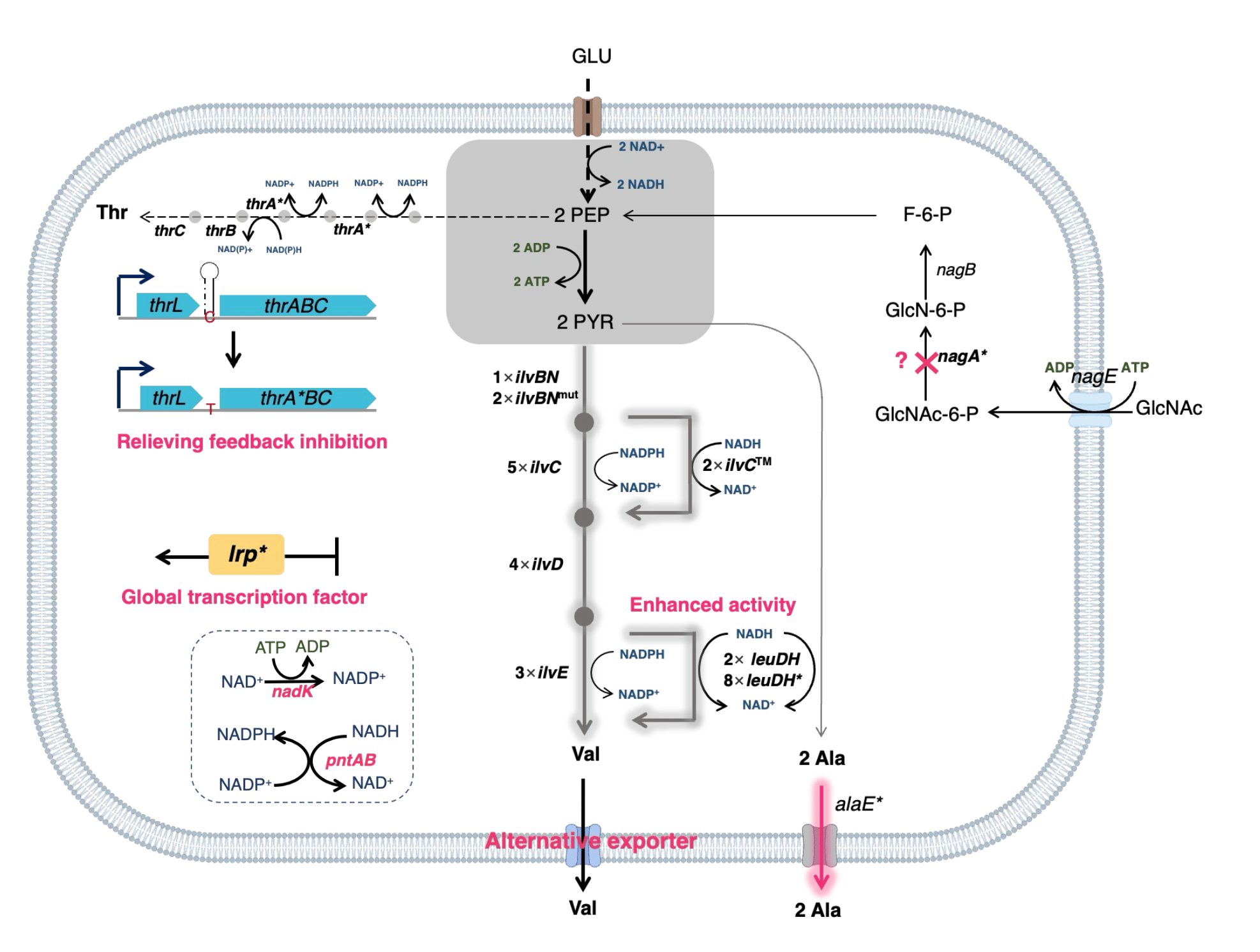
This project taught me not only how to design evolutionary trajectories, but also gave me the opportunity to experience the entire Design–Build–Test–Learn (DBTL) cycle from start to finish.
During the first half of my PhD, my research focused primarily on CRISPR-associated transposases (CASTs): discovering new systems, improving their performance, and expanding their applications to additional microbial hosts. At the time, I thought I would continue along the path of genome editing tool development.
However, my advisor believed that I had not yet been exposed to what he considered the most powerful aspect of our lab: tackling challenging problems originating from industry, including some that industry itself had struggled to solve. Seeing that I still had some bandwidth, he assigned me a project aimed at understanding the mechanism of homotypic L-valine fermentation. Interestingly, this also gave me an opportunity to apply CAST during the Build phase of the DBTL cycle.
Through this work, I gained hands-on experience in metabolic engineering, adaptive laboratory evolution, metabolic flux analysis, enzyme activity characterization, next-generation sequencing analysis, and even the art of responding to reviewer comments (They considered the performance too good to be true). Today, nearly a year and a half into my postdoc at Berkeley, this study has finally been published in Nature Communications. (Ironically, shortly after the paper was accepted in principle, the journal was added to the list of journals that certain Chinese Academy of Sciences funding sources can no longer support.)
One of the key lessons from this project was surprisingly simple: when designing an anaerobic L-valine production strain, every excess metabolite needs an exit route. This insight has already been applied to the design of improved L-valine-producing strains.
Now I have returned to the field of genome engineering, working on microbiome editing. Hopefully, the technologies we are developing today will eventually find real-world applications as well.
On to the next paper!
Follow the Topic
Spotlight on Research from China
Research Publishing > Spotlight on Research from China
Metabolic Engineering
Life Sciences > Biological Sciences > Microbiology > Industrial Microbiology > Metabolic Engineering
-
Nature Communications
An open access, multidisciplinary journal dedicated to publishing high-quality research in all areas of the biological, health, physical, chemical and Earth sciences.

Related Collections
With Collections, you can get published faster and increase your visibility.
Women's Health
A selection of recent articles that highlight issues relevant to the treatment of neurological and psychiatric disorders in women.
Publishing Model: Hybrid
Deadline: Ongoing
Tumor Microenvironment Crosstalk and Therapeutic Implications
With this cross-journal Collection, the editors at Nature Immunology, Nature Communications, Communications Medicine and Scientific Reports invite manuscripts that highlight cutting-edge research on TME crosstalk and its therapeutic implications. Topics of interest include immune modulation and checkpoint pathways, cancer-associated fibroblasts and stromal remodeling, angiogenesis and vascular normalization, metabolic reprogramming within the TME, and the role of microbiota in tumor-immune dynamics. We also welcome studies on novel therapeutic approaches that exploit TME vulnerabilities to advance cancer treatment.
Publishing Model: Hybrid
Deadline: Nov 02, 2026