Caves provide early warning of unprecedented decrease in rainfall recharge of groundwater
Published in Earth & Environment

What is the connection between stalagmites and groundwater?
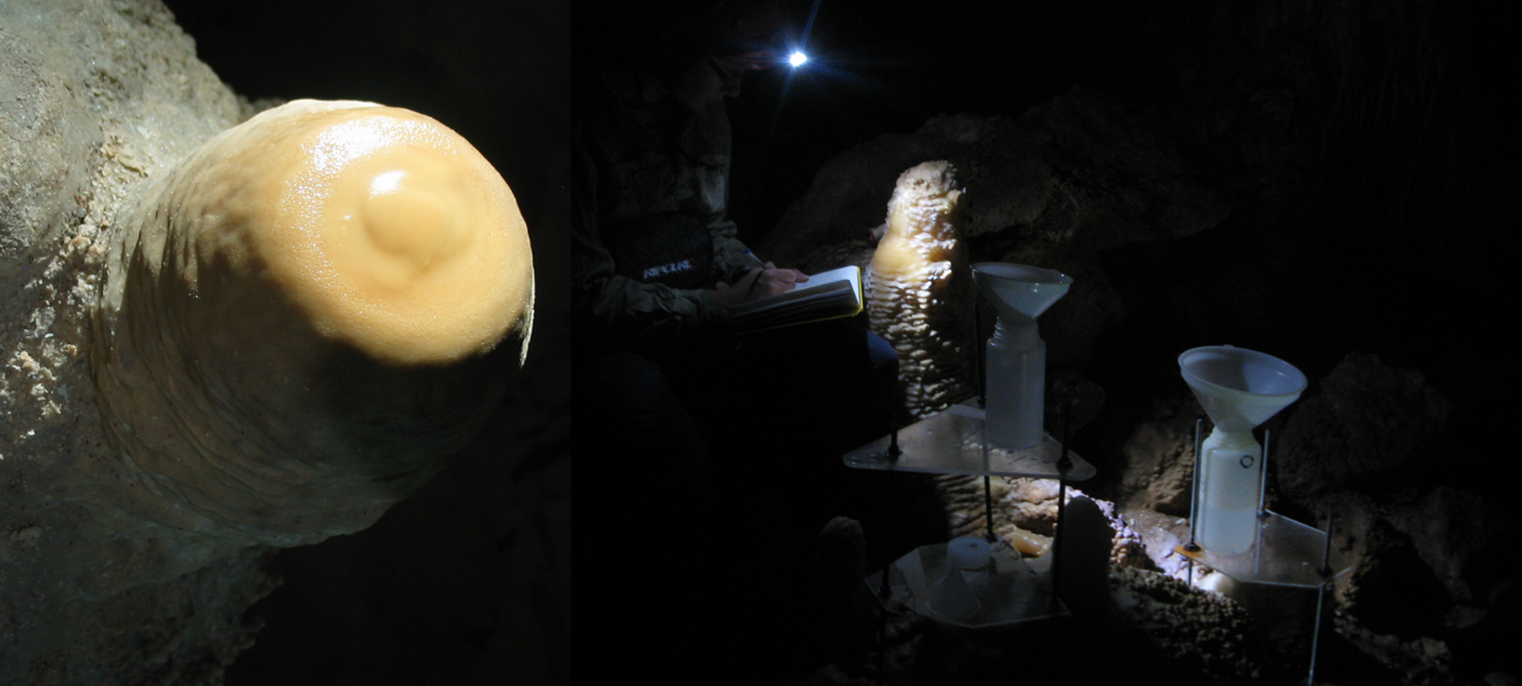
Caves are natural windows in the subsurface where we can observe groundwater recharge. Using caves, we can set up monitoring and water sampling equipment directly within the vadose zone (the portion of the subsurface that lies above groundwater) and measure water on its way to becoming groundwater. It is advantageous to look at the vadose zone rather than measure the water table itself, because other processes such as groundwater abstraction, can obscure the impacts of climate change on groundwater recharge.
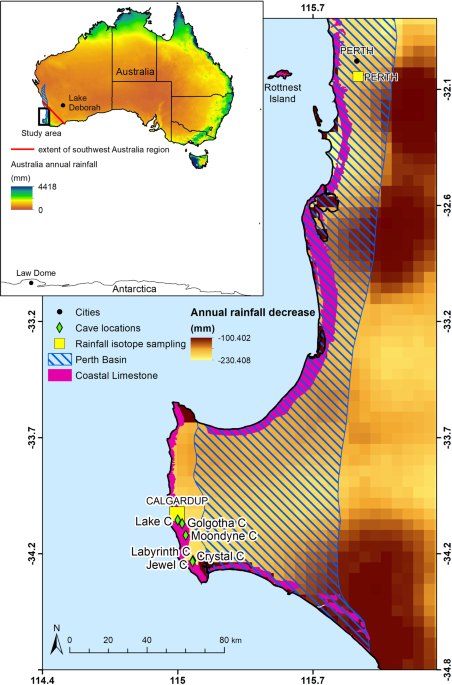
From caves in southwest Australia, we measured seven stalagmite records and drip water that showed a common rise or ‘uptick’ in oxygen isotopic composition (δ18O) that mirrored the reduction in the water table.
Stalagmites, a type of speleothem, are a type of cave deposit which grow up from the cave floor in places where carbonate-rich cave water drips from the cave roof. Stalagmite δ18O is usually treated as a faithful recorder of rainfall δ18O, an approach which works well for many northern hemisphere sites. It doesn’t work like this in southwest Australia, though. While this region has suffered a decline in rainfall since the 1960s (Hope et al., 2010), the change in rainfall δ18O values has been small and not at all able to explain the changes in stalagmite δ18O. In fact, the uptick in the stalagmite and drip water δ18O values was about ten times greater. This means another process was responsible for the isotopic uptick.
How did analysing drip water in the caves help?
Drip water monitoring helped us understand the process responsible for the uptick in speleothem and drip water δ18O values.
Our observations showed that drips were fed by two main flow types: diffuse flow through the porous limestone matrix and preferential flow along fractures. There was an isotopic distinction between these flow types: while average δ18O values for diffuse flow is close to average value for all rain events, preferential flow is 1 ‰ lower. We know this because our rainfall observations show that heavy rainfall is associated with low δ18O values. This indicates that larger magnitude rainfall events are supplying preferential flow. In other words, there is a recharge-bias response in drip water δ18O values, which is also seen at a global scale in cave drips (Baker et al., 2019).
We interpret that the δ18O uptick is due to reduced preferential flow causing a drift in the isotopic values of drip water towards that of diffuse flow. This implies a reduction in preferential flow reaching the cave due to the rainfall decrease.
How has rainfall recharge to groundwater in southwest Australia changed?
Preferential flow is an important mechanism for rainfall recharge to groundwater. Preferential flow supplies larger volumes of water to groundwater compared to diffuse flow. This was confirmed by the similarity of groundwater (green distribution) and preferential flow (blue distribution) δ18O values whereas diffuse flow drip water is higher (orange distribution). This can also be seen in the stalagmite image where a contraction of the growth to the centre of the stalagmite indicates a reduction in drip rate.
A reduction in preferential flow will also lead to a decline in rainfall recharge to groundwater. A decline in the local water table from another cave system in the region that began around 1980 is in agreement with the beginning of the δ18O uptick and confirms the decline in rainfall recharge to groundwater.
Reduced groundwater recharge has important implications for understanding the threat to groundwater dependent ecosystems biodiversity, and sustainable use of groundwater in a region heavily dependent on it and where future use is anticipated to increase (Ali et al., 2012).
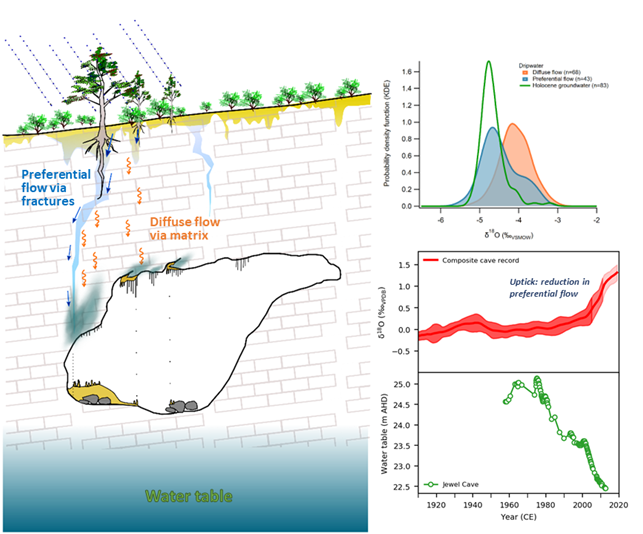
A conceptual model of the transport processes controlling the incorporation of stable water isotopes into speleothems. Distributions of δ18O values for Golgotha drip water and groundwater and the uptick in cave δ18O data that is interpreted to be a reduction in preferential flow reaching the cave. The uptick in speleothem and drip water δ18O values (red; values are mean subtracted) mirrors the local water table decrease beneath Jewel Cave (green). Credit: Priestley et al., (2023), Figure 3 and 5.
What effect is ongoing climate change expected to have on groundwater?
Having now understood that the speleothem record is capturing changes in the groundwater recharge process (reduced preferential flow), we can use stalagmites to look further back in time to find evidence of previous upticks. This is the second advantage of having approached this problem using caves, as the stalagmite is essentially an archive of past drip water δ18O, and upticks further back in time would indicate if similar reductions in groundwater recharge had occurred. Importantly, this longer record indicates that the current reduction in rainfall recharge is unprecedented in the last 800 years. Thus, the drying climate impacting southwest Australia is causing a disconnection in rainfall recharge to groundwater such that reliable rainfall recharge of groundwater may no longer be occurring.
We now have a tool (oxygen isotopes in stalagmites and other speleothems) to allow us to assess how rainfall recharge rates have changed over even longer time periods. Importantly, we are now working towards extending the record further back in time, to 10,000 years ago, to understand when groundwater was recharged and under what past climate scenarios this occurred. This means we can better understand the limits and sustainability of this valuable resource for communities that rely heavily on groundwater.
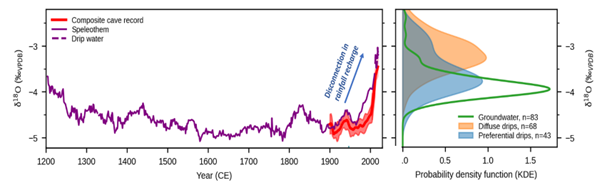
Recent uptick in δ18O values indicates a disconnection in rainfall recharge (reduced preferential flow) to groundwater that is unprecedented in the last 800 years. Credit: Priestley et al. (2023), Figure 7
For more information about our work, visit: 10.1038/s43247-023-00858-7
References
Ali R, McFarlane D, Varma S, Dawes W, Emelyanova I, Hodgson G, et al. Potential climate change impacts on groundwater resources of south-western Australia. J. Hydrol. 475, 456-472 (2012). https://doi.org:https://doi.org/10.1016/j.jhydrol.2012.04.043
Baker A, Hartmann A, Duan W, Hankin S, Comas-Bru L, Cuthbert MO, et al. Global analysis reveals climatic controls on the oxygen isotope composition of cave drip water. Nature Communications 10(1), 2984 (2019). https://doi.org:10.1038/s41467-019-11027-w
Hope P, Timbal B, Fawcett R. Associations between rainfall variability in the southwest and southeast of Australia and their evolution through time. International Journal of Climatology 30(9), 1360-1371 (2010). https://doi.org:https://doi.org/10.1002/joc.1964
Priestley SC, Treble PC, Griffiths AD, Baker A, Abram NJ, Meredith KT. Caves demonstrate decrease in rainfall recharge of southwest Australian groundwater is unprecedented for the last 800 years. Communications Earth & Environment 4(1) (2023). https://doi.org:10.1038/s43247-023-00858-7

Follow the Topic
-
Communications Earth & Environment
An open access journal from Nature Portfolio that publishes high-quality research, reviews and commentary in the Earth, environmental and planetary sciences.

Related Collections
With Collections, you can get published faster and increase your visibility.
Ecological resistance and resilience under global change
Publishing Model: Open Access
Deadline: Apr 07, 2027
Hazards in Mountain Regions
Publishing Model: Open Access
Deadline: Nov 02, 2026