Cement‑Based Thermoelectric Materials, Devices and Applications
Published in Materials and Mechanical Engineering
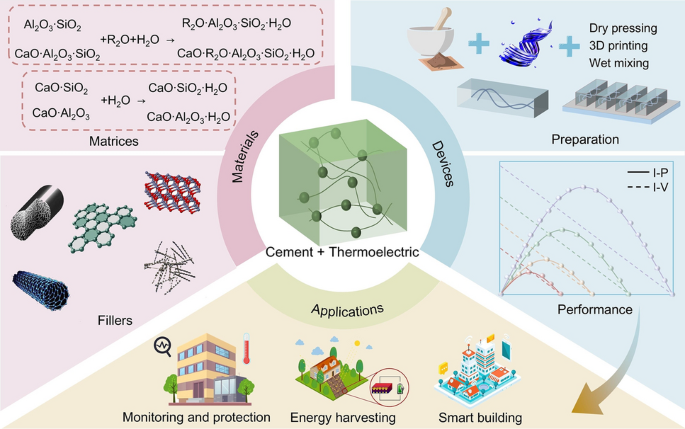

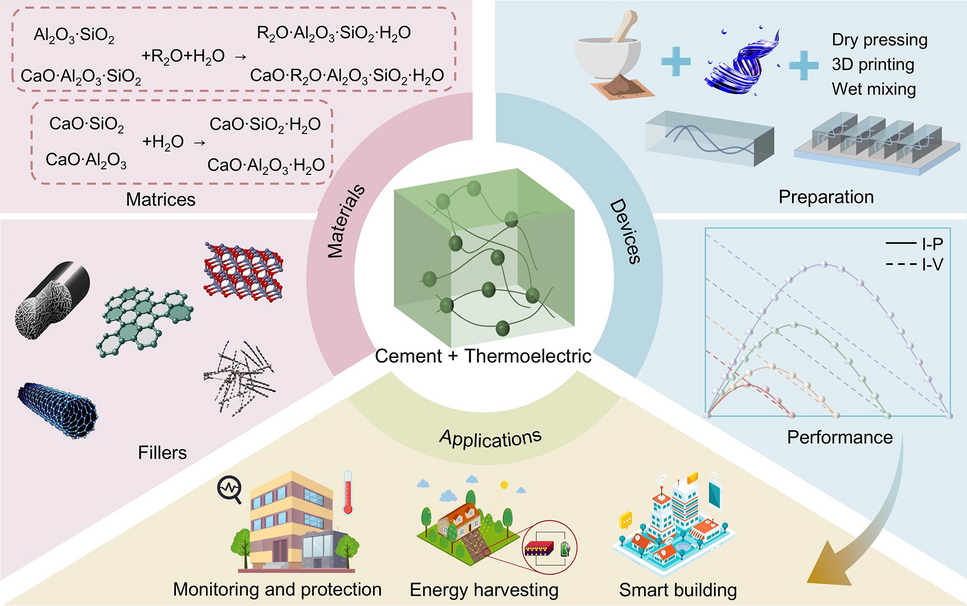

As global energy demands rise and carbon neutrality becomes imperative, traditional construction materials like cement are being reimagined with multifunctional capabilities. Now, researchers from Shenzhen University, led by Prof. Chunyu Du and Prof. Guangming Chen, have published a comprehensive review on cement-based thermoelectric materials (CTEMs) and their potential applications in smart buildings, energy harvesting, and structural monitoring. This work offers a timely and systematic overview of how cement can go beyond construction to become an active energy material.
Why Cement-Based Thermoelectric Materials Matter
- Energy Harvesting: CTEMs can convert waste heat from buildings, pavements, and industrial structures into usable electricity, contributing to zero-energy infrastructure.
- Self-Powered Sensing: With intrinsic thermoelectric properties, CTEMs enable real-time structural health monitoring without external power sources.
- Carbon Reduction: By functionalizing cement with thermoelectric fillers, CTEMs support low-carbon construction and sustainable urban development.
Innovative Design and Features
- Material Systems: The review categorizes CTEMs into fillers (carbon-based, metal oxides, composites) and matrices (ordinary Portland cement, geopolymer, alkali-activated cement), detailing their roles in enhancing thermoelectric performance.
- Performance Optimization: Strategies such as defect engineering, interfacial design, and ionic–electronic mixed conduction are explored to improve Seebeck coefficient, electrical conductivity, and figure of merit (ZT).
- Device Architectures: Various preparation methods (dry pressing, wet mixing, 3D printing) and device structures (π-type, multi-element modules) are discussed for scalable thermoelectric device fabrication.
Applications and Future Outlook
- Structural Monitoring: CTEMs can detect temperature gradients and mechanical strain, enabling non-destructive evaluation of concrete structures.
- Energy Harvesting: Embedded CTEMs in roads or building facades can harvest solar heat and indoor–outdoor temperature differences, powering low-energy electronics.
- Smart Buildings: Integration with building management systems allows CTEMs to contribute to adaptive thermal regulation, energy-saving, and real-time environmental sensing.
Challenges and Opportunities
The review highlights key challenges such as material compatibility, device stability, and cost-effectiveness, and proposes future directions in multiscale modeling, standardized testing, and application-specific design. With continued interdisciplinary research, CTEMs are poised to become a cornerstone technology for intelligent, sustainable infrastructure.
This comprehensive review provides a roadmap for the development and deployment of cement-based thermoelectric materials. It underscores the importance of materials science, civil engineering, and energy technology convergence in shaping the future of smart construction. Stay tuned for more groundbreaking work from Prof. Chunyu Du and Prof. Guangming Chen at Shenzhen University!

Editor of Nano-Micro Letters, which is an Open-Access, peer-reviewed journal reported papers that have at least one dimension ranging from a few sub-nanometers to a few hundreds of micrometers. The journal is published by Springer Nature and indexed by SCI, EI, SCOPUS, Pubmed, etc. The 2025 JCR Impact Factor is 38.5. The 2025 CiteScore is 58.9.
Follow the Topic
-
Nano-Micro Letters
Nano-Micro Letters is a peer-reviewed, international, interdisciplinary and open-access journal that focus on science, experiments, engineering, technologies and applications of nano- or microscale structure and system in physics, chemistry, biology, material science, and pharmacy.