Changing Cultural Landscape of the Tons River Basin
Published in Social Sciences




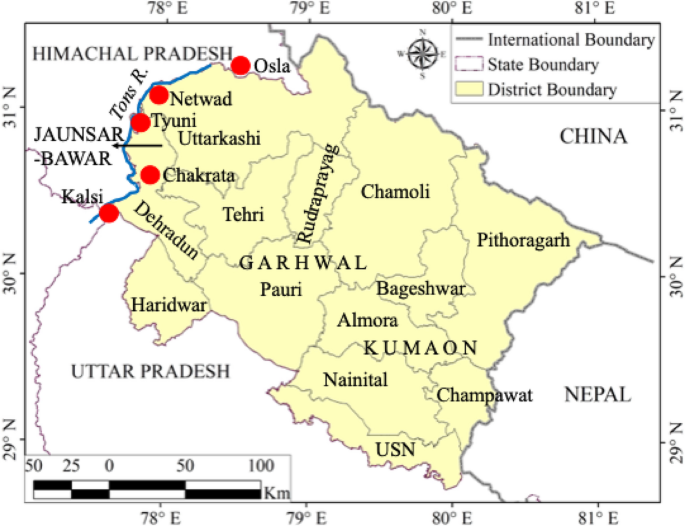

The cultural landscape of the Tons River Basin of the Himalayan region is one of the most culturally diversified regions in the world with deep-rooted history, migration, settlement of different communities and it is shaping this landform over centuries . This dynamic cultural corridor situated between the Indian subcontinent and the Tibetan plateau has undergone several changes due to trade, movement of people creating distinctive cultural zones reflecting through vibrant fairs and festivals, rich oral traditions, different communities’ delectable cuisines, mythological belief systems which are widely practiced over this region with utmost enthusiasm. Within the broader Himalayan context, the Uttarakhand Himalaya is identified as pivotal juncture of archeological remnants, topographically modified by the rivers Alakananda, Bhagirathi, Yamuna, Tons, Ramganga and Sarayu and agrarian society which made it a culturally significant place from the past till today beckoning as ‘Dev Bhumi’, the land of Gods and Goddesses associated with riverine morphology and sacred cultural sites. The Tons River Basin is such evidence of cultural geomorphological region where precipitous slope, rugged terrain, river valleys of the Rupin and Supin rivers (tributaries of the Tons River), terraced agricultural fields, forest lands have shaped the land as distinctive yet colloquial Himalayan cultural den. Among the three sub cultural realms of Uttarakhand Kumaon, Garhwal and Jaunsar-Bawar and Rawain reign the Tons River Basin forms part of the Jaunsar-Bawar and Rawain sub cultural realm reflecting history and culture through each architectural structure, traditions, cultural practices. Local mythology echoed in every corner of this small riverine place where major rural settlements such as Purola, Mori, Hanol, Netwar, Gaichwan, Dharkot, Gangad, Osla (the very first village of the Tons River Basin) and Har ki Dun are the treasure house of regions’ temple history, folk deities and their present forms practiced during vibrant festivals.
Navigating through this place, interacting with the villagers, priests, elderly people, spending hours in informal chatting and formal interviews have given multiple insights regarding traditional livelihood practices and their role in cultural identity, cultural riches, folk deities, mythology and its impact on social and cultural landscape. Seasonal migration is the essential character of practicing traditional agriculture and livestock rearing. The temperate- cold climate and vast grazing lands profoundly support cultivation of coarse grains, temperate fruits, livestock products and selling them from farms to local markets. Interestingly customary customary rituals are closely interconnected, as cultivation and harvesting processes traditionally begin with offerings to local deities. Drawing references for Uttarakhand it is popularly known that important Hindu scripts and Mythological derivation like the Rigveda, Mahabharata, and the Skanda Puran, all have given sacred status to this state which in evidently reflects through cultural riches of the Tons Valley too. It’s a valley predominantly comprising the Hindu population consisting of various castes like Bhramins, Rajputs, Scheduled Castes and Scheduled Tribes. It’s a saying that the residents of this region are considered more ancient compared to those in other parts of Uttarakhand.
The Tons Basin Region due to its strong mythological reference exhibits exquisite diversity expressed through traditions, folklore, religious beliefs, festivals, and food practices closely shaped by the physical environment and sacred temple landscape dedicated to the Lord Shiva, Lord Vishnu the Pandavas and the Kauravas. From social organization to cultural practices, the worship of deities in diverse forms is regarded as sacred and deeply integrated into the regional culture.
The presence of the Lord Shiva, considered as the guardian deity is felt in structural and non-structural form in every nook and corner of this Himalayan reign. Shiva resides here in Someshwar form, he is the chief of the villages, lives in a wood, stone carved temple and makes his annual appearance – Dev Avataran, with an annual journey in a palanquin to ensure the well-being, prosperity of this region’s inhabitants.
The evolution of the temple region, the Tons also comes from its mythological scripts. It is said ‘Tons’ come from ‘Tamas’(sorrow) River after Karna’s death his followers wept profusely and tears became ‘Tamas’. The people here worship the Pandavas and the Kauravas which is the unique sacred identity of this region which distinguishes this region from the rest of the country. However, Tons River Valley is popularly known for Mahasu Devta- as an incarnation of the Lord Shiva whose temple is located on the left bank of the Tons River in Hanol village. The journey to the temple and villages itself is an experience as the road passes through cedar trees, lush green meadows and steep agricultural fields. One can relish the regional cuisines like Mandu ki Roti, Chaulai ka Saag, Rajma and popular fermented drink made with millets while conduiting through these highlands and river valleys of this region.
For a longer time, Tons Valley was cut from the contemporary world and retained its unique rich cultural traditions and heritage. But in recent times even with minimal infrastructural development, connectivity and a shift in cultural practices have been noticed. For a recreational retreat, development of the transport system has contributed to the growth of cultural and adventurous tourism. As a significant amount of youth out migrated, women of the villages took charge in conserving cultural traditions and led to community-based tourism activities. Regardless of any changes Tons River Basin is maintaining its history, captivating natural beauty and mythological stories will continue to emulate through its oral traditions.
Follow the Topic
-
Discover Global Society
This is an interdisciplinary, international journal that welcomes research on the complexities of modern global society, its development and its challenges.

Related Collections
With Collections, you can get published faster and increase your visibility.
Migration, Social Change, and Policy Responses in a Global Society
Migration is a defining feature of contemporary global societies, shaping social structures, political debates, economic outcomes, and cultural identities across regions. In recent years, migration dynamics have been further reshaped by profound geopolitical transformations, including armed conflicts, shifts in international alliances, border reconfigurations, and changing migration governance regimes. These developments interact with long-standing economic inequalities, demographic change, and environmental pressures, producing increasingly complex migration patterns and societal responses.
At the same time, migration has become central to public and political debates concerning its economic and fiscal implications. Across countries, questions persist regarding the costs associated with immigration—such as public spending on integration, welfare, and services—and the extent to which migration contributes to state finances through taxation, labour market participation, and long-term demographic sustainability. Assessing whether and under what conditions immigration represents a fiscal burden or a net benefit for public budgets remains a key empirical and policy challenge.
This Topical Collection aims to advance research on migration and social change from a global and comparative perspective, with particular attention to the interaction between geopolitical change, fiscal sustainability, and migration policy. It welcomes contributions examining migration flows, integration processes, public attitudes toward migrants, cost–benefit assessments of immigration, and policy design at local, national, and supranational levels.
The Collection is open to studies addressing different migration types, including labour migration, forced displacement, refugee movements, return migration, and environmentally influenced mobility. Special emphasis is placed on quantitative, mixed-method, and computational approaches, including econometric analysis, survey data, experimental methods, fuzzy and multi-criteria decision models, and text-as-data techniques. Comparative and cross-national studies are especially encouraged, particularly those linking migration outcomes to institutional capacity, fiscal frameworks, and governance arrangements. The Collection aims to provide empirically grounded insights to inform academic debates and evidence-based policymaking in an increasingly unstable and interconnected world.
Publishing Model: Open Access
Deadline: Nov 13, 2026
AI-Driven Transitions in the Global Digital Economy: Rethinking Governance, Sustainability, and Social Justice
In the wake of accelerating technological disruption and AI proliferation, societies across the globe are undergoing structural transformations that challenge conventional paradigms of governance, equity, and sustainability. This Collection explores how AI-driven digitalization is reshaping economic structures, labor markets, institutional trust, and policy frameworks in diverse socio-political settings.
We invite interdisciplinary contributions that critically engage with emerging governance models, the ethical and distributive implications of platform capitalism, and the socio-environmental impacts of AI-powered economic systems. Special emphasis will be placed on comparative analyses between advanced and developing economies, South–South cooperation, digital divides, and the unintended consequences of algorithmic control in public and private sectors.
Submissions may address, but are not limited to: AI governance and regulatory innovation; digital labor and automation; sustainable digital finance; AI and global trade architecture; data justice; environmental footprint of digital infrastructures; and AI’s influence on institutional resilience and global inequality. We welcome theoretical, empirical, and policy-oriented studies across economics, sociology, international relations, environmental studies, and political science.
This Collection aims to provide a platform for forward-looking research that not only diagnoses current dilemmas but also reimagines normative frameworks for just and sustainable digital futures. We seek to bring together diverse voices from academia, policy, and civil society to co-construct insights into how global society can adapt to and shape AI-led transitions.
Keywords: Artificial Intelligence, Digital Transformation, Global Governance, Sustainability Transitions, Data Justice, Trade Policy, Algorithmic Inequality, Digital Economy, Institutional Resilience, Platform Capitalism.
Publishing Model: Open Access
Deadline: Sep 30, 2026