Cloud-Radiative Feedbacks Boost the Formation of Stalled Weather Patterns
Published in Earth & Environment


In the midlatitudes, the prevailing west-to-east progression of weather systems can occasionally slow down or stall. These so-called atmospheric blocking events occur when large high-pressure systems stall over a region for days or even weeks, disrupting the normal flow of weather. Blocking can lead to prolonged heat waves, cold spells, droughts, or flooding, depending on the season and location.
For decades, scientists believed that these stalled patterns were driven mainly by large-scale dry dynamical processes in the atmosphere, with clouds and moisture playing only a minor supporting role. However, growing evidence have now suggested that diabatic processes (latent heating and those involving heating and cooling from clouds) may be far more important than previously thought, particularly over the Euro-Atlantic region. One key but poorly understood process is the cloud radiative effects: the way clouds trap and emit heat, especially infrared (longwave) radiation. This study, recently published in Nature Communications, asked a simple but fundamental question: Do clouds radiative effects help create and maintain these stalled weather systems?
To answer this, researchers at Pacific Northwest National Laboratory (PNNL) used a state-of-the-art Earth system model and ran a set of carefully designed experiments using the Energy Exascale Earth System Model (E3SM). In one experiment, clouds were "locked" so radiation no longer responded to or influenced atmospheric motion. In another, clouds were made transparent to infrared radiation, effectively removing their heating effect. The team then tracked how the building blocks of large-scale weather patterns grew and evolved in each experiment.
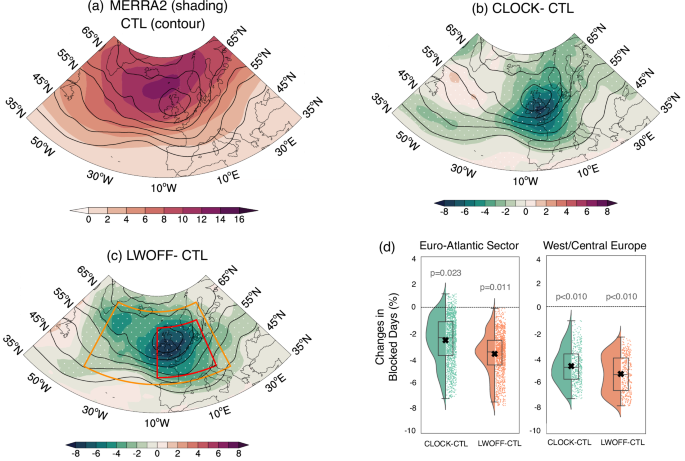
This study shows that when cloud–radiation interactions are removed from the model, wintertime blocking over the Euro-Atlantic region drops sharply--by about 22% when clouds are locked, and by 37% when cloud infrared heating is turned off (Figure 1). The results really showed that clouds play a crucial role. When clouds interact normally with radiation, they enhance heating upstream of Europe in two ways: directly by trapping infrared heat, and indirectly by strengthening latent heating released as moist air rises along storm systems (known as warm conveyor belts). This extra heating energizes atmospheric waves, which increases their chances of piling up downstream and forming long-lived high-pressure blocking systems (Figure 2).
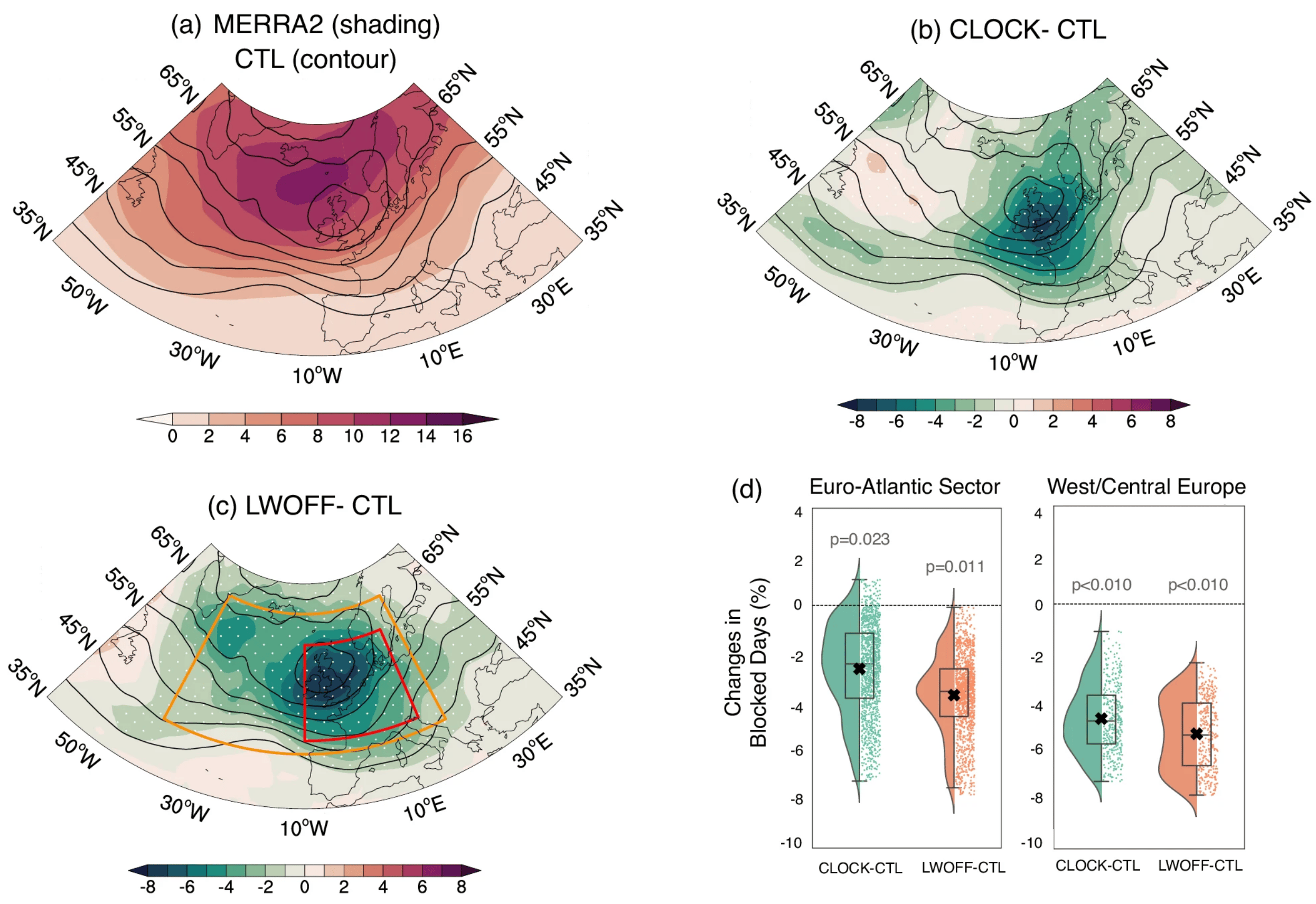
Figure 1 compares winter blocking frequency for the control, cloud-locking, and longwave-off runs. Removing cloud-radiation effects reduces Euro-Atlantic blocked days, highlighting clouds’ role in promoting blocking.
This is the first study to isolate these effects using multiple targeted model experiments and to confirm them across several other independent climate models. The findings reveal a previously underappreciated pathway: cloud-radiation interactions amplify moisture-related heating, which in turn strengthens the atmospheric wave activity needed to form and sustain blocking.
Because many weather and climate models still rely on simplified representations of clouds and radiation, missing or misrepresenting these interactions can lead to systematic errors--especially in forecasting prolonged extreme events. Improving how models represent cloud-radiation-circulation feedbacks will help scientists deliver more reliable multi-day forecasts and better projections of future weather risks.
Why this research matters?
Accurately simulating atmospheric blocking has long been one of the toughest challenges in weather and climate modeling. Most models underestimate how often blocking occurs in winter, particularly over the Euro-Atlantic region, limiting confidence in predictions of extreme weather.
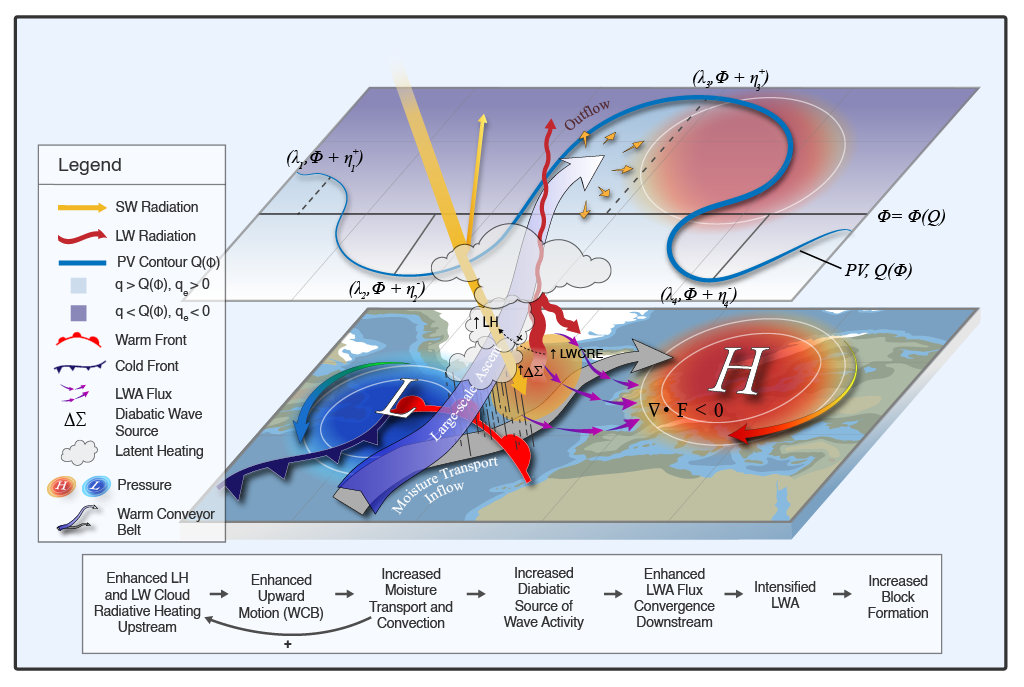
Figure 2 shows a schematic diagram illustrating a newly identified mechanism by which cloud radiative effects (CREs) enhance upstream diabatic heating and promote atmospheric block formation across the Euro-Atlantic region.
This study demonstrates that cloud radiative effects are a missing piece of the puzzle. Using DOE’s Energy Exascale Earth System Model (E3SM), researchers compared a standard simulation with experiments that removed clouds’ ability to interact with radiation or atmospheric circulation. By tracking the full life cycle of blocking events, they found that cloud-driven heating--especially through moisture-rich storm systems--strengthens the atmospheric waves that ultimately form blocking highs. When these cloud-radiation interactions were suppressed, the frequency of winter blocking dropped substantially. The study also showed that clouds influence the broader atmospheric environment, including jet stream position, storm growth, and moisture transport, further shaping the likelihood of blocking.
Together, these results highlight that clouds are not just passive bystanders in large-scale weather patterns and extreme events. Instead, they actively help lock weather systems in place. Accurately representing cloud-radiation interactions in Earth system models is therefore essential for improving predictions of stalled weather patterns and the high-impact events they bring.
Citation:
Lubis, S. W., Harrop, B. E., Lu, J., Leung, L. R., Chen, Z., Huang, C. S. Y. & Omrani, N.-E. Cloud radiative effects significantly increase wintertime atmospheric blocking in the Euro-Atlantic sector. Nat. Commun. 16, 9763 (2025). https://doi.org/10.1038/s41467-025-64672-9
Related Links

Dr. Lubis is an atmospheric scientist with a broad interest in atmospheric dynamics and climate variability and change.
Follow the Topic
-
Nature Communications
An open access, multidisciplinary journal dedicated to publishing high-quality research in all areas of the biological, health, physical, chemical and Earth sciences.

Related Collections
With Collections, you can get published faster and increase your visibility.
Women's Health
Publishing Model: Hybrid
Deadline: Ongoing
DNA repair and human disease
Publishing Model: Hybrid
Deadline: Oct 31, 2026