Consumption of Dairy Fat Products and Their Association with Chronic and Cardiovascular Diseases Among Saudi Adults: Insights from a National Cross-Sectional Survey
Published in Social Sciences, Chemistry, and Biomedical Research
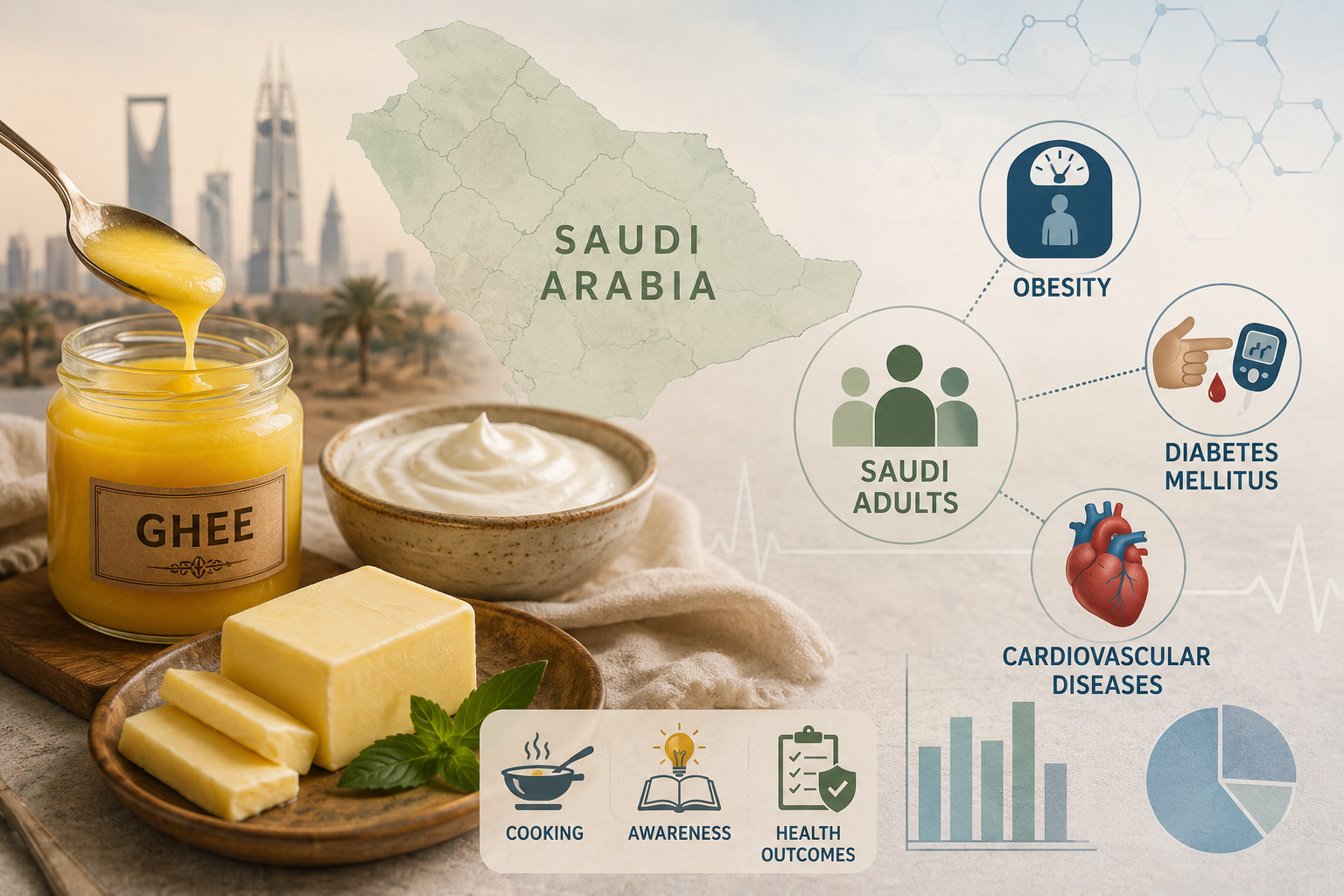




Dietary fat remains one of the most debated topics in nutrition science. While dairy products provide essential nutrients, their fat-rich components—particularly ghee, butter, and cream—contain substantial amounts of saturated fatty acids and cholesterol, raising longstanding questions about their role in obesity, diabetes, and cardiovascular disease. In Saudi Arabia, these products are deeply embedded in culinary traditions, yet relatively little is known about how frequently they are consumed, how well the public understands their potential health implications, and whether consumption patterns are associated with chronic diseases. Our study sought to address these questions through a nationwide cross-sectional survey of Saudi adults.
The research was motivated by the rapid nutritional transition occurring across Saudi Arabia. Traditional dietary patterns have increasingly given way to more Westernized eating habits, accompanied by higher consumption of energy-dense foods rich in saturated fat. At the same time, the prevalence of obesity, diabetes, hypertension, and cardiovascular diseases has continued to rise. Although dairy fat has often been implicated in these conditions, the scientific evidence remains mixed. Some studies suggest that replacing saturated fats with unsaturated fats lowers cardiovascular risk, whereas others report neutral or even beneficial effects of dairy fat within balanced diets. Against this backdrop, we aimed not to settle the debate, but rather to examine current consumption patterns and public awareness in a Saudi population.
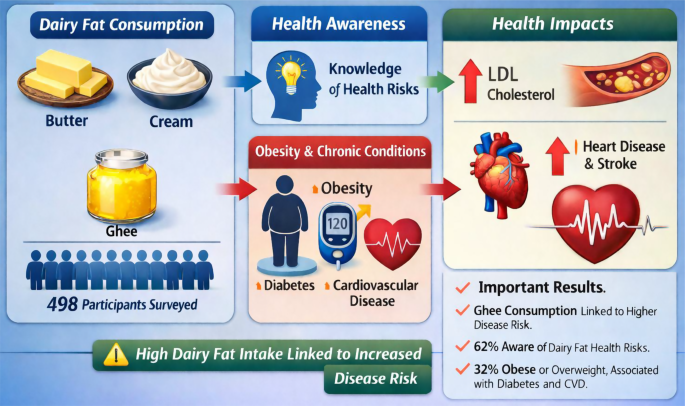
Between January and March 2024, we conducted an online survey involving 498 adults aged 18–70 years from different regions of Saudi Arabia. The questionnaire collected information on demographic characteristics, body mass index (BMI), medical history, family history of chronic diseases, frequency and methods of consuming butter, cream, and ghee, and participants’ awareness of the potential health risks associated with these products. Statistical analyses were performed using Chi-square tests to examine associations between dietary habits, awareness, and reported health conditions.
Several findings stood out. More than one-third of participants were overweight, reflecting the growing burden of excess body weight within the population. Most respondents reported no diagnosed chronic disease, although many had first-degree relatives affected by diabetes, hypertension, obesity, or cardiovascular disease, emphasizing the importance of both genetic predisposition and lifestyle factors. These background characteristics provided valuable context for interpreting dietary behaviors.
Among the dairy fat products investigated, ghee emerged as the most noteworthy. Participants reported using ghee primarily during cooking rather than as a spread or accompaniment, highlighting its central role in traditional meal preparation. Importantly, higher ghee consumption showed statistically significant associations with obesity, diabetes, and cardiovascular diseases. By contrast, butter and cream consumption did not demonstrate significant associations with these chronic health outcomes in our analyses. These findings suggest that not all dairy fat products may contribute equally to health risks, although the observational nature of the study prevents conclusions about causality.
Another important aspect of the study involved public awareness. Approximately 62% of respondents indicated that they were aware of the potential health risks associated with dairy fat consumption. However, awareness did not always translate into healthier behavior. Individuals who consumed ghee more frequently were generally less likely to recognize its possible adverse health effects, suggesting an inverse relationship between knowledge and habitual intake. This disconnect highlights the complexity of dietary decision-making, where cultural preferences, taste, cooking practices, and long-established habits may outweigh nutritional knowledge.
The findings also reinforce the broader complexity of dairy fat research. Milk fat is not nutritionally uniform; it contains not only saturated fatty acids but also fat-soluble vitamins, phospholipids, conjugated linoleic acid, and other bioactive compounds that may exert beneficial physiological effects. Consequently, evaluating dairy fat solely on the basis of saturated fat content may oversimplify its nutritional profile. Our discussion therefore acknowledges both perspectives within the scientific literature: evidence supporting potential cardiovascular risks associated with excessive saturated fat intake, particularly from ghee, and studies suggesting that dairy fat may have neutral or context-dependent effects when consumed in moderation as part of an overall healthy diet.
Like any survey-based investigation, our study has important limitations. Because it employed a cross-sectional design, it identifies associations rather than cause-and-effect relationships. All dietary habits, body weight, and medical histories were self-reported, introducing the possibility of recall bias or inaccurate reporting. The participant population was also predominantly female and heavily represented by individuals from the Western Region of Saudi Arabia, which may limit the generalizability of the findings to the broader Saudi population. Moreover, dietary behaviors are influenced by numerous factors—including physical activity, socioeconomic status, total calorie intake, and other lifestyle characteristics—that were not fully controlled in this analysis.
Despite these limitations, the study provides one of the first comprehensive snapshots of dairy fat consumption patterns and related health awareness among Saudi adults. The findings suggest that nutrition education remains an important public health priority, particularly regarding ghee consumption. Improved food labeling, culturally appropriate dietary guidance, and public awareness campaigns may help consumers make more informed choices without disregarding traditional dietary practices. Rather than eliminating dairy fat products altogether, promoting moderation and encouraging balanced dietary patterns may represent the most practical approach.
Future research should build upon these findings using prospective cohort studies and randomized clinical trials capable of clarifying whether the observed associations reflect causal relationships. Experimental studies comparing ghee with butter, vegetable oils, and other dietary fats could further improve our understanding of their metabolic and cardiovascular effects. Such evidence will be essential for developing evidence-based nutritional recommendations tailored to Saudi Arabia and other populations where dairy fat products remain an important part of everyday diets.

Mohamed Fawzy Ramadan is a Professor of Biochemistry at the Department of Clinical Nutrition, Faculty of Applied Medical Science, Umm Al-Qura University, Makkah, Saudi Arabia.
Prof. Ramadan obtained his Ph.D. (Dr. rer. nat.) in Food Chemistry from the Berlin University of Technology (Germany, 2004). Prof. Ramadan continued his postdoctoral research at ranked universities, including the University of Helsinki (Finland), the Max Rubner Institute (Germany), the Berlin University of Technology (Germany), and the University of Maryland (USA). In 2012, he was appointed as a Visiting Professor (100% teaching) in the School of Biomedicine, Far Eastern Federal University in Vladivostok, Russian Federation.
Prof. Ramadan has published more than 450 research papers and reviews in international peer-reviewed journals. He also edited and published several books and book chapters (Scopus h-index is 55 and more than 11000 citations). He was an invited speaker at several international conferences. Since 2003, Prof. Ramadan has been a reviewer and editor for several highly cited international journals, including the Journal of Medicinal Food, eFood, the Journal of Umm Al-Qura University for Applied Sciences, and the Journal of Advanced Research. He is the editor-in-chief of Journal of Umm Al-Qura University for Medical Science.
Prof. Ramadan received several prizes, including Abdul Hamid Shoman Prize for Arab Researcher in Agricultural Sciences (2006), the Egyptian State Prize for Encouragement in Agricultural Sciences (2009), European Young Lipid Scientist Award (2009), AU-TWAS Young Scientist National Awards (Egypt) in Basic Sciences, Technology and Innovation (2012), TWAS-ARO Young Arab Scientist (YAS) Prize in Scientific and Technological Achievement (2013), and Atta-ur-Rahman Prize in Chemistry (2014).
Follow the Topic
-
Saudi Journal of Food Security and Environmental Sustainability
This is an international, open-access, peer-reviewed journal dedicated to advancing impactful research that supports global food security and environmental sustainability.



Please sign in or register for FREE
If you are a registered user on Research Communities by Springer Nature, please sign in