When Sport Is Not About Stress: Rethinking Why Chilean Youth Move
Published in Social Sciences, Earth & Environment, and Public Health





Ask most people why children should play organized sport, and "to manage stress" will appear near the top of the list. It is an intuitive answer, supported by decades of evidence linking physical activity to better mental health. But intuitions deserve to be tested, and when we examined nationally representative data from Chile, the picture that emerged was more nuanced — and, we believe, more interesting.
Our study, "Association between organized sport participation and stress-related motivation for physical activity among Chilean children and adolescents", published in Discover Public Health, began with a question that has received surprisingly little attention in Latin America: do young people who participate in organized sport actually report stress relief as their motivation for being physically active?
An unexpected pattern
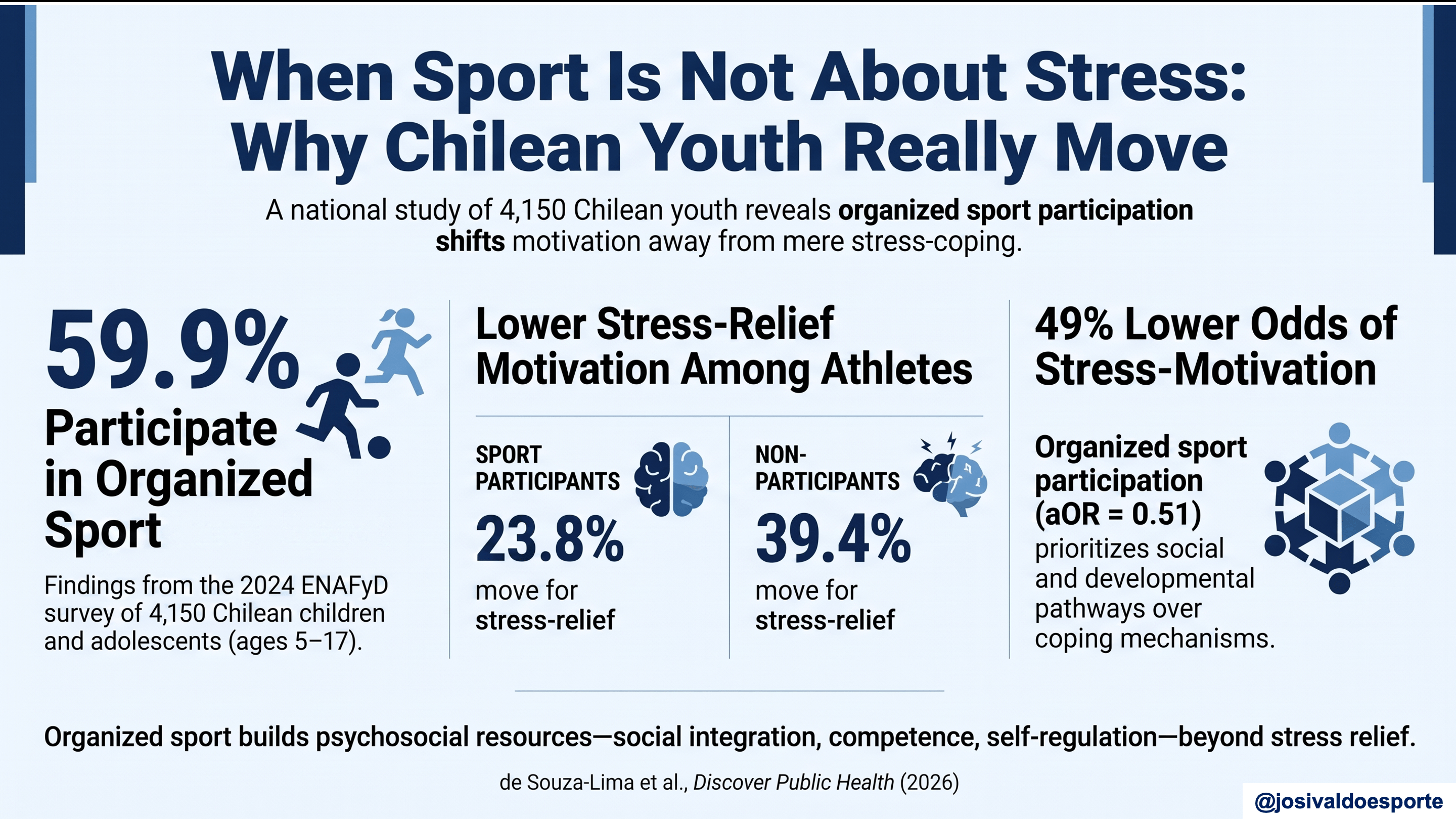
Using data from 4,150 participants aged 5–17 years in the 2024 Chilean National Physical Activity and Sport Survey (ENAFyD), we found that children and adolescents engaged in organized sport were substantially less likely to endorse stress relief as a primary motivation for physical activity. After adjusting for sex, age, socioeconomic status, and area of residence, participants in organized sport had 49% lower odds of reporting stress-related motivation than non-participants.
At first glance, this might seem to contradict the well-documented mental health benefits of sport. We would argue the opposite. The finding suggests what we describe as a motivational displacement: organized sport appears to operate through alternative psychosocial pathways — social integration, competence development, and the building of self-regulatory skills — that may reduce the need to use exercise as an immediate coping "escape valve". Those who exercise outside structured settings, by contrast, may be turning to physical activity precisely because they are seeking relief from stress.
Self-Determination Theory offered us a valuable lens here. When basic psychological needs — autonomy, competence, and relatedness — are satisfied within sport contexts, motivation tends to become more autonomous and sustainable, oriented toward enjoyment and mastery rather than symptom management.
The question behind the question
Working with these data also confronted us with a persistent public health concern: access. Organized sport participation in our sample was higher among urban residents and higher socioeconomic groups, echoing international evidence of stratified access to youth sport. If organized sport indeed cultivates deeper psychosocial resources, then unequal access to it is not merely a sporting inequity — it is a mental health inequity.
This is where we believe the study speaks most directly to policy. Chile, like many countries in the region, has made important efforts to promote youth physical activity. Our findings suggest two complementary priorities: reducing socioeconomic and urban–rural disparities in access to organized sport, and intentionally integrating mental health–promoting components into youth sport programs rather than assuming they occur by default. The motivational climate created by coaches matters; environments emphasizing encouragement, effort, and enjoyment promote psychological safety, whereas performance-pressured climates may do the opposite.
Interpreting with humility
As with any cross-sectional analysis, we interpret these associations with caution. Our design cannot disentangle selection effects from true program effects, and all measures were self-reported. We conducted sensitivity analyses under alternative outcome codings, and the association remained consistent in direction and magnitude — but the deeper causal questions remain open. Longitudinal designs and objective measures in Latin American populations are, in our view, the natural next step.
This humility is not a weakness of the study; it is part of how we understand science. Findings that complicate a simple narrative are often the ones that teach us the most.
A collaborative effort
This work reflects the collaboration of colleagues across nine institutions in Chile, Ecuador, and Spain, and would not have been possible without the Chilean Undersecretariat of Sport granting access to the ENAFyD 2024 data. Behind the tables and odds ratios lie many conversations about what motivation means for a ten-year-old kicking a ball after school — conversations that continually reminded us why we do this work.
We hope this study contributes to a more textured understanding of why young people move, and we welcome dialogue with researchers, practitioners, and policymakers interested in youth sport, motivation, and mental health across Latin America and beyond.
Read the full open access article: https://rdcu.be/fsdp8

Follow the Topic
-
Discover Public Health
This is an open access journal publishing research from all fields relevant to public health.

Related Collections
With Collections, you can get published faster and increase your visibility.
Mental and Behavioral Health in Conflict-Affected Settings: Coping, Resilience, and Social Influences
Conflict-affected settings are characterized by chronic instability, economic hardship, and social disruption, all of which profoundly impact mental and behavioral health. In such contexts, individuals are often exposed to cumulative stressors that increase vulnerability to psychological distress, maladaptive coping strategies, and health-risk behaviors. Understanding the mechanisms that shape mental health outcomes in these environments is essential for developing effective public health interventions.
This Collection aims to advance knowledge on the psychological and behavioral determinants of mental health in conflict-affected populations, with a particular emphasis on personality traits, coping strategies, resilience, and social influences. These factors play a critical role in shaping how individuals perceive, respond to, and adapt to adversity. Personality traits may influence vulnerability or protection against mental health disorders, while coping mechanisms and resilience determine the capacity to manage stress and maintain psychological well-being. In parallel, social influences such as stigma, social norms, and perceived acceptability of behaviors contribute significantly to health-related decision-making and risk behaviors.
We welcome original research articles, systematic reviews, and methodological studies that explore mental and behavioral health outcomes in populations exposed to conflict, political instability, or socioeconomic crises. Studies employing observational, analytical, or longitudinal designs are particularly encouraged, as well as those introducing innovative approaches to measurement and analysis in public health.
By bringing together interdisciplinary research, this Collection seeks to provide a comprehensive understanding of the psychological and social processes underlying mental health in fragile settings. Ultimately, it aims to inform evidence-based interventions, support policy development, and strengthen mental health systems in regions affected by conflict and crisis.
This Collection supports and amplifies research related to SDG 3: Good health and Well-Being.
Keywords: Mental health; Behavior health; Refugees; Conflict-affected populations; Coping; Resilience; Social Influences; Well-being; Psychological distress
Publishing Model: Open Access
Deadline: Mar 05, 2027
Promoting Healthy Diets and Food Security across Global Public Health Systems
The interconnection between healthy diets and food security is a critical concern for global public health systems, particularly in the context of escalating population growth, climate change, and socioeconomic disparities. Proper nutrition is essential for overall health and well-being; however, millions worldwide face malnutrition in its various forms, including undernutrition, micronutrient deficiencies, and obesity. Food security encompasses not only the availability of food but also its accessibility, utilization, and stability. Addressing these complex challenges is vital for achieving sustainable development goals and improving health outcomes across diverse populations.
This Collection is motivated by the urgent need to strengthen the integration of health policy with healthy diet promotion and food security within public health frameworks. As nations work to build resilient health systems, innovative strategies that promote healthy eating and ensure food security are essential. This Collection aims to gather interdisciplinary insights and research that address these pressing issues, fostering collaboration among public health experts, nutritionists, policymakers, and community stakeholders.
The purpose of this Collection is to provide a platform for sharing research findings and practical solutions that enhance healthy diets and food security through effective health policies. We welcome contributions that explore policy interventions, community-based initiatives, and innovative programs focused on promoting nutrition education and improving food access. By highlighting diverse perspectives and successful models, this Collection seeks to inform future public health strategies and contribute to the development of effective, equitable food systems worldwide.
Topics of interest include, but are not limited to:
- Evidence-based community interventions to enhance food security
- The influence of health policy on food systems and public health outcomes
- Global case studies demonstrating effective food access and health promotion
This Collection supports and amplifies research related to SDG 2 and SDG 3.
Keywords: healthy diets; food security; nutrition promotion; malnutrition; public health; health policy; food access and availability
Publishing Model: Open Access
Deadline: Dec 05, 2026

Please sign in or register for FREE
If you are a registered user on Research Communities by Springer Nature, please sign in