Criteria-based curation of a therapy-focused compendium to support treatment recommendations in precision oncology
Published in Cancer
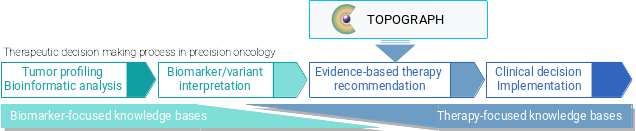
Precision oncology is expanding at a rapid pace. As genomic testing in cancer is becoming commonplace, oncologists are often challenged by unfamiliar findings in ever-more complex molecular pathology reports. Clinically, there is a persistent challenge of linking genomic alterations to available treatments in the context of a patient's disease, under various healthcare resource constraints.

In our recently published paper in npj Precision Oncology 1, we describe the rationale behind the curation of a specialised knowledge base named TOPOGRAPH (Therapy-Oriented Precision Oncology Guidelines for Recommending Anti-cancer PHarmaceuticals). This is an independent, oncologist-led effort to catalogue clinical and scientific literature systematically, to address the unmet information need when making evidence-based recommendations about drug treatments in precision cancer medicine.
TOPOGRAPH is conceptually different from other resources already available for explaining the significance of specific genomic alterations in cancer. While the established resources are useful for explaining the pathogenicity (and sometimes actionability) of specific mutations, there is often not enough information about individual drugs and/or combinations, with links to clinical evidence, to guide oncologists in selecting which exact drugs should be solicited for treating the patient. The lack of a practical resource especially presents a unique challenge in managing patients with treatment-refractory cancer.
We propose a different approach of organising knowledge for treatment selection guided by genomics and/or other biomarkers — by switching the emphasis to "therapies" with reference to clinical evidence and drug accessibility (hence "therapy-focused"). Rather than asking the question “whether a genomic alteration is targetable”, we have in turn designed a process surrounding the most pertinent question of “whether a drug is valuable when a particular genomic alteration is seen”. It aims to translate molecular pathology findings more directly into actionable treatment decisions. Practically, a therapy-focused collection can direct oncologists to focus on the most relevant literature at the point of decision-making.
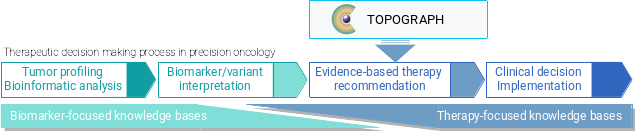
The TOPOGRAPH database exemplifies how a practical resource can be built using the above framework. In addition to cataloguing biomarker-cancer-therapy triplets, we emphasise on documenting potential accessibility of a treatment, given it is a major consideration when selecting a drug for patients with advanced cancer. Based on this premise, the knowledge content needs to be organised in a jurisdiction-specific manner: currently, the TOPOGRAPH database provides data with reference to the Australian public health system, although a similar approach can be easily adopted to build similar resources for other health systems.
To organise knowledge effectively, we have specified a set of literature criteria to reduce variability in the curation process. A purpose-built tiering system is designed to grade therapies by their accessibility (regulatory approval and reimbursement) and maturity (with respect to stage of drug development, also considering the outcomes of relevant clinical trials). To make this resource more accessible in the clinic, the tiering system is closely integrated with a decision-support algorithm. This flowchart-based tool aims to promote evidence-based discussions about targeted treatments between patient and her/his treating oncologist, with a goal of finding the most suitable drug options bound by a rational clinical decision-making framework.
In short, the content curated by therapy-oriented approach aims to provide information about whether a therapy has relevance in the presence of a variant or biomarker. Practically, however, TOPOGRAPH only complements, but does not replace, the existing clinical processes. For example, the standard therapeutic guidelines should always be consulted. Therapies that are not selected by biomarkers should always be reviewed in conjunction with the targeted therapies. Expertise in molecular pathology and other resources should be accessed when interpreting the pathogenicity of gene variants in cancer.
This research is a collaborative work between Garvan Institute of Medical Research, University of Sydney, and Australian Genomic Cancer Medicine Program (Omico). The TOPOGRAPH database can be accessed at https://topograph.info/ 2.
References:
- Lin, F.P., Thavaneswaran, S., Grady, J.P., Ballinger, M., Kansara, M., Oakes, S.R., Desai, J., Lee, C.K., Simes, R.J., and Thomas, D.M. Criteria-based curation of a therapy-focused compendium to support treatment recommendations in precision oncology. npj Precis Oncol 2021; 5: 58 doi: 10.1038/s41698-021-00194-z
- Therapy-Oriented Precision Oncology Guidelines for Recommending Anti-cancer Pharmaceuticals: TOPOGRAPH database. URL: https://topograph.info/

Other affiliations: Research Fellow, NHMRC Clinical Trials Centre, University of Sydney; St Vincent's Clinical School, University of New South Wales, Sydney, Australia
Medical oncology; Cancer informatics; Precision medicine; Clinical decision support; Applied artificial intelligence; Machine learning.
Follow the Topic
-
npj Precision Oncology
An international, peer-reviewed journal committed to publishing cutting-edge scientific research in all aspects of precision oncology from basic science to translational applications to clinical medicine.

Related Collections
With Collections, you can get published faster and increase your visibility.
Minimal Residual Disease and Circulating Tumor DNA Dynamics in Personalized Cancer Treatment
Publishing Model: Open Access
Deadline: Mar 12, 2027
Next-Generation AI in Drug Design for Precision Oncology
Publishing Model: Open Access
Deadline: Apr 01, 2027