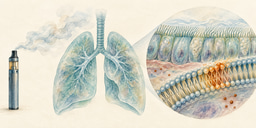
E-cigarette metal particles and their impact on mitochondria and male reproductive health
Published in Cell & Molecular Biology and Biomedical Research

Explore the Research
Just a moment...
Review article
Mitochondrial Mechanisms in the Potential Male Reproductive Toxicity of E-Cigarette-Derived Metal-Containing Nanoparticles
The overlooked source
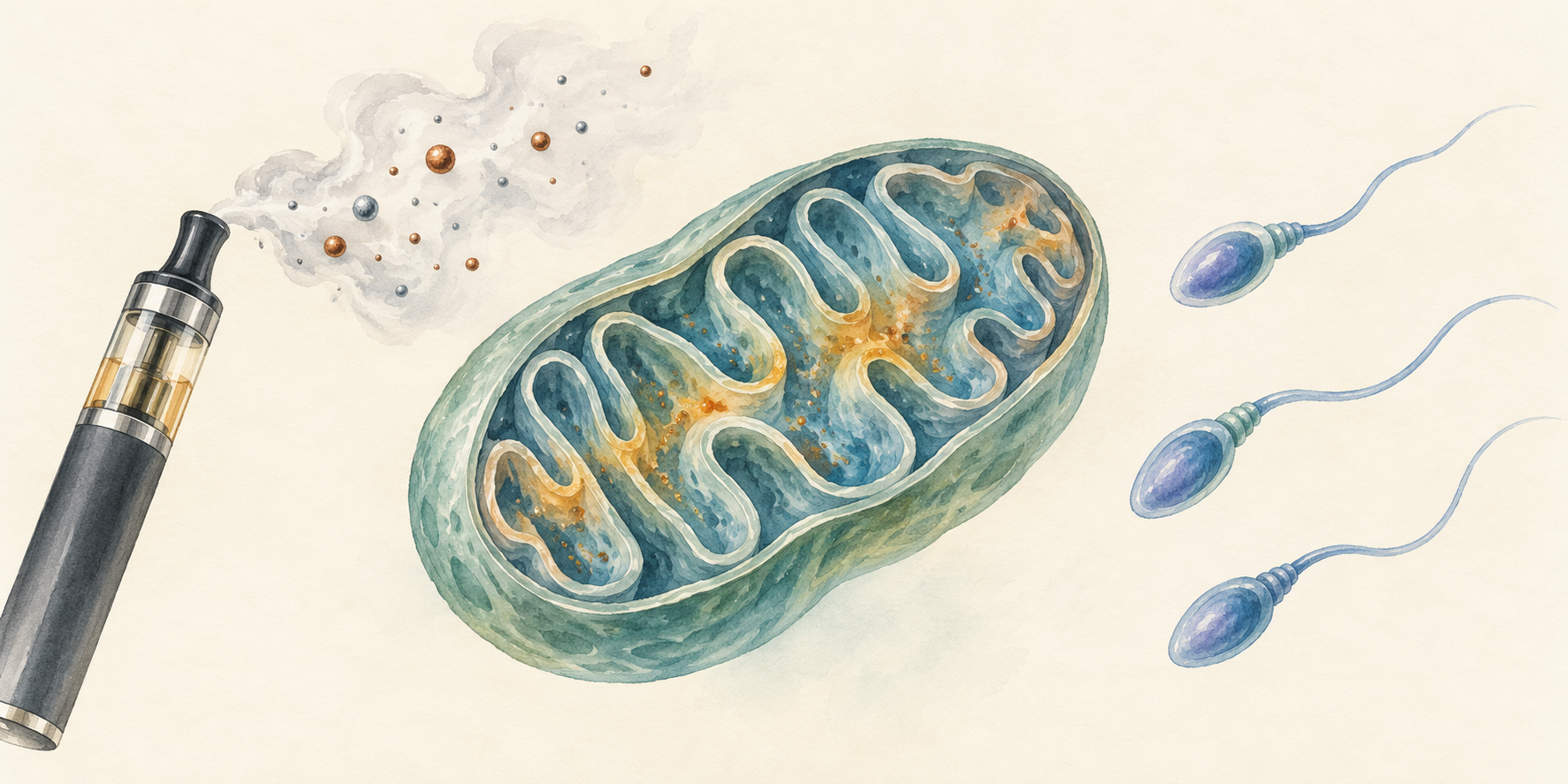
E-cigarette toxicity discussions often focus on the liquid, but devices can also release metals. Heating coils, solder and other components may generate metal-containing particles, including nanoparticles, as they heat and age.
Could inhaled particles affect reproductive tissues beyond the lungs? This review examines that possibility through aerosol chemistry, nanoparticle toxicology and male reproductive biology, with mitochondria as a possible link.
Why particle form matters
Total metal levels do not show whether metals are present as ions, particles or both. Particle size, surface chemistry and dissolution rate can affect cellular entry, distribution and persistence.
The particulate fraction therefore deserves attention alongside nicotine, carbonyls and dissolved metals. Similar metal concentrations may produce different biological effects.
Mitochondria as a possible target
Mitochondria regulate energy production, redox balance, cell survival and steroid hormone synthesis. They also support sperm development and function.
Studies of engineered nanoparticles and soluble metals report impaired respiration, oxidative stress, mitochondrial DNA damage and cell-death signaling. These findings suggest possible mechanisms but do not prove that vaping-derived particles cause the same effects.
Effects beyond individual cells
Sertoli cells support germ-cell development and the blood–testis barrier, while Leydig cells produce testosterone through mitochondria-dependent processes. Mitochondrial damage could therefore affect hormonal, metabolic and protective systems throughout the testis.
Reproductive toxicity should be studied across interacting cell types, not only through sperm count and motility.
When recovery breaks down
Cells maintain mitochondrial health through fusion, division and mitophagy. Metal exposure may cause excessive fragmentation or prevent damaged mitochondria from being cleared.
Persistent dysfunction can increase reactive oxygen species, inflammation and apoptosis. Outcomes depend on the material, dose, cell type and capacity for recovery. Increased mitophagy signaling does not necessarily mean damaged mitochondria are being removed successfully.
The evidence gap
No direct, particle-resolved evidence currently shows that e-cigarette-derived metal nanoparticles accumulate in testicular tissue.
Much evidence comes from engineered particles or soluble metals tested under conditions unlike vaping. Detecting metal in tissue would not prove that it arrived as an inhaled particle or identify its chemical form.
The proposed pathway is plausible, not proven.
What research should do next
Future studies should characterize particles emitted by real devices, use realistic inhalation conditions and track movement from the lungs to other tissues.
Researchers should identify which reproductive cells are exposed and test mitochondrial effects alongside sperm DNA integrity, chromatin maturation and acrosomal function.
The broader question
Metal-containing particles add complexity to e-cigarette aerosols. Their effects may depend on how they form, change after inhalation and interact with cells.
Mitochondria provide a useful framework for testing these possibilities. The key question is whether vaping-derived particles reach reproductive tissues and disrupt mitochondrial functions needed for male fertility.
Reference
Sailis AB. Mitochondrial Mechanisms in the Potential Male Reproductive Toxicity of E-Cigarette-Derived Metal-Containing Nanoparticles. Journal of Applied Toxicology. 2026;1–22. https://doi.org/10.1002/jat.70382