What ferroptosis may tell us about vaping-related lung injury
Published in Cell & Molecular Biology and Biomedical Research


Review article
Ferroptosis in e-cigarette aerosol-associated respiratory injury
Why I wrote this paper
When we talk about vaping, the conversation often stays at the surface: is it better than smoking, or is it harmful?
But inside the lungs, the question is more specific.
E-cigarette aerosol is not just water vapor. It can contain nicotine, solvents, flavoring chemicals, aldehydes, metals, fine particles, and reactive molecules. These substances first meet the airway lining, which is the protective layer that helps keep the lungs clear, balanced, and defended.
Many studies already show that e-cigarette aerosol can affect this lining. It may weaken the epithelial barrier, increase oxidative stress, change mucus production, disturb immune responses, and promote inflammation.
This made me interested in a more focused question:
Could some of this injury be linked to ferroptosis?
"Ferroptosis"?
Ferroptosis is a type of cell death linked to iron and fat damage.
A simple way to understand it is this: cell membranes contain fats. When those fats are damaged by oxidation, the cell needs antioxidant systems to repair or control the damage. One important defense system involves GPX4 and glutathione.
If that protection becomes weak, and iron-related stress is also present, lipid damage can build up. At some point, the cell may no longer recover. That process is called ferroptosis.
For lung cells, this is important because they are constantly exposed to inhaled materials. If e-cigarette aerosol pushes lung cells toward oxidative stress, lipid peroxidation, altered iron handling, and weaker antioxidant defenses, it may create conditions where ferroptosis becomes more likely.
What the review found
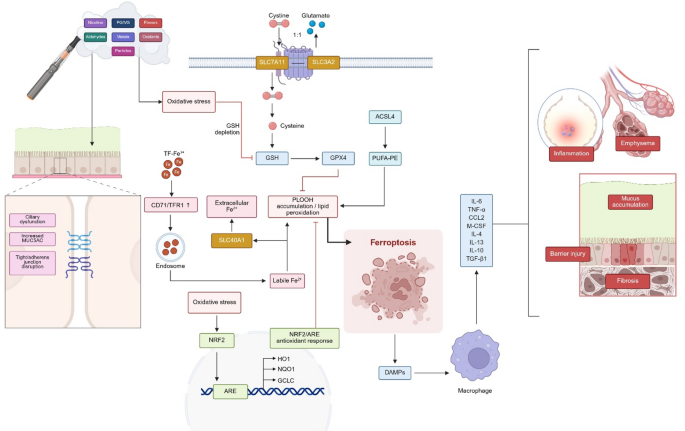
Current evidence suggests that e-cigarette aerosol may create a “ferroptosis-permissive” environment in respiratory cells. This means it may not directly prove ferroptosis in every case, but it may create the right conditions for ferroptosis-related injury to occur.
These conditions include oxidative stress, impaired GPX4/GSH defense, altered iron metabolism, ACSL4-related lipid remodeling, mitochondrial stress, lipid peroxide buildup, epithelial cell death, inflammation, mucus changes, and tissue remodeling.
One important preclinical study showed that electronic nicotine delivery system exposure worsened lung injury in a susceptible COPD-like mouse model. The study found ferroptosis-related changes such as increased CD71/TFR1 and ACSL4, reduced GPX4, lipid peroxidation, inflammation, mucus accumulation, emphysema-like changes, and fibrosis.
But the evidence is still developing.
We still need more human studies, better vaping exposure models, and stronger ferroptosis-specific experiments. Future studies should not rely on one or two markers only. They should test lipid peroxidation, iron dependence, GPX4 activity, GSH depletion, ACSL4 involvement, labile iron, and whether ferroptosis inhibitors can rescue the injury.
For me, the key takeaway is simple:
E-cigarette aerosol should not be treated as biologically inactive.
Even if e-cigarettes are discussed in terms of reduced harm compared with cigarettes, their aerosol can still interact with lung cells in complex ways. Ferroptosis may be one useful mechanism to understand how vaping-related oxidative stress can turn into real epithelial injury.
The field is still early, especially in humans, but the question is now clear enough to test properly.
Reference
Sailis AB. Ferroptosis in e-cigarette aerosol-associated respiratory injury. Archives of Toxicology. 2026. https://doi.org/10.1007/s00204-026-04486-w
Full text: https://rdcu.be/fqGPW

Ardie Barry Sailis is a PhD candidate in Pharmaceutical Sciences at Universiti Malaya, specializing in toxicology, pharmacology, and molecular systems biology.
His research focuses on the toxicological effects of e-cigarette exposure, particularly on reproductive health.
He is also developing a conceptual program, Cellular Signaling as Dynamic Regulatory Circuits, which frames biological pathways as control systems.
Follow the Topic
-
Archives of Toxicology
This is a cutting-edge journal providing latest advancements in the field of toxicology.