We need to confirm that e-cigarette doesn't produce microplastics during use
Published in Earth & Environment and Biomedical Research
Explore the Research
15376516.2026.2695155?utm_campaign=related_content&utm_source=HEALTH&utm_medium=communities
Review article
Could e-cigarette devices generate inhalable micro- and nanoplastics? Exposure plausibility and reproductive relevance
It is not only nicotine
When people talk about vaping, they usually focus on nicotine and other chemicals in the aerosol. Then, I wanted to ask a different question: could part of the exposure come from the device itself?
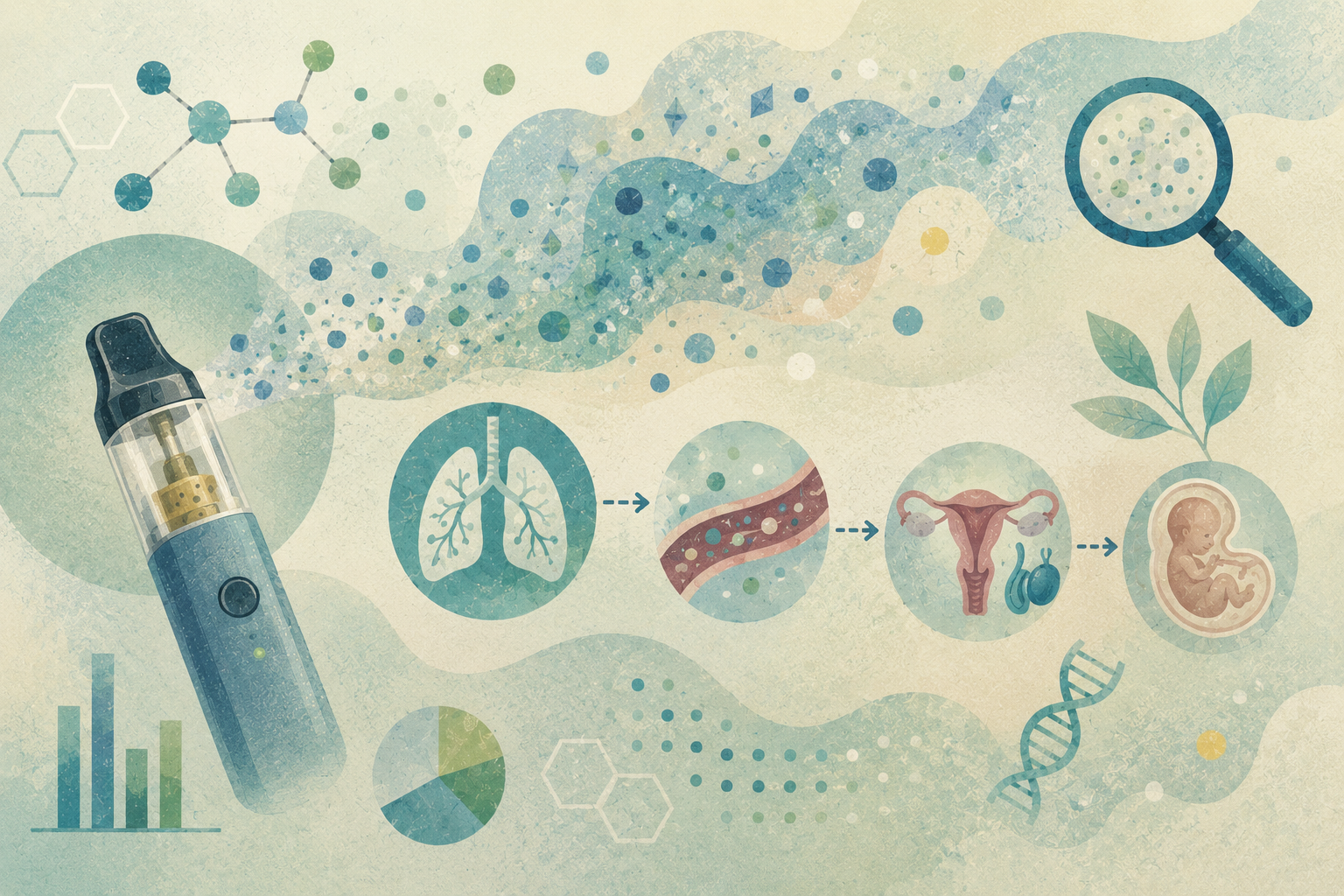
E-cigarette devices contain plastic-based parts. Some are close to the heating coil, where they may face heat, e-liquid contact, repeated heating and cooling, and normal wear. This raised a simple but overlooked question: could these parts break down into inhalable microplastics or nanoplastics?
What the review found
The main finding was a gap. So far, no study has clearly confirmed device-derived microplastics or nanoplastics in e-cigarette aerosol.
This means the paper does not claim that vaping definitely exposes users to these particles. Instead, it asks whether this pathway is possible and how it should be tested.
This matters because experimental studies show that microplastics and nanoplastics can affect oxidative stress, inflammation, hormones, and reproductive biology. But those studies mostly use model particles, not particles from vaping devices. So we cannot assume the same effects occur during vaping.
Why it matters
Nicotine, metals, and carbonyls remain the best-known toxicants in e-cigarette aerosol. Device-derived microplastics are still only a hypothesis, but they are a reasonable safety question because vaping devices contain polymers, heat, solvents, and airflow.
Future studies should test real devices under realistic vaping conditions. They need to identify whether plastic particles are present, what type of plastic they are, how small they are, how many are produced, and whether they can reach the lungs or other organs.
For me, this paper is about making an overlooked question visible. Before asking whether vaping-related microplastics affect health, we first need to know whether vaping devices generate them at all.
Therefore, this article wants to initiate researchers to start to confirm whether this is a possibility.
Reference
Sailis AB. Could e-cigarette devices generate inhalable micro- and nanoplastics? Exposure plausibility and reproductive relevance. Toxicology Mechanisms and Methods. 2026. https://doi.org/10.1007/s00204-026-04486-w
Full text: link

Ardie Barry Sailis is a PhD candidate in Pharmaceutical Sciences at Universiti Malaya, specializing in toxicology, pharmacology, and molecular systems biology.
His research focuses on the toxicological effects of e-cigarette exposure, particularly on reproductive health.
He is also developing a conceptual program, Cellular Signaling as Dynamic Regulatory Circuits, which frames biological pathways as control systems.