East European sedimentary basins long heated by a fading mantle upwelling
Published in Earth & Environment


What was a motivation of the research?
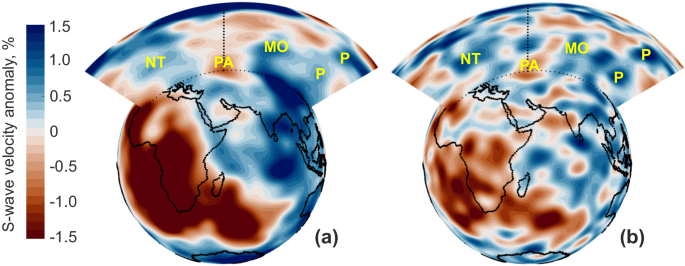
Twelve years ago I (Alik Ismail-Zadeh) was visiting the Institut de Physique du Globe de Paris (IPGP) in France and started a cooperation with Anne Davaille to compare analogue and numerical models of the evolution of thermochemical mantle plumes (upwellings in the Earth’s mantle generated primarily at the core-mantle boundary and raising toward the lithosphere). Both we noticed a paper by Lecic et al. (2012) related to a seismic tomography study, which revealed the presence of a province of low seismic wave velocities at the core-mantle boundary (the authors called it the Perm Anomaly) beneath the south-eastern part of the East European platform. The seismic tomography image is a snapshot of the present structure of the Earth showing the regions of low seismic velocities (or hotter mantle) and high velocities (colder mantle). Although the tomography image of the Perm Anomaly did not feature a prominent mantle plume, we questioned whether the Perm Anomaly is the remnant of a mantle plume. Both we studied a thermal plume’s diffusive decay (Anne using laboratory experiments, and I numerical experiments) and observed that a weak feeding of mantle plumes by the hot material from the core-mantle boundary results in the diffusive disappearance of plume tails first and plume heads and feet later. We were curious about the origin of the plume associated with the Perm Anomaly and its surface manifestations.
How was our research team built?
Anne and I approached Jean Besse, a paleomagnetologist, and asked him to help us with plate motion reconstructions related to the region of the interest. Meanwhile, I realized that the oil-and-gas bearing basins of the East European lithosphere could be benefited from the presence of the Perm Anomaly plume for a long geological time due to an enhanced heat flow. I discussed the idea with my colleague Yuri Volozh, a geologist, and invited him to cooperation. So, a multidisciplinary, international team of scientists was built to develop a model of mantle plume dynamics and its surface manifestations since the Upper Triassic (some 210 million years ago) until present.
A curiosity-driver scientific research
Our research spanned over several years: we collected and analysed data, studied laboratory and numerical experiments of mantle plumes, developed paleomagnetic reconstructions of global plate motion, analysed tectonic subsidence of sedimentary basins, and developed thermal models of the lithosphere. So, we tried to put all pieces of the complex geological puzzle together. The results of the efforts have now been published.
What are the research results?
Using mantle plume modelling and global plate motion reconstructions, we have demonstrated that the East European lithosphere is likely to have been located above the weakening (due to a diffusive decay) Perm Anomaly upwelling for approximately 150-200 million years ago, as indicated in the accompanying Figure. As the East European platform moved over the Perm Anomaly during the post-Jurassic period, the vertical tectonic movements recorded in sedimentary hydrocarbon-rich basins indicate either uplift (no sedimentation) or insignificant subsidence. The analysis of heat conduction across the lithosphere reveals that the basins have experienced prolonged heating due to the Perm Anomaly upwelling, resulting in favourable circumstances for the maturation of hydrocarbons.
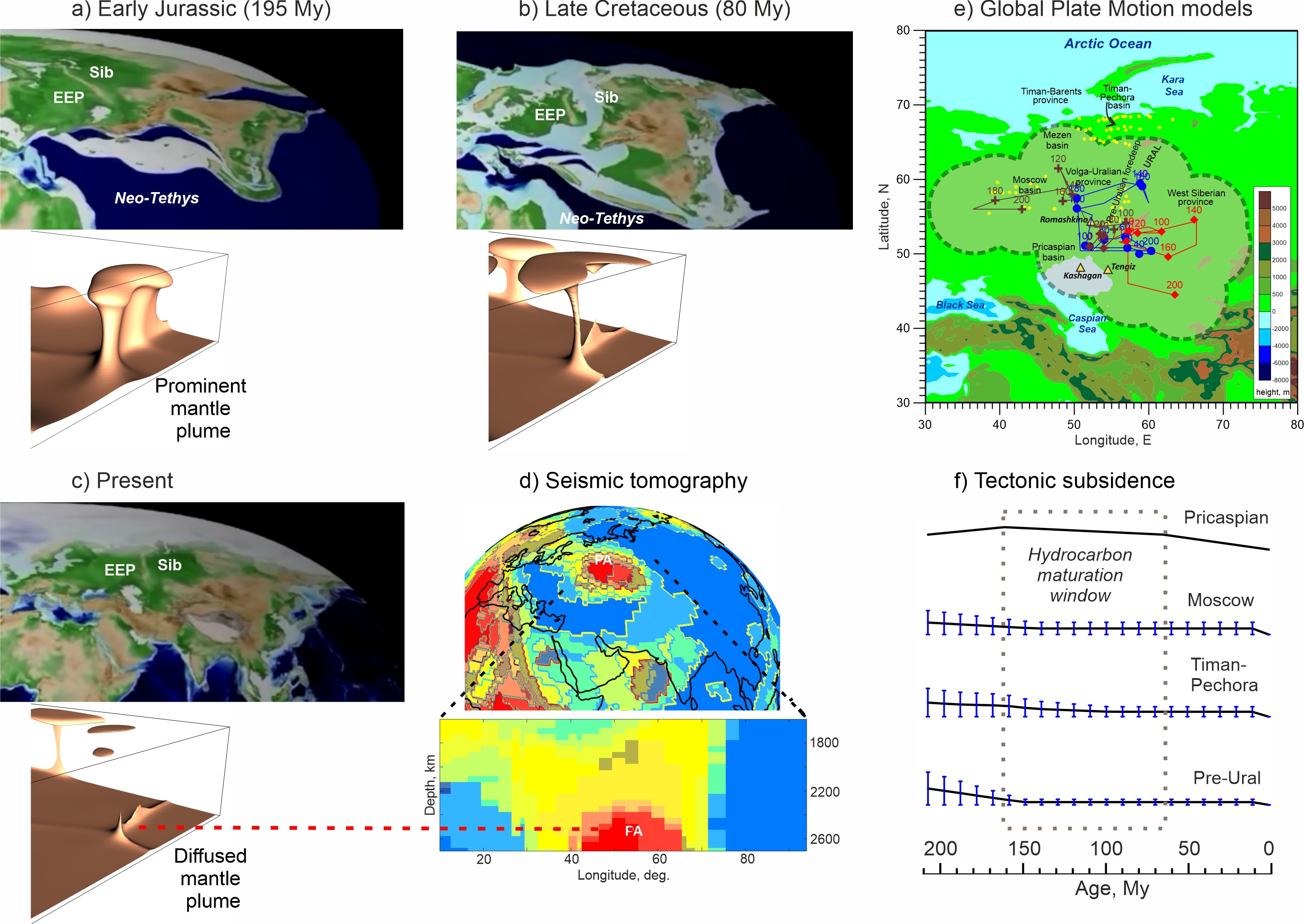
(panel d) since the Early Jurassic times. Tracks of the projection of the Perm Anomaly plume’s
centre on the surface of western Eurasia from the present position of this centre (51°N, 52°E)
to its position in the Early Jurassic (~200 Ma); the tracks are derived from three models
(marked by brown crosses, blue circles, and red diamonds) of global plate models (panel e).
Vertical tectonic movements in East European sedimentary basins (panel f) have been
derived from the analysis of sediments in many drilled boreholes (yellow dots in panel e).
What could be a broader impact of our research?
The research findings indicate a robust correlation between a mantle plume that heats the thick continental lithosphere over an extended geological period, the sedimentary basins heated by this plume becoming thermally weak with time, and the subsequent development of hydrocarbon provinces within these basins. The generation of oil and gas fields can occur on oceanic passive margins along the path of mantle upwellings. Hydrocarbon resources discovered in the North Sea and the Norwegian margins may be associated with the Eifel hotspot activity during the Middle-Late Jurassic times. Our model has the potential to provide an explanation for the recent findings of significant resources offshore Brazil and Africa along the track of the Tristan da Cunha plume. This plume led to the Paraná-Etendeka large igneous province development approximately 132 million years ago, and subsequently triggered the opening of the South Atlantic Ocean. Our research indicates that shallow or deep hydrocarbon fields (and potentially hydrogen fields) can be concentrated in sedimentary basins where deep-source heat flow enhancements occur. This is primarily owing to the protracted presence of mantle upwelling underneath these basins.
For more details, please refer to the full article:
Ismail-Zadeh, A., Davaille, A., Besse, J. & Volozh, Y. East European sedimentary basins long heated by a fading mantle upwelling. Nature Communications 15, 3915 (2024).

My research interests include mathematical geophysics; computational geodynamics; lithosphere dynamics and earthquakes; lava dynamics; geohazards and disaster risks; science policy, diplomacy, and history.
Follow the Topic
-
Nature Communications
An open access, multidisciplinary journal dedicated to publishing high-quality research in all areas of the biological, health, physical, chemical and Earth sciences.

Related Collections
With Collections, you can get published faster and increase your visibility.
Women's Health
Publishing Model: Hybrid
Deadline: Ongoing
Tumor Microenvironment Crosstalk and Therapeutic Implications
Publishing Model: Hybrid
Deadline: Nov 02, 2026