Eco‑Nanozymology: A Catalytic Paradigm Integrating Energy, Environment, and Ecology
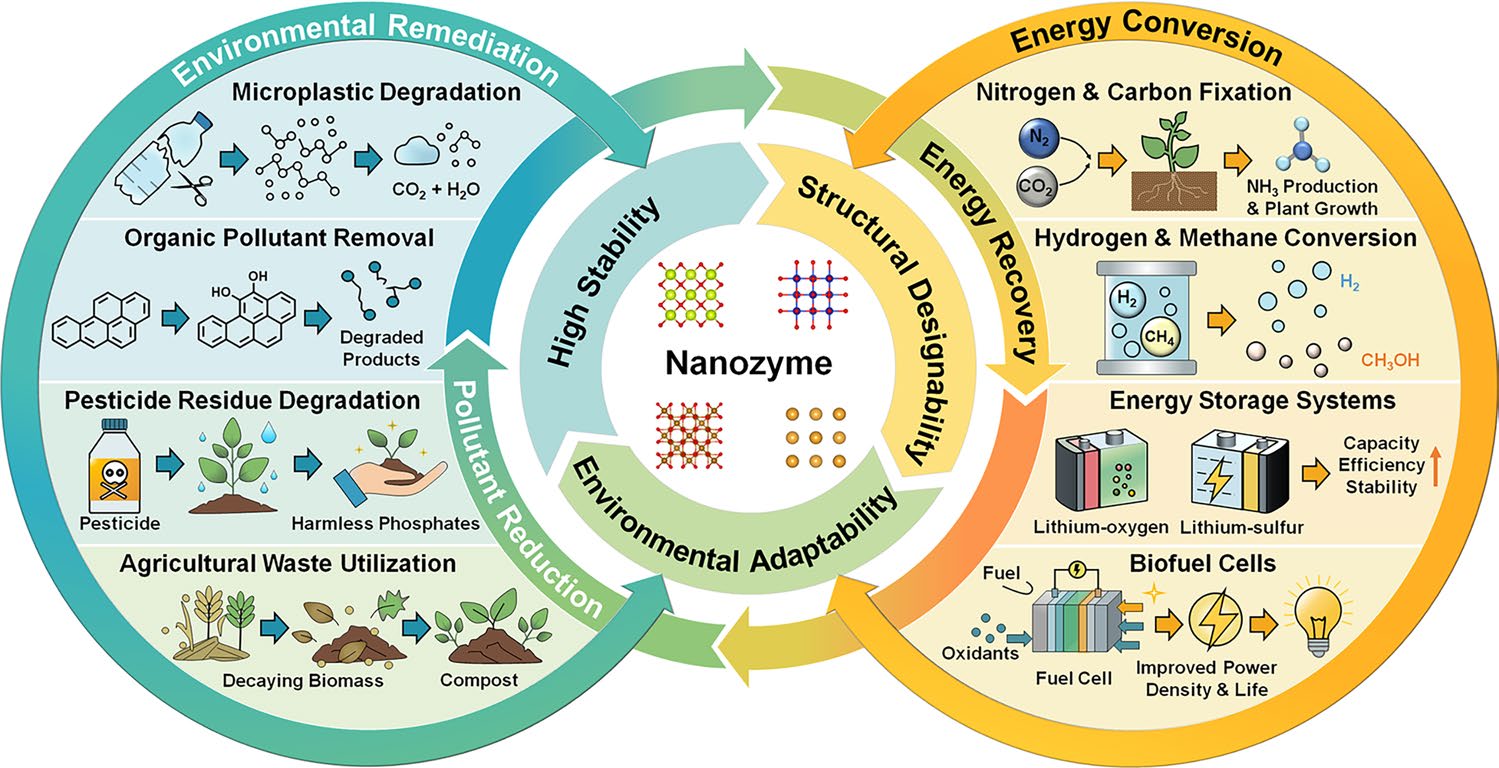
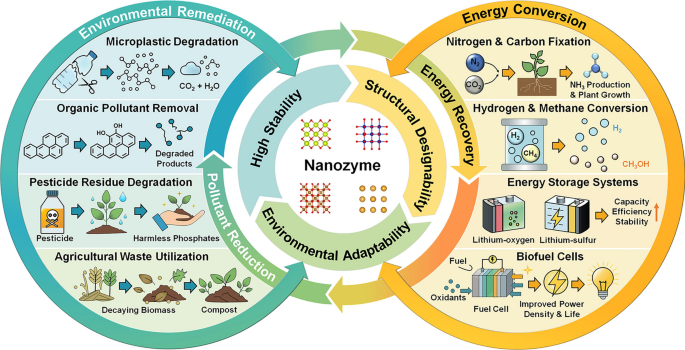

As global challenges in energy scarcity, environmental pollution, and climate change intensify, conventional enzymatic catalysis faces limitations in stability, cost, and operational lifespan. Now, researchers from Qingdao University of Science and Technology, led by Professor Zhiling Zhu, Professor Dehong Chen, and their team including Limin Shang, Ziqi Zhang, Hongyu Lin, and Zichang Wang, have presented a groundbreaking conceptual framework that bridges nanotechnology, enzymology, and ecology—Eco-Nanozymology.
Why This Framework Matters
Traditional nanozyme research has largely focused on isolated catalytic reactions and material-level optimization, lacking systematic integration with ecosystem-level processes. Eco-nanozymology overcomes this limitation by positioning nanozymes as embedded regulatory nodes within coupled environmental transformation networks. Rather than treating nanozymes as standalone catalysts, this framework explicitly incorporates feedback coupling between nanozyme-mediated reactions and system-level matter and energy fluxes—enabling artificial regulation of energy flow and material cycling across scales.
Innovative Concept and Mechanism
The framework is built on the precise modulation of interfacial microstructures, electronic distributions, active site configurations, multienzyme cascade catalysis, and functionalized carrier engineering. By harnessing and amplifying natural ecological processes, eco-nanozymology enables effective modulation of biogeochemical cycles—including carbon fixation, nitrogen fixation, methane oxidation, and hydrogen production—while achieving efficient environmental remediation and low-value biomass valorization.
Outstanding Performance Across Domains
Energy Conversion: Eco-nanozymes demonstrate remarkable advances in artificial nitrogen fixation (NH3 production rates up to 50.82 μmol g-1 h-1 with Faradaic efficiencies exceeding 97%), photocatalytic CO2 reduction (CO generation rates of 740.7 μmol g-1 h-1 sustained over 188 h), and hydrogen evolution (915 L h-1 g-1). In energy storage systems, biomimetic nanozymes enhance lithium–oxygen batteries (1000 mAh g-1 after 100 cycles), lithium–sulfur batteries (991 mAh g-1 after 200 cycles), and zinc–air batteries (power densities up to 217.8 mW cm-2).
Environmental Remediation: Nanozyme systems achieve >90% mineralization of microplastics into CO2 and water without toxic intermediates, 94.27% degradation of methylene blue, and >80% removal of antibiotic pollutants within 30 minutes. For agricultural applications, symbiotic nanozymes boost soybean nitrogen fixation efficiency by 260% while enhancing photosynthetic performance by 67.2%.
Applications and Future Outlook
Eco-nanozymology establishes a unified theoretical foundation for designing next-generation catalytic systems with multi-responsiveness, tunability, and evolvable characteristics. The framework charts a development roadmap: short-term (1–3 years) focus on performance evaluation and ecological risk quantification; medium-term (3–7 years) AI-guided optimization and system integration; and long-term (7–15 years) realization of low-carbon, large-scale production across energy, environmental remediation, and ecosystem management.
By integrating emerging technologies such as AI-driven design, multi-scale modeling, and high-throughput synthesis with quantitative structure–activity relationships, eco-nanozymology opens promising avenues for addressing global sustainability challenges—offering green, environmentally friendly, and technologically viable pathways toward carbon neutrality and circular bioeconomy.
Stay tuned for more groundbreaking research from this collaborative team at Qingdao University of Science and Technology!

Editor of Nano-Micro Letters, which is an Open-Access, peer-reviewed journal reported papers that have at least one dimension ranging from a few sub-nanometers to a few hundreds of micrometers. The journal is published by Springer Nature and indexed by SCI, EI, SCOPUS, Pubmed, etc. The 2025 JCR Impact Factor is 38.5. The 2025 CiteScore is 58.9.
Follow the Topic
-
Nano-Micro Letters
Nano-Micro Letters is a peer-reviewed, international, interdisciplinary and open-access journal that focus on science, experiments, engineering, technologies and applications of nano- or microscale structure and system in physics, chemistry, biology, material science, and pharmacy.