Engineering a Dual-Action Magnetic Catalyst to Destroy Antibiotics and Pathogens in Wastewater
Published in Chemistry, Earth & Environment, and Materials




The Silent Incubators of Antimicrobial Resistance
When we think of the fight against Antimicrobial Resistance (AMR), we often picture hospitals and clinics. However, some of the most dangerous breeding grounds for "superbugs" are actually our municipal wastewater treatment plants. Every day, recalcitrant pharmaceuticals—such as the widely used antibiotic Metronidazole (MTZL)—slip through conventional treatment filters. When these active pharmaceutical ingredients mix with concentrated biological wastewater, they create the perfect environmental incubator for AMR.
At the SMART Lab, our environmental engineering philosophy is simple: we cannot rely on legacy infrastructure to solve 21st-century chemical threats. We needed a material that didn't just passively filter water, but actively sought out and destroyed both the antibiotic pollutants and the pathogenic bacteria simultaneously.
The "Behind the Paper" Challenge: Bridging Efficacy with Scalability
In our recent paper published in Photochemical & Photobiological Sciences, my co-author Faisal Suleiman Mustafa and I set out to engineer a solution. Advanced Oxidation Processes (AOPs) are highly effective, but traditional photocatalysts suffer from two major real-world bottlenecks:
-
They often rely on UV light (which is energy-intensive).
-
They are incredibly difficult to recover from the water post-treatment, leading to secondary nano-pollution.
To solve this, we turned to spinel ferrites. Our "aha" moment came when we successfully engineered a Dual-Functional Cobalt-Doped Binary Metal Ferrite.
Optoelectronic Precision and Magnetic Recovery
By strategically doping the binary ferrite lattice with Cobalt ions, we achieved two critical breakthroughs:
-
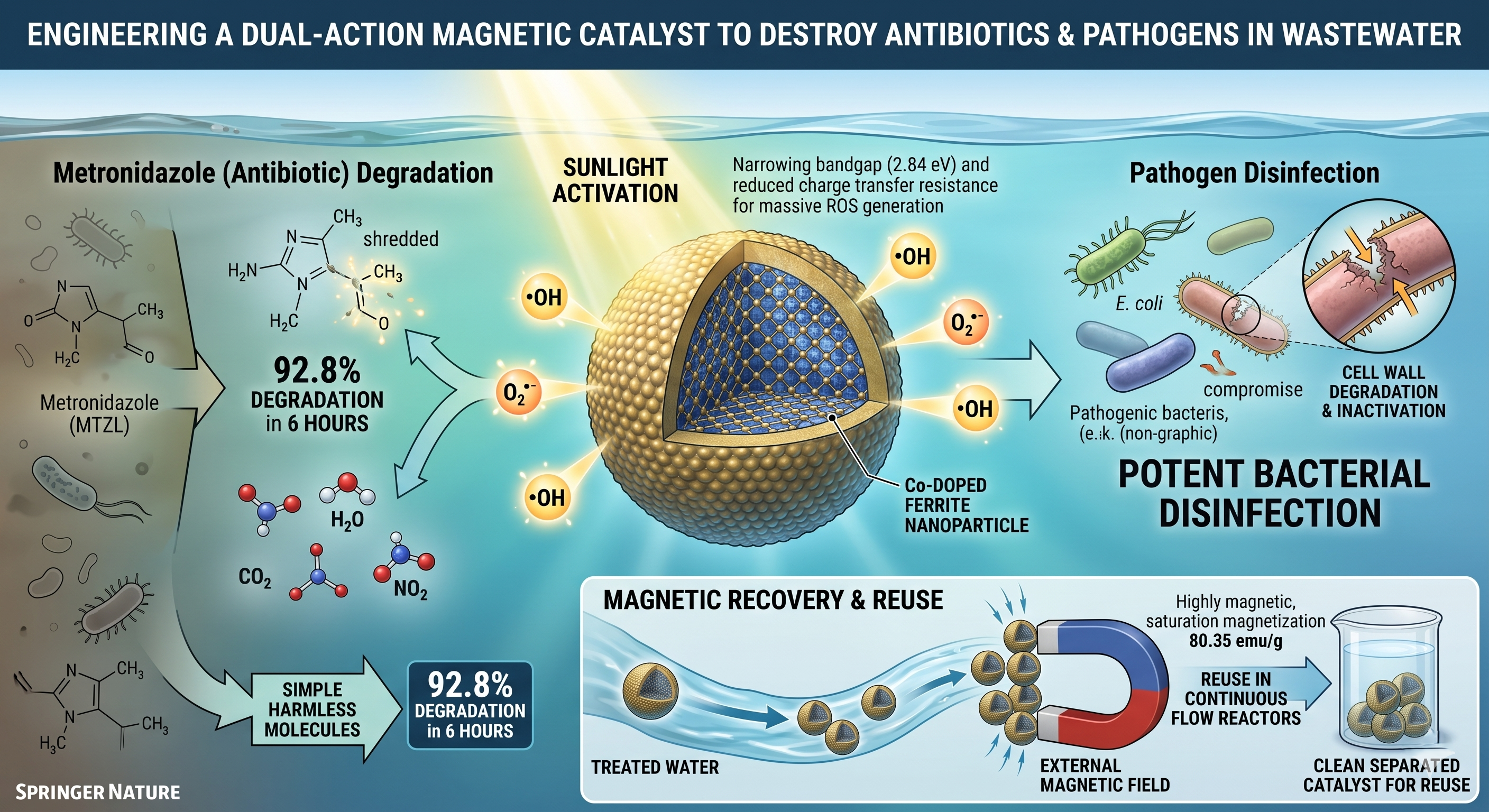
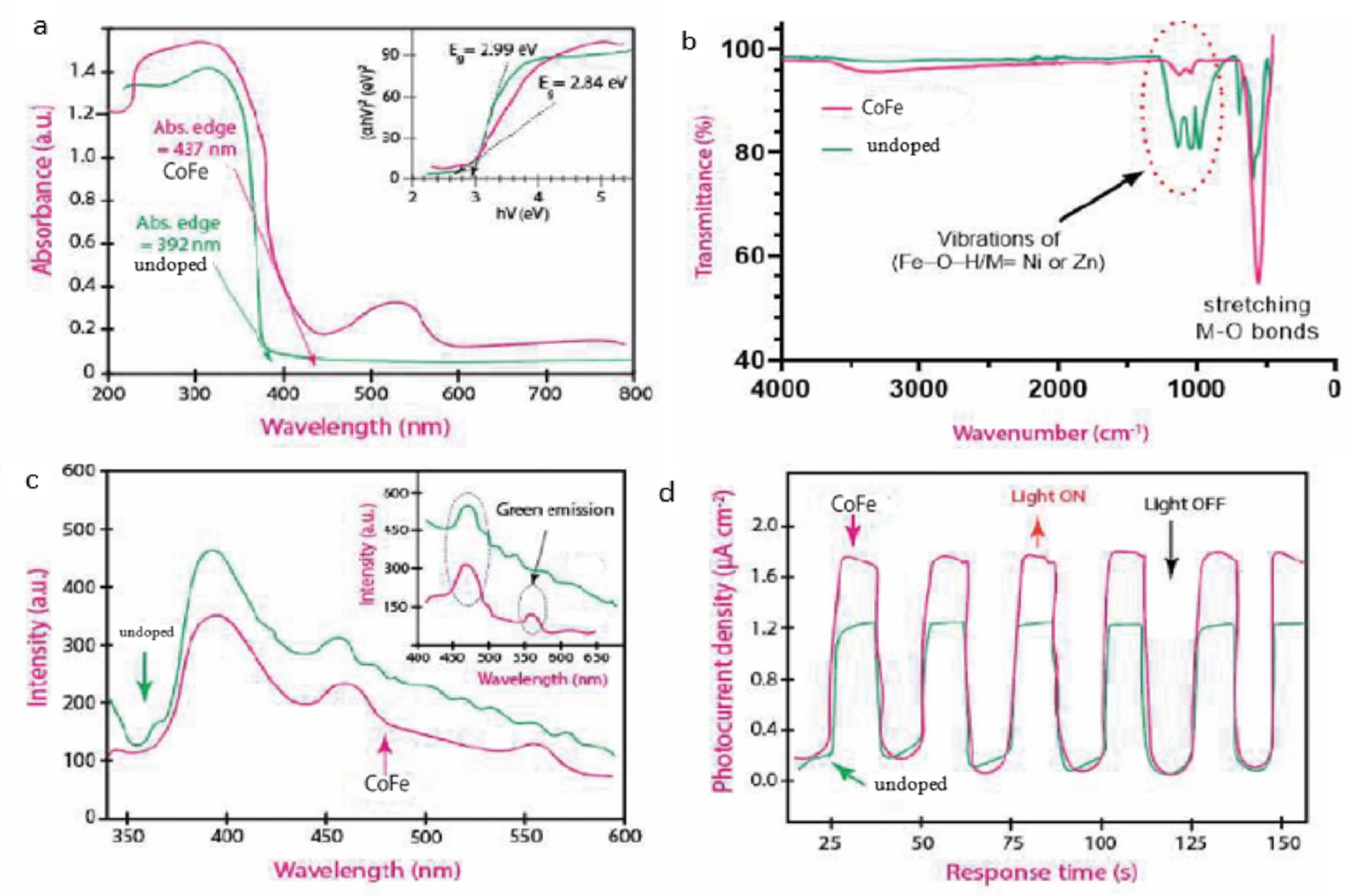
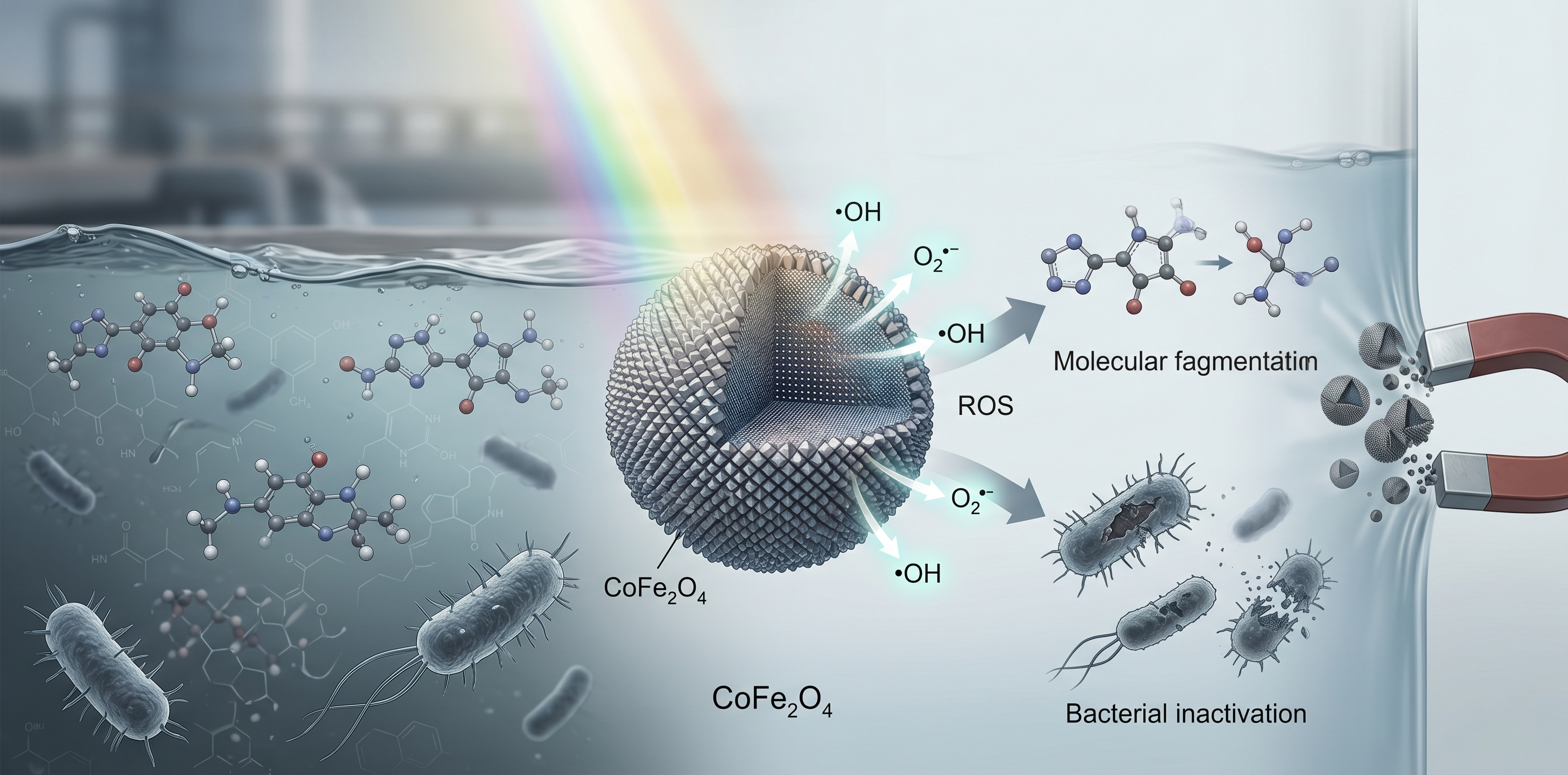
Narrowing the Bandgap: The cobalt doping significantly narrowed the optical bandgap to 2.84 eV and reduced charge transfer resistance. This turned the material into a highly active photo-Fenton catalyst capable of generating massive amounts of reactive oxygen species (ROS) to shred the MTZL molecules.
-
Instant Recovery: To ensure this material could actually be deployed in a real-world reactor, we engineered it to be highly magnetic (achieving a saturation magnetization of 80.35 emu/g). After the treatment cycle, the catalyst can be instantly and cleanly separated from the effluent using a simple external magnetic field.
Validating the Mechanism
We didn't want to just report macroscopic degradation percentages; we wanted to understand the atomic-level "lock and key" mechanics. By integrating experimental photo-Fenton data with computational molecular docking, we were able to map the precise surface interactions driving the degradation process.
Under optimized conditions, our dual-action system achieved a 92.8% degradation of 50 ppm MTZL in just 6 hours, while simultaneously demonstrating potent bacterial disinfection capabilities.
Looking Forward
This research proves that by applying a Safe-and-Sustainable-by-Design (SSbD) framework to nanomaterials, we can mechanistically decouple high reactivity from ecological hazard. As we look toward scaling these technologies, the focus must remain on multi-functional materials that can be easily recovered and reused in continuous-flow industrial applications.
I invite you to read the full open-access study and explore the molecular docking insights that made this breakthrough possible.
Read the full paper here: Published
How is your lab addressing the recovery and scale-up challenges of nanomaterials in environmental applications? I would love to connect and discuss advanced oxidation strategies in the comments below!
Follow the Topic
-
Photochemical & Photobiological Sciences
Photochemical & Photobiological Sciences is an international peer-reviewed journal publishing comprehensive research in the fields of photochemistry and photobiology.

Related Collections
With Collections, you can get published faster and increase your visibility.
50 years of Italian Photochemistry Group
This collection is aimed to celebrate the 50th anniversary of Italian Photochemistry Group (GIF) constitution. We feel this is a good occasion to acknowledge pioneering vision of its founding members, who in 1976 established GIF as an association a iliated to the European Photochemistry Association (EPA) aimed at creating a national school on Photochemistry and solid national network with relevant international collaborations. The collection is willing to highlight the variety of expertise that has grown within GIF over the years also thanks to the important international collaboration. We invite all the friends and co-workers of GIF to contribute to this collection.
Publishing Model: Hybrid
Deadline: Nov 30, 2026
A Life in Light: Celebrating the Scientific Legacy of Miguel Ángel Miranda
In the sad and unfortunate event of the decease of Miguel Ángel Miranda it is the right moment to honor the scientific legacy of this very re-known photochemist.Professor Miranda’s multifaceted research program covered mechanistic photochemistry, photobiology, and applied aspects of light-induced processes. The collection is intended to highlight these aspects in the broadest sense.
Publishing Model: Hybrid
Deadline: Nov 30, 2026